
Navigating Central Bank Policy Uncertainty: Federal Reserve Rate Cuts and Market Reactions in December 2025
 Aime Summary
The Fed's Delicate Tightrope: Policy Rationale and Internal Divisions
The December 2025 rate cut was driven by a dual mandate challenge: inflation, though elevated, showed signs of moderation, while labor market indicators-such as slowing job gains and a rising unemployment rate-suggested a need for accommodative policy according to reports. This decision followed a contentious October meeting, where two dissenting votes highlighted the FOMC's growing ideological rift. Hawks, including Boston Fed President Susan Collins, warned against premature easing, citing risks of inflation reacceleration, while doves like New York Fed President John Williams emphasized the fragility of the labor market.
Compounding these tensions was the government shutdown, which delayed critical economic data such as October employment and inflation reports. As a result, the FOMC relied on private-sector indicators, such as ADP payroll data, to inform its decision. This reliance on imperfect data underscored the Fed's operational challenges in a polarized environment, leaving investors to grapple with heightened uncertainty.
Powell's Post-Meeting Remarks: A Mixed Signal for Markets
Federal Reserve Chair Jerome Powell's post-meeting comments further complicated market expectations. On December 1, 2025, Powell announced the end of the Fed's quantitative tightening program, signaling a shift toward accommodative policy. However, his remarks tempered enthusiasm for additional rate cuts, stating that "the path forward will depend on incoming data and evolving economic conditions." This cautious language dampened immediate market euphoria, as investors recalibrated their expectations for further easing. 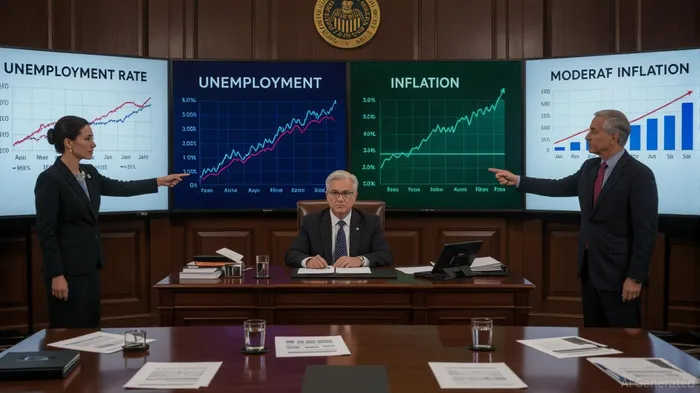
The CME FedWatch tool, which tracks market expectations for rate cuts, still projected an 86% probability of a December cut, but Powell's emphasis on data dependency introduced volatility. Equity markets, for instance, saw a surge in the S&P 500 and Russell 2000 indices, as rate cut hopes gained traction, while bond yields fluctuated, dropping to 3.485% on the 2-year Treasury before rebounding according to market data. These shifts illustrate the delicate interplay between policy signals and investor sentiment in a low-interest-rate environment.
Market Reactions: Opportunities and Risks Across Asset Classes
Equities: In a non-recessionary easing scenario, equities historically outperform, as lower interest rates reduce the cost of capital and boost risk-on sentiment. The S&P 500's rally in December 2025 aligned with this pattern, with investors favoring sectors like technology and consumer discretionary according to market analysis. However, the Fed's mixed messaging-coupled with the likelihood of further policy uncertainty-poses risks of short-term volatility, particularly if inflationary pressures resurface.
Bonds: Treasury yields exhibited a seesaw pattern, reflecting divergent investor strategies. While initial rate cut expectations drove yields lower, subsequent data prompted a rebound. This volatility highlights the challenges for bond investors in a low-rate environment, where duration risk and yield curve dynamics become critical considerations.
Commodities: Gold and oil emerged as beneficiaries of the Fed's accommodative stance. Gold's appeal as a hedge against inflation and currency devaluation gained traction, while oil prices rose on global economic momentum and a weaker dollar according to market analysis. These trends underscore commodities' role as a diversification tool in portfolios exposed to equity and bond market fluctuations.
Navigating the Uncertainty: Strategic Implications for Investors
The December 2025 Fed meeting underscores the importance of agility in a divided economic outlook. For equity investors, a focus on high-quality, cash-generative stocks may offer resilience against potential rate hikes. Bond investors, meanwhile, should prioritize short-duration instruments to mitigate interest rate risk, while commodities can serve as a counterbalance to equity and bond volatility.
However, the Fed's policy path remains far from certain. As Powell emphasized, incoming data will dictate future actions, and the FOMC's internal divisions suggest further rate cut debates in 2026. Investors must remain vigilant, balancing optimism about accommodative policy with caution against inflationary surprises or labor market deterioration.
In this environment, diversification and active portfolio management are paramount. The December 2025 rate cut, while a step toward easing, is but one chapter in a broader narrative of central bank policy uncertainty-a narrative that demands both strategic foresight and tactical flexibility.

Delivering real-time insights and analysis on emerging financial trends and market movements.
Latest Articles
Stay ahead of the market.
Get curated U.S. market news, insights and key dates delivered to your inbox.


AInvest
PRO
AInvest
PRO



Comments
No comments yet