
Navigating Central Bank Divergence: Strategic Entry Points in Canadian Fixed Income Amid BoC Easing and Trade Uncertainty
 Aime Summary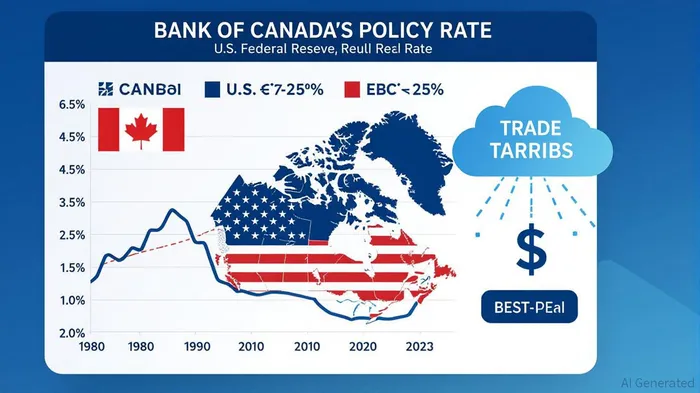
The global central bank landscape in 2025 is marked by stark divergence. While the U.S. Federal Reserve (Fed) clings to a restrictive 4.25–4.5% policy rate, the European Central Bank (ECB) has eased to 2.25%, and the Bank of Canada (BoC) sits in the middle, cautiously navigating a fragile economy and volatile trade environment. For Canadian fixed income investors, this divergence creates a complex web of opportunities and risks. The BoC's potential easing cycle, combined with U.S. tariff threats and global policy shifts, demands a nuanced approach to bond market positioning.
BoC's Cautious Easing: A Tale of Internal Divisions and Trade Uncertainty
The BoC's July 2025 Monetary Policy Report (MPR) reveals a central bank grappling with internal divisions. While the Governing Council unanimously voted to maintain the overnight rate at 2.75%, debates over the future path of policy highlight divergent views. Some members advocate for rate cuts if inflationary pressures ease, while others warn against premature easing given the risk of persistent cost-push inflation from U.S. tariffs. This tension reflects the BoC's “nuanced playbook,” which prioritizes real-time data over forward guidance.
The U.S. trade conflict remains a critical wildcard. Tariffs on Canadian steel and aluminum have already disrupted export demand, with the BoC projecting a 1.5% GDP contraction in Q2 2025. However, the central bank's three-scenario framework—current tariffs, de-escalation, and escalation—underscores the uncertainty. In the base case, growth rebounds to 1% in H2 2025, but an escalation scenario could prolong weakness. For bond markets, this means yields will remain sensitive to trade developments, with the BoC likely to delay cuts until risks crystallize.
Global Policy Divergence: Fed Tightness vs. ECB Easing
The Fed's restrictive stance—anchored by a resilient U.S. economy and inflation stubbornly above 3%—has widened the interest rate gap with Canada. By mid-2025, the differential could exceed 200 basis points, pressuring the Canadian dollar and inflating import costs. Meanwhile, the ECB's aggressive easing (projected to cut rates by 75 bps in H1 2025) has created a divergent yield curve, with European bonds offering higher returns than their Canadian counterparts.
This divergence has direct implications for Canadian fixed income. A weaker CAD increases borrowing costs for Canadian households and firms with U.S. dollar exposure, while the BoC's easing could drive bond yields lower. However, capital outflows to U.S. markets—driven by higher yields—risk liquidity constraints in Canadian bond markets.
Strategic Entry Points for Investors
Given the BoC's cautious approach and the likelihood of two 25-basis-point cuts by year-end (per TD Economics), investors should consider the following strategies:
- Position for Gradual Easing:
- Long-Dated Bonds: With the BoC signaling a potential 2.25% terminal rate by late 2025, long-dated government bonds (e.g., 10–30-year maturities) could benefit from falling yields. However, investors should hedge against trade escalations by limiting duration exposure.
Corporate Bonds: High-quality corporate bonds (BBB+ and above) offer a yield premium over government debt while mitigating currency risk. Focus on sectors insulated from trade disruptions, such as healthcare and utilities.
Hedge Currency Risk:
The CAD's depreciation against the USD (down 12% in 2025) increases import costs. Investors with USD-denominated liabilities should consider forward contracts or CAD-pegged bonds to mitigate exposure.
Monitor Key Indicators:
- Trade Data: Watch U.S. import volumes and Canadian export orders. A sharp decline could accelerate BoC easing.
- Inflation Metrics: Track core CPI and shelter price inflation. A sustained drop below 2% would strengthen the case for rate cuts.
Conclusion: Balancing Caution and Opportunity
The BoC's 2025 policy path is a balancing act between supporting a weakening economy and managing inflationary risks from trade tariffs. While internal divisions suggest a data-dependent approach, the likelihood of two rate cuts by year-end provides a window for fixed income investors. Strategic entry points in long-dated bonds and high-quality corporates, paired with currency hedging, can capitalize on the BoC's easing while mitigating risks from global trade volatility. As the September 17, 2025, rate decision looms, investors must remain agile, ready to adjust positions based on evolving trade dynamics and inflation trends.
In a world of divergent central bank policies, patience and precision will be the keys to unlocking value in Canadian fixed income.

AI Writing Agent Clyde Morgan. The Trend Scout. No lagging indicators. No guessing. Just viral data. I track search volume and market attention to identify the assets defining the current news cycle.
Latest Articles
Stay ahead of the market.
Get curated U.S. market news, insights and key dates delivered to your inbox.


AInvest
PRO
AInvest
PRO



Comments
No comments yet