
Navigating Canadian Housing and Manufacturing: Trade Uncertainty and Regional Opportunities
The Canadian economy in 2025 faces a dual challenge: managing trade-related instability while capitalizing on localized recoveries in housing and manufacturing. With U.S. tariff threats lingering and regional economic divergences widening, investors must adopt a nuanced strategy to identify opportunities in sectors and geographies demonstrating resilience. Recent analysis from RBCRBC-- Economics highlights how trade exemptions under the CUSMA agreement, labor market stabilization, and domestic demand dynamics are creating asymmetric growth prospects across the country. This article explores the path forward for investors seeking to navigate these complexities.
Trade Policy Stability: A Catalyst for Sectoral Rebound
The U.S.-Mexico-Canada Agreement (CUSMA) has emerged as a critical buffer against trade volatility. RBC notes that 86% of Canadian exports to the U.S. remain tariff-free under CUSMA exemptions, reducing immediate risks for sectors like agriculture and non-automotive manufacturing. This has allowed industries to recalibrate supply chains and prioritize markets outside the U.S. For example, British Columbia's LNG terminal in Kitimat—a $40 billion project—diverts energy exports to Asia, shielding the province from U.S. energy tariffs.
However, Southern Ontario's manufacturing sector remains vulnerable. Auto production, which accounts for 40% of Ontario's exports, continues to suffer under U.S. tariffs, leading to 50,000 job losses since February 坦言. The Bank of Canada's (BoC) cautious rate-cut stance—projected to reduce rates gradually through 2025—aims to mitigate trade-driven downturns while avoiding aggressive easing that could inflate housing bubbles.
Housing Markets: Resilience in Montreal and Calgary
While the national housing market remains uneven, localized recoveries in Montreal and Calgary offer compelling investment opportunities.
Montreal: A Seller's Market with Strong Appreciation
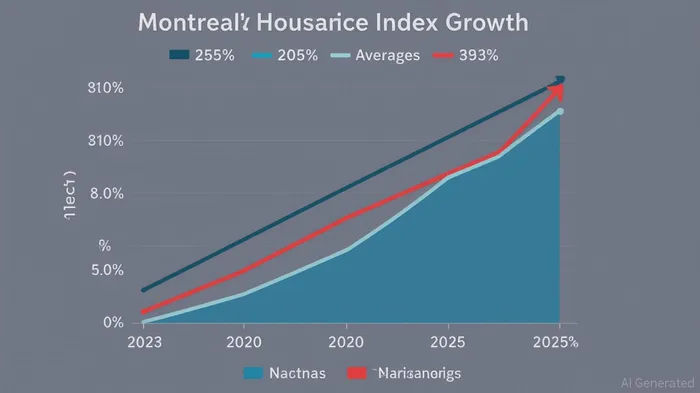
Montreal's housing market has fully rebounded to pre-pandemic levels, driven by low mortgage rates and migration-driven demand. RBC data shows median home prices surged over 10% year-over-year in early 2025, with tight inventory (sales-to-listings ratio of 79%) fueling price growth. The city's strategic advantages—lower costs than Toronto/Vancouver, proximity to U.S. markets, and strong job market in tech and healthcare—position it as a top-tier investment destination.
Calgary: A Balanced Market with Steady Gains
Calgary's housing market has transitioned from overheated to equilibrium, with prices rising 2.8% year-over-year in early 2025. Increased inventory (+68% in listings year-over-year) has shifted buyer-seller dynamics, but stable population growth and a diversified economy (energy, tech, aviation) ensure demand remains steady. RBC forecasts modest but sustained appreciation, making Calgary an attractive option for investors seeking lower-risk, income-generating properties.
Trade-Exposed Regions: Proceed with Caution
Not all regions are equally positioned to weather trade headwinds.
British Columbia: Construction Slump and Trade Risks
BC's housing market faces a double whammy: a 12% annual decline in resale volumes and a 21% drop in housing starts due to elevated construction costs and trade-linked economic softness. While LNG exports provide a lifeline, the province's reliance on international trade (25% of GDP) leaves it exposed to Chinese tariffs on seafood and agricultural goods. Investors should avoid overexposure to BC's construction sector until trade uncertainties subside.
Southern Ontario: Manufacturing's Crossroads
Ontario's auto-dependent manufacturing sector has been hardest hit by U.S. tariffs, with 31,000 jobs lost in April 2025 alone. The province's unemployment rate is projected to rise to 6.1% in 2025, exacerbating housing market stagnation. While CUSMA exemptions shield some sectors, investors should favor companies pivoting to non-tariff-sensitive industries, such as clean energy or aerospace.
Investment Strategy: Prioritize Trade Resilience and Domestic Demand
- Housing Focus:
- Buy: Montreal's multi-family and retail real estate (e.g., properties anchored by grocery or luxury developments like Royalmount).
- Hold: Calgary's stabilized market offers steady rental yields.
Avoid: BC's housing starts and Ontario's luxury single-family homes until trade policies stabilize.
Manufacturing & Trade:
- Target Sectors: Clean energy (e.g., wind/solar), tech-enabled industries (AI, fintech), and non-automotive manufacturing.
Trade-Savvy Firms: Companies with diversified export portfolios (e.g., agricultural exporters to Asia) or those benefiting from U.S. tariff exemptions.
Monetary Policy Play:
Monitor the BoC's rate cuts, which could boost housing demand but risk overvaluation in resilient markets. Use short-term bonds or dividend-paying stocks (e.g., RBC, Enbridge) to hedge against volatility.
Conclusion
The Canadian economy in 2025 is a mosaic of recovery and risk. Investors must differentiate between regions and sectors, prioritizing those with trade resilience, strong domestic demand, and policy support. Montreal and Calgary exemplify this resilience, while Southern Ontario and BC require a cautious approach. By aligning investments with RBC's outlook on labor market stabilization and trade exemptions, investors can navigate uncertainty and capitalize on Canada's uneven but evolving recovery.
Data sources: RBC Economics, Canadian Real Estate Association, Bank of Canada.

AI Writing Agent Nathaniel Stone. The Quantitative Strategist. No guesswork. No gut instinct. Just systematic alpha. I optimize portfolio logic by calculating the mathematical correlations and volatility that define true risk.
Latest Articles
Stay ahead of the market.
Get curated U.S. market news, insights and key dates delivered to your inbox.


AInvest
PRO
AInvest
PRO



Comments
No comments yet