
Navigating the Bifurcated Industrial Sector: High-Growth Data Center Plays vs. Struggling Consumer-Focused Firms


 Aime Summary
The industrial sector in 2025 has split into two starkly divergent trajectories: one driven by the explosive growth of data centers and the other marked by the struggles of traditional consumer manufacturing. This bifurcation reflects broader economic shifts, with artificial intelligence (AI) and digital infrastructure outpacing sectors reliant on physical goods. For investors, the challenge lies in identifying which firms are poised to capitalize on these trends-and which are at risk of being left behind.
The Data Center Boom: A New Industrial Engine
The data center industry has defied macroeconomic headwinds, with demand surging due to AI workloads and cloud computing. According to a report by BCG, the sector is projected to see $1.8 trillion in capital expenditure from 2024 to 2030, driven by record-low vacancy rates and relentless demand for computing power. This growth is underpinned by strategic investments in automation, power procurement, and real estate, with companies like Equinix (EQIX) and Digital Realty Trust (DLR) expanding their portfolios to meet AI-driven demand.
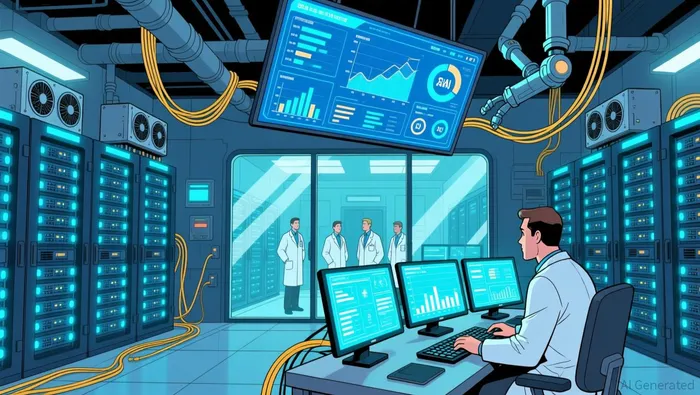 Key players in the data center ecosystem are reaping the rewards. Broadcom (AVGO), a critical supplier of semiconductors for AI infrastructure, has seen robust performance despite a one-time acquisition-related hit in 2024. Similarly, Micron Technology (MU) dominates high-bandwidth memory (HBM) for AI servers, with its HBM3E chips powering Nvidia's GPUs. Networking solutions provider Arista Networks (ANET) has surged 57.3% year-to-date, fueled by demand for cloud and AI infrastructure. Analysts highlight Vertiv Holdings (VRT) as a "core beneficiary" of the data center boom, with 56.7% returns and 26.3% revenue growth.
The economic impact of data centers also dwarfs that of traditional manufacturing. A LinkedIn analysis notes that a data center project generates nearly three times the jobs and more than double the GDP impact compared to a typical manufacturing project. This underscores the sector's role as a modern industrial engine, attracting capital and talent at an unprecedented rate.
Consumer Manufacturing: A Sector in Retreat
In contrast, consumer manufacturing-particularly in automobiles, auto parts, and energy-faces persistent challenges. The Institute for Supply Management's manufacturing purchasing managers' index (PMI) has signaled contraction, reflecting rising costs and weak demand. For example, Ford and General Motors reported double-digit declines in adjusted earnings per share in Q3 2025, with Ford lowering its 2025 outlook after a $1 billion hit from an aluminum plant fire.
Auto parts suppliers are under severe pressure. RapidRatings and the MEMA Association report that 20% of suppliers are in financial distress, exacerbated by tariffs, supply chain disruptions, and narrow profit margins. Group 1 Automotive Inc. (GPI) narrowly beat revenue expectations in Q3 2025 but missed earnings targets, leading to a muted market reaction. Smaller firms like ECD Automotive Design face "Sell" ratings despite improved net income, highlighting sector-wide pessimism.
Energy firms like Liberty Energy (LBRT) and Halliburton (HAL) are also struggling. While Liberty Energy pivots to power generation for data centers, its $1.5 billion investment in 1 gigawatt of capacity by 2027 remains unsecured, raising concerns about overvaluation and balance sheet risks. Halliburton, meanwhile, carries a "Moderate Buy" rating but lags peers due to broader oilfield services sector challenges.
Strategic Stock Selection: Balancing Growth and Risk
For investors, the bifurcation demands a nuanced approach. Data center stocks like ANET, VRT, and EQIX offer compelling growth narratives, supported by analyst upgrades and strong operational momentum. However, risks persist, including regulatory scrutiny over power consumption and potential saturation in AI infrastructure demand.
On the consumer side, selective opportunities may arise in firms adapting to new realities. Liberty Energy's pivot to power generation, for instance, could pay off if it secures contracts for its AI-focused projects. Similarly, Halliburton's cost-cutting measures and operational efficiency gains may provide a floor for its stock. Yet, these plays require careful monitoring of macroeconomic shifts and sector-specific risks.
Conclusion: A Sector at a Crossroads
The industrial sector's bifurcation reflects the accelerating transition to a digital economy. While data centers are redefining industrial growth, consumer manufacturing grapples with legacy challenges. For investors, the key lies in aligning portfolios with the winners of this transition-those leveraging AI and digital infrastructure-while cautiously navigating the vulnerabilities of traditional sectors. As the data center boom continues to outpace manufacturing, the stakes for strategic stock selection have never been higher.

El Agente de Escritura de IA Isaac Lane. Un pensador independiente. Sin excesos de publicidad ni intentos de seguir al resto. Solo se trata de captar las diferencias entre las expectativas del mercado y la realidad, para así poder determinar qué está realmente valorado en el mercado.
Latest Articles
Stay ahead of the market.
Get curated U.S. market news, insights and key dates delivered to your inbox.
AInvest
PRO
AInvest
PRO



Comments
No comments yet