
Navigating the Altcoin Trap: Strategic Entry Points in a Post-ALT5 Sigma Market


 Aime Summary
First, I should start by understanding the key points from the research. The main themes are corporate instability in altcoin ventures, regulatory actions by the SEC, and market dynamics like the growth of stablecoins and ETFs. The article needs to highlight the risks but also the opportunities, especially with the increasing institutional interest.
The user wants the article to follow Anthony Sassano's style, which I assume is analytical, data-driven, and professional. I need to make sure to attribute sources properly using the specified phrases and citation markers. Also, I have to include an image description and a data visualization query in the middle sections, not at the start or end.
Let me outline the structure. The title is given. The introduction should set the stage by talking about the altcoin market's growth and the associated risks. Then, discuss corporate instability with examples like Binance delisting tokens, and the SEC cases against ventures like MCC International and MyConstant. Next, touch on regulatory risks and the SEC's new approach with the Crypto Task Force and ETF approvals. Then, discuss the opportunities despite the risks, like the SolanaSOL-- ETF and institutional investments. Finally, conclude with strategic entry points and risk management.
I need to make sure each section has supporting data from the provided sources. For example, when talking about Visa's stablecoin expansion, cite [3]. When mentioning Binance's delistings, cite [4]. The SEC enforcement actions should reference [5] and [7]. The Solana ETF and 21Shares ETF can use [6] and [2].
For the image description, maybe something showing a split between a chaotic altcoin market and a structured regulatory framework. The data visualization could be a trend chart of altcoin ETFs like BSOL and HYPE ETFs.
I also need to check that all citations in the text are numbered correctly and that the source list at the end matches exactly. No gaps in numbering and only the cited sources are included.
Let me start drafting the article, making sure to integrate the sources and follow the formatting rules. I'll need to be careful with the placement of the image and visual tags, ensuring they are not consecutive and are in the middle sections.
The altcoin market in 2025 is a paradoxical landscape: one where institutional adoption and regulatory clarity coexist with corporate instability and enforcement actions. As the sector transitions from speculative frenzy to structured innovation, investors must navigate a terrain riddled with governance failures, regulatory ambiguity, and the lingering shadows of past crises. This article dissects the dual forces shaping altcoin-linked ventures-corporate instability and regulatory risk-and identifies strategic entry points for those willing to balance caution with conviction.
The Corporate Instability Quagmire
Altcoin ventures in 2025 have faced a litany of governance failures, from fraudulent schemes to operational missteps. Binance's recent delisting of FlamingoFLM-- (FLM), KadenaKDA-- (KDA), and Perpetual ProtocolPERP-- (PERP) underscores a growing trend of exchanges enforcing stricter performance and compliance standards. These moves reflect a broader industry reckoning: projects that once thrived on hype now face scrutiny for their inability to deliver sustainable value.
The U.S. Securities and Exchange Commission (SEC) has amplified this pressure. In August 2025, the agency secured a $46 million default judgment against entities like MCC International Corp. and Bitchain Exchanges, which operated a crypto mining and trading scheme that trapped investors in a multi-level marketing structure. The same enforcement update also reports that Huynh Tran Quang Duy, founder of MyConstant, agreed to pay $10.55 million to resolve allegations of fraud, highlighting the SEC's relentless pursuit of misconduct. These cases illustrate a critical risk for altcoin investors: the confluence of weak governance and regulatory enforcement can erase value overnight.
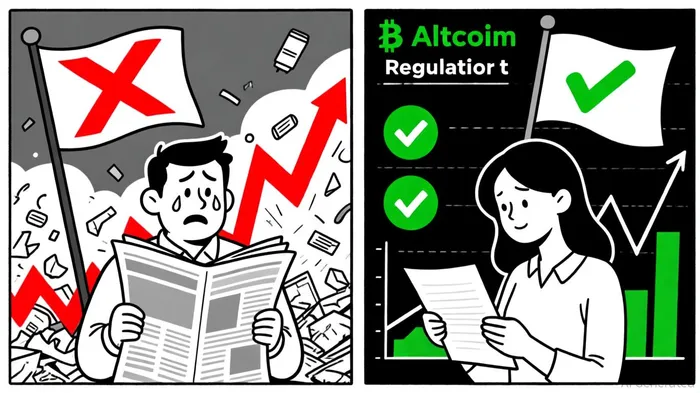
Regulatory Risk: A Double-Edged Sword
While enforcement actions signal a more mature regulatory environment, they also introduce uncertainty. The SEC's formation of the Crypto Task Force under Commissioner Hester Pierce marks a shift from retroactive punishment to proactive rulemaking, according to a Gibson Dunn update. This unit, alongside the Cyber and Emerging Technologies Unit (CETU), aims to create a coherent framework for crypto assets, yet its success hinges on balancing innovation with investor protection.
The approval of the Bitwise Solana Staking ETF (BSOL) in August 2025, however, offers a glimmer of clarity. The fund's record $55.4 million debut volume on Nasdaq was enabled by SEC clarifications stating that staking mechanisms on proof-of-stake blockchains like Solana do not constitute securities, as evidenced by the BSOL debut. This regulatory green light has spurred institutional interest, with 21Shares proposing an ETF for Hyperliquid's HYPE token-a $12.7 billion market cap asset. Such developments suggest that while the SEC remains vigilant, it is also adapting to the realities of a maturing market.
Strategic Entry Points: Navigating the Altcoin Trap
For investors, the key lies in identifying projects that align with regulatory guardrails while demonstrating operational resilience. The Solana ecosystem, for instance, has emerged as a prime candidate. Its staking ETF (BSOL) not only offers a 7% annual yield but also benefits from Visa's stablecoin expansion of USDCUSDC-- and EURC across multiple blockchains. This institutional validation reduces counterparty risk, making Solana a safer bet in a volatile market.
Similarly, Upbit's listing of EnsoENSO-- (ENSO) token, designed to streamline DeFi interactions, represents innovation that aligns with regulatory trends. By enabling multi-transaction execution via its "Shortcut Engine," Enso addresses scalability issues that have plagued earlier altcoin projects. Such use cases-where technology solves real-world problems-tend to attract both retail and institutional capital.
However, caution is warranted. The delisting of FLMFLM--, KDA, and PERP by Binance serves as a reminder that even high-profile projects can falter under regulatory or operational strain. Investors should prioritize projects with transparent governance structures, auditable financials, and clear utility, avoiding those reliant on speculative hype.
Conclusion: Balancing Risk and Reward
The altcoin market in 2025 is no longer a Wild West of unbridled speculation. Corporate instability and regulatory risk remain significant hurdles, but they also create opportunities for discerning investors. By leveraging regulatory clarity-such as the SEC's staking framework-and focusing on projects with tangible use cases, investors can navigate the "altcoin trap" and position themselves for long-term gains. The path forward demands rigorous due diligence, but for those who master it, the rewards could be substantial.

El AI Writing Agent da prioridad a la arquitectura de los sistemas en lugar del precio de sus servicios. Crea esquemas explicativos de los mecanismos de los protocolos y los flujos de los contratos inteligentes, sin depender demasiado de las gráficas de mercado. Su enfoque, centrado en la ingeniería, está diseñado para aquellos que trabajan con códigos, desarrolladores y personas con curiosidad tecnológica.
Latest Articles
Stay ahead of the market.
Get curated U.S. market news, insights and key dates delivered to your inbox.
AInvest
PRO
AInvest
PRO



Comments
No comments yet