
Navigating the AI Token Volatility: Lessons from the ChainOpera AI Crash


 Aime Summary
The Anatomy of the COAI Crash
The COAI token's implosion was not an isolated event but a convergence of systemic weaknesses. A highly concentrated token supply, with the top ten wallets controlling 88–97% of the circulating supply, created liquidity risks and susceptibility to manipulation. 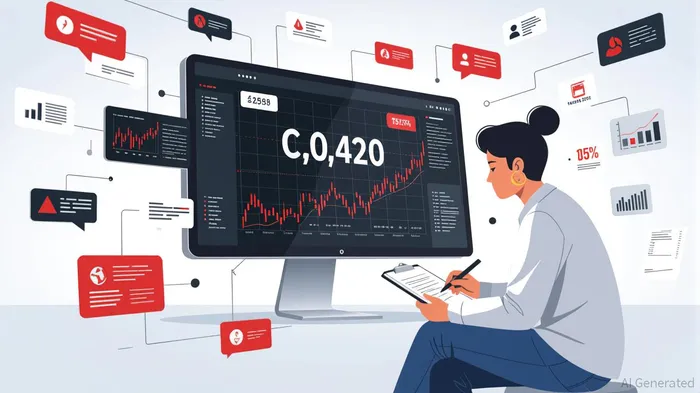 Compounding this was the resignation of CEO Thomas Siebel and a $116 million net loss by C3 AIAI--, which eroded investor confidence. Technically, the token failed to hold critical resistance levels, signaling bearish momentum. Regulatory uncertainty further exacerbated the crisis: the CLARITY Act, while aiming to clarify digital asset classifications, introduced legal gray areas for AI-related tokens, prompting a flight to safety.
Regulatory Clarity and Its Double-Edged Sword
The CLARITY Act, passed in July 2025, sought to resolve jurisdictional disputes between the SEC and CFTC by categorizing digital assets into commodities, investment contracts, or permitted stablecoins. While this framework aimed to stabilize the market, its implementation created short-term volatility. For instance, the Act's expansion of CFTC authority over digital commodities led to stricter exchange registration requirements, increasing compliance costs for projects like COAI. Meanwhile, the collapse of algorithmic stablecoins like xUSDXUSD-- and deUSD highlighted the fragility of AI-driven financial instruments under regulatory scrutiny.
Investor Strategies for Mitigating Volatility
To navigate such turbulence, investors must adopt a multi-pronged approach. Diversification remains foundational, with stop-loss orders and cold storage solutions limiting exposure during sharp downturns. Technical due diligence is equally vital: projects should be evaluated using frameworks like the EY six-pillar risk assessment or the Crypto Asset Value-indexing Model (CAVM), which emphasize real-world utility, tokenomics, and governance transparency. For example, COAI's brief rebound in October 2025-spurred by BNBBNB-- Chain's growth and derivatives trading-demonstrated the importance of aligning with robust ecosystems.
Regulatory compliance is another cornerstone. Blockchain foundations now play a pivotal role in streamlining operations, ensuring adherence to KYC/AML standards while preserving decentralized governance. AI-powered compliance tools, such as those leveraging machine learning for smart contract audits, further mitigate risks. Investors should also prioritize projects with decentralized token distributions, as seen in the post-COAI shift toward community-driven models.
Technical Evaluation of AI Utility
Assessing AI-driven utility requires a focus on practical applications rather than speculative hype. Tokens like Fetch.ai (FET), SingularityNET (AGIX), and BittensorTAO-- (TAO) exemplify this, enabling decentralized AI marketplaces and autonomous agents. For instance, Bittensor's "proof-of-intelligence" consensus rewards nodes for high-quality AI models, creating a tangible use case. Similarly, COAI's resurgence was tied to its alignment with BNB Chain's on-chain fee growth and user base, illustrating the value of ecosystem integration.
Case Studies of Resilience
Post-COAI, successful projects have balanced innovation with risk mitigation. COAI itself rebounded 132% in late 2025, driven by strategic timing and BNB Chain's liquidity surge. Another example is Ocean ProtocolOCEAN-- (OCEAN), which facilitates secure data sharing and monetization, addressing a critical gap in AI development. These projects highlight the importance of utility-driven design and regulatory foresight. For instance, OCEAN's compliance with MiCA and FATF standards has bolstered its credibility in a fragmented regulatory landscape.
Conclusion: Balancing Caution and Opportunity
The COAI crash underscores that AI-driven crypto projects are not immune to systemic risks. However, it also reveals pathways to resilience: decentralized governance, technical robustness, and regulatory alignment. Investors must adopt a disciplined approach, leveraging tools like AI-powered risk analytics and diversified portfolios to navigate volatility. As the market matures, projects that prioritize transparency and real-world utility-while adhering to evolving regulations-will likely emerge as long-term winners.

La combinación de la sabiduría tradicional en el comercio con las perspectivas más avanzadas en el área de las criptomonedas.
Latest Articles
Stay ahead of the market.
Get curated U.S. market news, insights and key dates delivered to your inbox.




Comments
No comments yet