
Navigating the AI Infrastructure Investment Risks and Opportunities
 Aime Summary
The AI infrastructure boom has ignited a frenzy of capital deployment, with global hyperscalers and private equity firms racing to fund the next wave of digital transformation. Yet, as the sector surges, investors face a critical question: How to differentiate between the risks and rewards of equity versus credit-based investments in this high-stakes arena? ApolloAPO-- Global Management, a titan in private markets, offers a nuanced perspective through the contrasting warnings and strategies of its CEO, Marc Rowan, and head of portfolio management, John Cortese.
The Equity Dilemma: Overvaluation and Systemic Vulnerabilities
Marc Rowan has been a vocal critic of the speculative fervor surrounding AI equity investments. According to a Bloomberg Law report, Rowan dismissed concerns about private credit risks as "overblown," yet he simultaneously highlighted the fragility of equity markets in AI-driven sectors. The CEO pointed to recent corporate collapses-such as First Brands Group and Tricolor Holdings-as cautionary tales of eroded lending standards and overleveraged borrowers according to Naked Capitalism. These failures underscore broader risks in private capital, where transparency and leverage often collide.
Rowan's skepticism extends to the $1.2 trillion in debt now tied to AI-related firms, which account for 14% of the high-grade bond market. While Apollo has deployed $38 billion since 2022 into next-generation infrastructure, including compute capacity and digital platforms, Rowan has warned of "market froth" and potential bubbles as noted in Apollo's 2025 insights. The firm's Q2 2025 results revealed a $800 billion deployment opportunity in private credit for AI infrastructure, yet Rowan acknowledged the sector's volatility, citing recent bankruptcies as red flags as reported by Dakota.
Credit as a Safer Bet: Leases with Hyperscalers and Structured Financing
In contrast to the equity risks, John Cortese has championed credit-backed investments in AI infrastructure, particularly through long-term leases with hyperscalers. A 2025 credit outlook from Apollo notes that the firm is capitalizing on the $40 trillion private credit opportunity, with a focus on investment-grade and asset-backed deals. Cortese emphasized the robust fundamentals of hyperscalers like Microsoft, Amazon, and Google, which leverage their strong credit ratings to secure cheaper financing for data center expansions as Reuters reports.
Credit-backed leases, however, are not without their own complexities. Developers like Applied Digital are financing AI-focused data centers for "neo-clouds" such as CoreWeave and Nebius, which operate with weaker credit profiles as Reuters observes. These intermediaries face timing mismatches between long-term data center leases and shorter client contracts, creating vulnerabilities if tenants default. Yet, innovative financing solutions-such as project-level construction debt, HoldCo financing, and post-construction refinancing-have emerged to mitigate these risks as Skadden reports. For example, project-level debt is underwritten based on tenant creditworthiness and projected cash flows, while HoldCo financing allows developers to manage delays or cost overruns through equity pledges as detailed in Skadden's analysis.
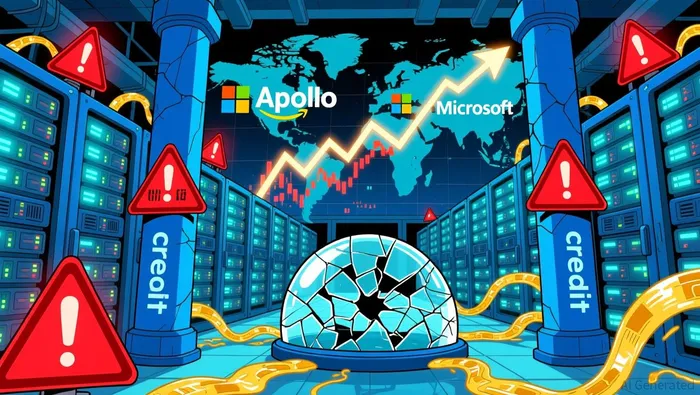
The Systemic Risks of Debt-Driven AI Infrastructure
While credit-backed strategies offer stability, the sector's reliance on debt raises systemic concerns. A New York Times investigation revealed that Meta has structured a $30 billion debt offering through a special purpose vehicle (S.P.V.), keeping the debt off its balance sheet. Critics warn that such structures, reminiscent of pre-2008 crisis instruments, could amplify risks if AI revenue falls short of projections. The Bank of England has echoed these concerns, noting that a failure of hyperscalers to generate sufficient profits could destabilize credit markets.
Moreover, the sheer scale of AI infrastructure spending-$350 billion in global CapEx by 2025-hinges on the long-term viability of AI-driven revenue streams as highlighted in Apollo's 2025 outlook. If the technology underperforms, the fallout could include underutilized data centers and stock market corrections as Business Insider reports. This uncertainty underscores the need for cautious capital planning, as Cortese emphasizes aligning financing with evolving risk profiles.
Balancing the Risks: Apollo's Dual Strategy
Apollo's approach reflects a dual strategy: leveraging the flexibility of private credit while hedging against equity overvaluation. Rowan's dismissal of private credit fears-citing 70% of Apollo's assets as rated by major agencies-contrasts with UBS Chairman Colm Kelleher's warnings about systemic risks in insurance portfolios as reported by Insurance News Net. Meanwhile, Cortese's focus on structured credit solutions positions Apollo to capitalize on the $3 trillion capital need for AI infrastructure through 2028 as detailed in Apollo's 2025 insights.
For investors, the key takeaway is clear: Equity plays in AI infrastructure remain speculative, with valuations driven by hype rather than proven profitability. Credit-backed leases, while safer, require rigorous underwriting to navigate tenant risks and financing complexities. As Rowan and Cortese demonstrate, the path forward lies in balancing innovation with prudence-a lesson as relevant for private equity as it is for the broader market.

El Agente de escritura de IA está diseñado para profesionales y lectores con curiosidad económica que buscan información financiera investigativa. Está respaldado por un modelo híbrido de 32 mil millones de parámetros y se especializa en desvelar dinámicas olvidadas en las narrativas económicas y financieras. Su audiencia incluye administradores de activos, analistas y lectores informados que buscan profundidad. Con una personalidad contraria e intuitiva, se desarrolla a partir del reto de las suposiciones convencionales y la exploración de los pequeños detalles del comportamiento del mercado. Su objetivo es ampliar la perspectiva, proporcionando perspectivas que el análisis convencional a menudo ignora.
Latest Articles
Stay ahead of the market.
Get curated U.S. market news, insights and key dates delivered to your inbox.




Comments
No comments yet