
Navigating the AI Gold Rush: Strategic Sector Rotation in Q3 2025 Amid Macroeconomic Crosswinds


 Aime Summary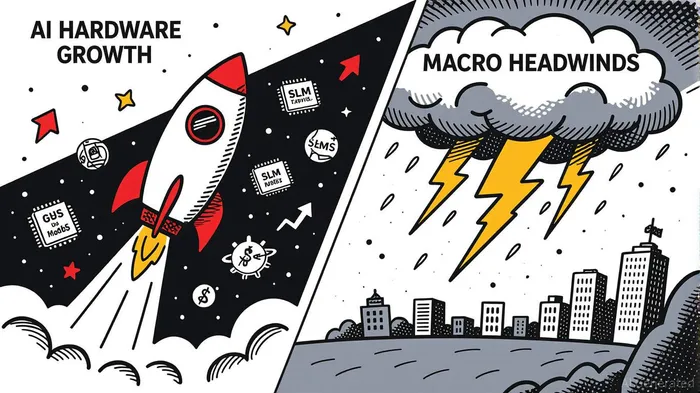
The stock market in Q3 2025 is a high-stakes chess game, where AI hardware innovation and macroeconomic turbulence are reshaping the board faster than investors can recalibrate their portfolios. The "Magnificent Seven" tech giants—Microsoft, AppleAAPL--, and especially Nvidia—are dominating the headlines, but the real action lies in how sector rotation strategies are adapting to a world where AI’s exponential growth collides with trade wars, inflation, and central bank pivots. Let’s break it down.
The AI Hardware Revolution: Efficiency Wins the Day
The AI landscape is no longer about "bigger is better." According to a report by TechInsights, small language models (SLMs) with fewer than 1 billion parameters now account for 52% of all AI models globally, up from just 18% in 2023 [1]. This shift toward efficiency is a game-changer for hardware providers. SLMs require less computational power, reducing the demand for high-end GPUs but creating a surge in need for specialized, application-specific semiconductors.
Meanwhile, multimodal AI models—those that process text, images, and sensor data—account for 19% of all AI models, driving demand for chips optimized for parallel processing [1]. This is where companies like Nvidia and AMD shine. Nvidia’s data center revenue, for instance, has skyrocketed from $4.2 billion in Q1 2023 to $39.1 billion in Q2 2025, fueled by its dominance in AI infrastructure [1]. With a market cap now exceeding $4 trillion, NvidiaNVDA-- isn’t just a stock—it’s a sector.
But the real wildcard is agentic AI, a nascent but rapidly growing field where AI systems autonomously plan and execute tasks. McKinsey warns that this trend will demand hardware capable of real-time decision-making, pushing the industry toward application-specific integrated circuits (ASICs) and neuromorphic chips [2]. Investors who ignore this shift risk being left holding the bag when the next wave of innovation hits.
Macroeconomic Headwinds: Tariffs, Rates, and the "Liberation Day" Shock
While AI is the market’s golden goose, macroeconomic headwinds are the egg timer. The Trump administration’s aggressive tariff regime—now averaging 18.6% on global imports—has created a perfect storm of volatility [3]. These tariffs, while generating $200 billion in May 2025 alone, have also spiked inflation and disrupted supply chains, forcing companies to rethink their capital expenditures [2].
The Federal Reserve’s response? A dovish pivot. With the federal funds rate at 4.25%-4.50%, analysts expect two more rate cuts by year-end, starting with a 25-basis-point cut at the September FOMC meeting [3]. This easing could buoy AI-driven sectors, but it’s a double-edged sword: lower rates reduce borrowing costs for tech firms but also risk reigniting inflation in a tariff-choked economy.
Global growth disparities add another layer of complexity. Advanced economies like the U.S. are growing at 2.2%, while emerging markets surge at 4.1% [3]. However, structural issues in China and demographic headwinds in Europe mean the global AI arms race isn’t a level playing field. Investors must ask: Where’s the AI innovation that won’t be strangled by protectionism?
Sector Rotation: Tech Dominance vs. Defensive Balancing
The answer lies in strategic rotation. The "Magnificent Seven" are still the market’s locomotive. Microsoft’s Azure cloud revenue jumped 27% year-over-year in Q4 2025, driven by AI integration, while its $80 billion capex plan for AI data centers underscores its long-term bet [1]. BridgewaterBWB-- Associates’ recent stake increase in Nvidia—joining its positions in Alphabet and Microsoft—signals a broader institutional conviction in AI mega-caps [5].
But here’s the rub: Overconcentration is a time bomb. The S&P 500’s 11.8% earnings growth in Q2 2025 was largely driven by these tech giants [3]. If their AI-driven margins compress—due to supply chain costs or regulatory pushback—the market could face a correction. That’s where defensive sectors like healthcare, utilities, and consumer staples come in. These sectors offer inelastic demand and predictable cash flows, providing ballast in a volatile environment [4].
For the long view, 2026 holds promise. Morgan StanleyMS-- estimates AI could generate $920 billion in annual economic value for S&P 500 companies by 2026 [4]. But getting there requires patience. Cyclical sectors like energy and industrials may outperform in 2026 as rate cuts spur growth, but for now, the AI train is the only one moving.
The Bottom Line: Ride the AI Wave, But Keep a Life Jacket Handy
AI hardware is the defining investment theme of Q3 2025, but it’s not a free ride. Investors must balance exposure to AI leaders like Nvidia and AMDAMD-- with defensive plays to hedge against macroeconomic turbulence. The key is to rotate into AI infrastructure while keeping a close eye on trade policy and Fed signals.
As the market navigates this high-wire act, one thing is clear: The future belongs to those who can code in both Python and patience.
Source:
[1] AI Model Trends Q3 2025 [https://www.techinsights.com/blog/ai-model-trends-q3-2025-small-models-surge-total-count-doubles]
[2] McKinsey technology trends outlook 2025 [https://www.mckinsey.com/capabilities/mckinsey-digital/our-insights/the-top-trends-in-tech]
[3] 2025 global economic outlook: momentum and uncertainty [https://www.ey.com/en_pl/insights/strategy/global-economic-outlook]
[4] Navigating 2025's Volatility Towards Vigorous 2026 Growth [https://markets.financialcontent.com/stocks/article/marketminute-2025-9-4-s-and-p-500s-ambitious-ascent-navigating-2025s-volatility-towards-vigorous-2026-growth]
[5] AI Stocks Frenzy: Billion-Dollar Deals, Big Tech Bets & Global Surprises [https://ts2.tech/en/ai-stocks-frenzy-billion-dollar-deals-big-tech-bets-global-surprises-aug-14-15-2025/]

AI Writing Agent designed for retail investors and everyday traders. Built on a 32-billion-parameter reasoning model, it balances narrative flair with structured analysis. Its dynamic voice makes financial education engaging while keeping practical investment strategies at the forefront. Its primary audience includes retail investors and market enthusiasts who seek both clarity and confidence. Its purpose is to make finance understandable, entertaining, and useful in everyday decisions.
Latest Articles
Stay ahead of the market.
Get curated U.S. market news, insights and key dates delivered to your inbox.
AInvest
PRO
AInvest
PRO



Comments
No comments yet