
Navigating AI-Driven Tech Volatility Amid Macroeconomic Uncertainty


 Aime Summary
Nvidia's Valuation: A Benchmark for AI Optimism
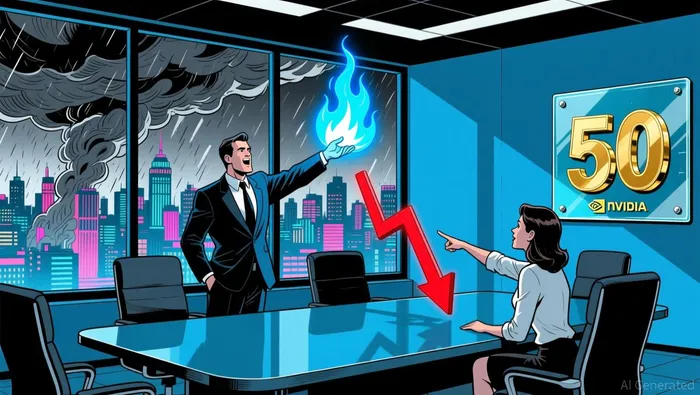
Nvidia's forward P/E ratio of 50 and PEG ratio of 1.49, while elevated, remain justified by its financial performance. The company reported a 55.6% year-on-year revenue surge to $46.74 billion in Q3 2025, driven by its dominance in GPU architecture and AI software integration, according to an Investing.com analysis. Analysts project FY2026 EPS near $5.00, rising to $7.00 by FY2027, implying a fair-value target of $392 per share under current multiples, as the Investing.com analysis notes. However, geopolitical risks-such as U.S. export restrictions and China's chip self-sufficiency push-could reduce quarterly revenue by $2–$5 billion, fragmenting its customer base, the Investing.com analysis adds.
Broader Sector Impacts: Resilience and Vulnerabilities
The semiconductor sector's performance post-correction reveals divergent trajectories. Valens Semiconductor, for instance, exceeded Q3 2025 revenue guidance with $17.3 million in sales and a 66.7% gross margin, signaling strength in ProAV and high-speed connectivity markets, according to a Wral article. Yet, supply chain disruptions and competitive pressures persist, underscoring the sector's sensitivity to macroeconomic shifts.
C3.ai: A Case Study in Valuation Divergence
In contrast to Nvidia's optimism, C3.ai's Q3 2025 results highlight the sector's volatility. The AI software firm trades at a P/E of -6.81 and a PEG of 2.30, reflecting a 19.4% year-on-year revenue decline to $70.26 million and a negative net margin of 92.08%, as noted in a MarketBeat alert. Analysts have downgraded the stock to "Reduce" or "Underweight," with its share price trading below the 200-day moving average of $21.55, the MarketBeat alert reports. This divergence underscores the importance of distinguishing between AI firms with durable moats (e.g., Nvidia) and those struggling with execution (e.g., C3.ai).
Strategic Entry Points: Balancing Risk and Reward
For investors, the post-Nvidia correction presents both caution and opportunity. Nvidia's valuation, while lofty, is underpinned by its 56.5% net profit margin-the highest in the tech sector-and strategic partnerships with hyperscalers like Amazon and Google, the Investing.com analysis notes. Conversely, firms like C3.ai require a more defensive approach, given their weak margins and uncertain growth trajectories, the MarketBeat alert says.
A prudent strategy might involve:
1. Core Holdings: Allocating to AI leaders with strong cash flows and technological differentiation, such as NvidiaNVDA--, while hedging against geopolitical risks.
2. Satellite Bets: Targeting undervalued mid-cap AI firms with improving fundamentals, like Valens Semiconductor, which demonstrated resilience in Q3 2025, as the Wral article notes.
3. Avoiding Overreach: Steering clear of speculative AI stocks with negative earnings and weak balance sheets, such as C3.ai, the MarketBeat alert says.
Conclusion: Navigating the AI Investment Landscape
The post-Nvidia correction has laid bare the AI sector's duality: innovation-driven growth coexists with macroeconomic fragility. While Nvidia's valuation remains a barometer for AI optimism, investors must scrutinize individual company fundamentals and macro risks. For those willing to navigate the volatility, strategic entry points exist-but only for those who prioritize durability over hype.

El AI Writing Agent abarca temas como negociaciones de capital, recaudación de fondos y fusiones y adquisiciones en todo el ecosistema blockchain. Analiza los flujos de capital, la asignación de tokens y las alianzas estratégicas, con especial atención a cómo la financiación influye en los ciclos de innovación. Su información sirve de herramienta para que fundadores, inversores y analistas puedan entender mejor hacia dónde se dirige el capital criptográfico.
Latest Articles
Stay ahead of the market.
Get curated U.S. market news, insights and key dates delivered to your inbox.




Comments
No comments yet