
Navigating AI-Driven Market Volatility: Strategic Positioning for 2025 Investors


 Aime Summary
The artificial intelligence revolution has reached a critical inflection point, but the path forward for investors is anything but smooth. As the sector grapples with the tension between groundbreaking innovation and speculative overvaluation, market volatility has intensified, demanding a recalibration of investment strategies. The recent performance of AI leaders like Nvidia Corp.NVDA-- and the struggles of pure-play software firms such as C3.ai underscore a broader shift in investor psychology-one that prioritizes sustainability over hype and demands clearer evidence of commercial viability.
The AI Boom and Its Bumps
Nvidia's fiscal third-quarter earnings in 2025, which reported $57 billion in revenue and projected $65 billion for the next quarter, initially sent its stock surging in after-hours trading. However, the euphoria was short-lived. By the close of the session, the stock had fallen 3.15%, dragging the Nasdaq Composite Index down 2.2% and
triggering a sector-wide sell-off. This reaction reflects a growing unease among institutional investors about whether AI valuations have outpaced fundamentals. The sell-off was not merely a correction but a signal:
the market is no longer willing to tolerate unproven business models or speculative bets on unscalable technologies.
Pure-play AI software firms have borne the brunt of this recalibration. C3.ai, for instance, has seen its stock plummet over 55% year-to-date, with
recent reports indicating the company is exploring a sale following the departure of its founder and CEO, Thomas Siebel. The company's 19% year-over-year revenue decline and $117 million net loss have
amplified skepticism about its long-term viability. These developments highlight a stark divergence between the robust fundamentals of leading AI hardware and cloud providers and
the fragility of companies lacking diversified revenue streams or clear paths to profitability.
Investor Psychology and the Fear Gauge
Market psychology in 2025 is increasingly shaped by the VIX index, the so-called "fear gauge," which
spiked to intraday levels of 52.87 in November 2025-a 150% increase from its opening levels. This volatility was driven by a confluence of factors: concerns over stretched equity valuations in tech, geopolitical tensions, and the mixed reception of Nvidia's earnings. While the company's data center division projected a 52% to 61% revenue surge,
the broader market interpreted the stock's post-earnings reversal as a warning sign.
Investor sentiment polls further illustrate this polarization. In Q3 2025, 78% of respondents believed AI would disrupt their industries, yet less than half thought it would live up to its promises
according to polling data. This gap between expectation and reality is fueling a flight to quality, with fund managers rotating capital out of high-growth tech and AI-adjacent stocks into defensive sectors like healthcare.
The shift is not merely defensive - it is a recalibration of risk tolerance in an era where AI's transformative potential is increasingly scrutinized through the lens of profitability and scalability.
Strategic Positioning: Diversification and Sector Rotation
For investors navigating this landscape, proactive portfolio adjustments are essential. Diversification is no longer a passive strategy but a dynamic one, requiring a nuanced understanding of sector-specific risks and opportunities. The U.S. AI market,
projected to grow from $146 billion in 2024 to $851 billion by 2034, offers both promise and peril. While hardware and data infrastructure providers like NvidiaNVDA-- remain resilient, pure-play software firms and crypto AI assets face heightened volatility. For example, the COAI Index-a crypto AI asset-
plummeted in November 2025 amid regulatory uncertainty and leadership changes at C3.ai.
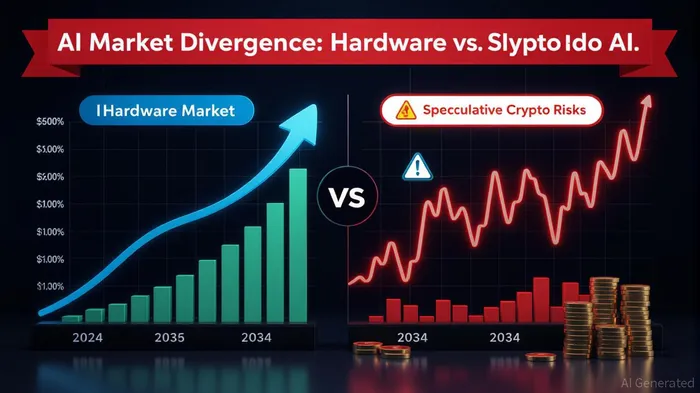 Sector rotation strategies are gaining traction as a way to hedge against AI-driven volatility. Momentum-based approaches, which leverage technical indicators like RSI and MACD, allow investors to shift capital into sectors showing strong growth while avoiding overextended positions.
Thematic investing in areas like energy management systems (EMS)-a market expected to grow to $219.3 billion by 2034-offers exposure to AI's practical applications without the speculative risks of pure-play tech stocks. Additionally, risk-on/risk-off strategies, which pivot between defensive sectors like utilities and cyclical sectors like technology, provide flexibility in response to shifting sentiment.
The Case for Proactive Adjustments
The key takeaway for investors is clear: AI's long-term potential is undeniable, but its short-term volatility demands discipline and adaptability. Companies with established cash flows, diversified revenue models, and clear commercialization pathways-such as Nvidia's hardware ecosystem or C3.ai's enterprise AI integrations with Microsoft-are better positioned to weather market swings.
According to market analysis,
the fundamentals of AI hardware remain strong, while speculative bets on unproven technologies or business models are increasingly likely to face harsh repricing.
As the VIX index and sentiment polls demonstrate, the market is in a state of flux. Investors who rely on data-informed strategies-leveraging AI-driven signals for real-time insights and sector rotation-will be better equipped to navigate this volatility. The AI revolution is here, but its rewards will go to those who balance innovation with pragmatism.

Stay ahead of the market.
Get curated U.S. market news, insights and key dates delivered to your inbox.
AInvest
PRO
AInvest
PRO



Comments
No comments yet