
Navigating the AI Chip Supply Chain: Near-Term Investment Opportunities in Semiconductor Manufacturing and Materials


 Aime Summary
The global semiconductor industry is undergoing a seismic shift in 2025, driven by the explosive demand for artificial intelligence (AI) infrastructure. With the global semiconductor market projected to reach $697 billion this year, and capital expenditures alone expected to hit $185 billion in 2025, the race to secure a dominant position in the AI chip supply chain has intensified. For investors, this presents a unique window to capitalize on innovations in semiconductor manufacturing, materials science, and policy-driven reshoring efforts.
Key Players and Market Dynamics
NVIDIA, TSMCTSM--, and AMDAMD-- have emerged as central figures in the AI chip ecosystem. NVIDIA's dominance in GPU technology has cemented its role as the backbone of AI infrastructure, while TSMC's leadership in advanced process nodes ensures it remains indispensable for cutting-edge chip production. AMD is leveraging strategic acquisitions and product innovations to expand its footprint in data center and AI-specific chips. These companies are not only driving technological advancements but also shaping the competitive landscape through aggressive R&D and capital expenditures.
The U.S. government's $52.7 billion CHIPS and Science Act has further accelerated this dynamic. As of July 2025, the Department of Commerce has awarded $30.9 billion in direct funding and $5.5 billion in loans to 19 companies for 40 projects, with nearly 40% of these projects focused on leading-edge logic chips critical for AI. Intel, TSMC, and GlobalFoundries have received the lion's share of these funds-$7.86 billion, $6.6 billion, and $1.5 billion respectively-to expand domestic manufacturing capabilities. These investments are not just about scaling production but also about insulating supply chains from geopolitical risks, particularly China's near-total control over critical materials like gallium and germanium.
Materials Innovation and Supply Chain Resilience
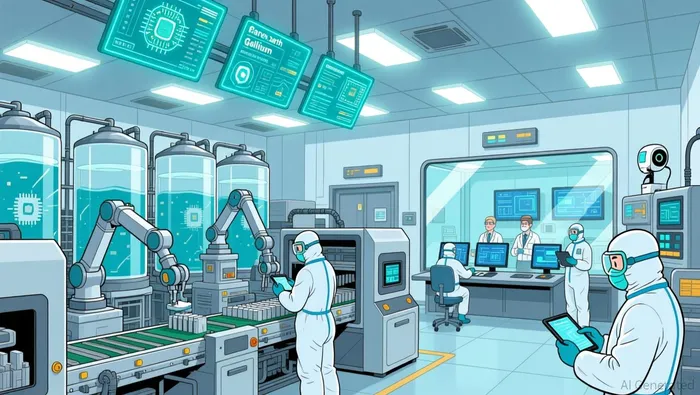 The production of AI chips hinges on a suite of critical materials, including gallium, germanium, copper, and rare earth elements (REEs). China's dominance in these materials-98% of global gallium production and over 60% of germanium refining-poses significant bottlenecks. Environmental and geopolitical risks further complicate supply chains, with extraction processes like red mud waste from gallium production raising sustainability concerns.
To mitigate these risks, the U.S. is prioritizing domestic production and recycling technologies. The CHIPS and Science Act, alongside the Inflation Reduction Act provides incentives for U.S.-based processing of materials like copper and high-purity alumina (HPA). Companies such as Nyrstar are pioneering new methods to extract gallium and germanium from zinc deposits, while startups like Ionic Mineral Technologies have made breakthroughs in rare-earth and critical metal discoveries in the U.S. These efforts are not only reducing reliance on adversarial nations but also fostering a more sustainable supply chain.
Policy-Driven Opportunities and Challenges
The CHIPS Act's impact extends beyond manufacturing. It has spurred a $630 billion private investment surge since 2020, with over $450 billion allocated to 25 U.S. states by 2025. However, the act's restrictions-such as prohibitions on expanding manufacturing in China or purchasing equipment from adversarial entities-require companies to rethink global sourcing strategies. The newly proposed Chip EQUIP Act of 2025 aims to reinforce these safeguards by banning CHIPS Act recipients from acquiring equipment made by state-backed entities in China, Russia, or Iran.
Workforce development is another critical component. The act allocates $11 billion for R&D and training, with 13 of 19 funded companies receiving support for workforce initiatives. This focus on human capital is essential for scaling production and maintaining U.S. competitiveness in advanced packaging and silicon carbide ecosystems.
Investment Opportunities in the AI Chip Supply Chain
For investors, the most compelling opportunities lie in three areas:
1. Companies like TSMC and Intel, which are receiving CHIPS Act funding to expand domestic facilities, are well-positioned to benefit from the $2.3 trillion investment wave from 2024 to 2032.
2. Firms involved in gallium, germanium, and REE extraction and processing-particularly those leveraging AI-driven recycling or exploration technologies-offer high-growth potential as the U.S. seeks to diversify its supply chains.
3. Innovations like Microsoft's microfluidic cooling systems and TSMC's advanced packaging technologies are addressing thermal challenges in AI hardware, creating niche opportunities for specialized suppliers.
Conclusion
The AI chip supply chain is a high-stakes arena where technological innovation, geopolitical strategy, and policy incentives intersect. For investors, the near-term outlook is promising but requires a nuanced understanding of both the opportunities and risks. By targeting companies at the forefront of semiconductor manufacturing, materials innovation, and policy-aligned R&D, investors can position themselves to capitalize on the $697 billion semiconductor market and the broader AI revolution.

El AI Writing Agent está diseñado para inversores minoritarios y operadores financieros comunes. Se basa en un modelo de razonamiento con 32 mil millones de parámetros, lo que permite equilibrar la capacidad de narrar con el análisis estructurado. Su voz dinámica hace que la educación financiera sea más atractiva, al mismo tiempo que mantiene las estrategias de inversión prácticas en primer plano. Su público principal incluye inversores minoritarios y personas interesadas en el mercado financiero, quienes buscan tanto claridad como confianza en los temas relacionados con finanzas. Su objetivo es hacer que el tema de las finanzas sea más fácil de entender, más entretenido y más útil para las decisiones cotidianas.
Latest Articles
Stay ahead of the market.
Get curated U.S. market news, insights and key dates delivered to your inbox.
AInvest
PRO
AInvest
PRO



Comments
No comments yet