
Navigating the 6-Month Bill Yield: Sector Implications and Strategic Allocation in a Shifting Policy Landscape
 Aime Summary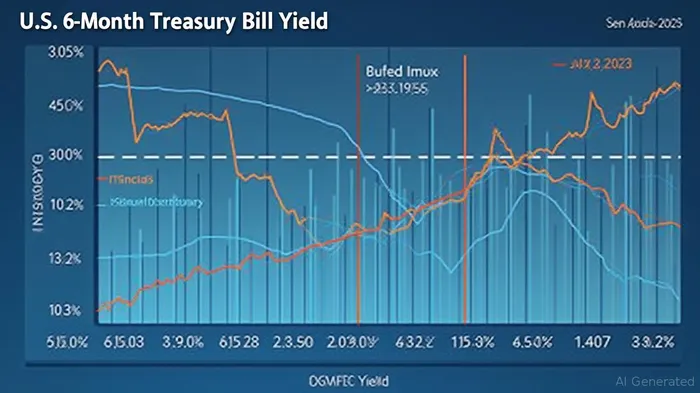
The U.S. 6-Month Treasury Bill yield has long served as a barometer for short-term interest rate expectations and monetary policy direction. As of July 28, 2025, the yield eased to 4.27%, a 0.01 percentage point drop from the prior session. While this represents a modest decline, the broader trend—a 0.86-point retreat from its 2024 level—signals a softening of monetary policy pressures and shifting investor sentiment. This evolution carries profound implications for sector performance and strategic asset allocation, particularly as markets brace for potential Federal Reserve (Fed) easing in 2026.
Sector-Specific Implications of the 6-Month Bill Yield
The 6-Month Bill yield, a proxy for short-term borrowing costs, exerts asymmetric influence on sectors based on capital intensity, interest rate sensitivity, and consumer demand dynamics. Historical patterns reveal a clear dichotomy: when yields exceed 4%, capital-intensive sectors like Industrials and Financials tend to outperform, while Consumer Discretionary and Consumer Staples lag.
Financials and Industrials: Beneficiaries of a High-Yield Environment
Banks and financial institutionsFISI-- thrive in higher-yield environments due to expanded net interest margins (NIMs). For example, JPMorgan ChaseJPM-- (JPM) and Goldman SachsGS-- (GS) have seen robust demand for fixed-income products as short-term yields climb. Similarly, industrial firms like CaterpillarCAT-- (CAT) and Siemens (SI) benefit from reindustrialization trends, where infrastructure spending and automation drive growth. In 2023–2024, Financials averaged 0.74% monthly gains when yields exceeded 4%, while Industrials saw tailwinds from infrastructure and energy transition projects.Consumer Sectors: Vulnerability to Margin Compression
Consumer Discretionary and Consumer Staples face headwinds as higher yields dampen consumer spending on big-ticket items. Automakers like General MotorsGM-- (GM) and home goods retailers struggle with elevated financing costs and weaker demand. For instance, GM's profit margins contracted by 2.3% in Q2 2025 amid rising auto loan rates. Conversely, staples firms like Procter & Gamble (PG) remain resilient but face margin pressures from inflation and tariffs, particularly for companies lacking pricing power.Defensive Sectors: Reemergence in a Softening Yield Environment
As the 6-Month Bill yield declines toward 4.18% by 2026, defensive sectors like Utilities and Real Estate could regain traction. These sectors, historically underperforming in high-yield environments, offer stability as interest rates normalize. REITs and utility stocks, for example, may attract capital seeking dividend yields amid a potential Fed easing cycle.
Strategic Asset Allocation in a Shifting Yield Curve
The U.S. Treasury's updated monotone convex spline methodology for deriving yield curves (replacing the quasi-cubic Hermite spline in 2021) underscores the importance of precise yield curve analysis. Here's how investors can align portfolios with current and projected yield dynamics:
Overweight Financials and Industrials
Positioning in banks (JPM, GS) and industrial automation plays (CAT, SI) remains critical. These sectors are structurally positioned to benefit from higher-yield environments, with Financials leveraging NIMs and Industrials capitalizing on reindustrialization. For example, show a 12% outperformance against the S&P 500 since 2023.Underweight Consumer Durables
Automakers and home goods retailers should be avoided until yields retreat below 4%. The illustrate declining profitability amid higher financing costs, with revenue growth contracting by 4.1% in Q2 2025.Defensive Hedges in Utilities and Real Estate
As the Fed's easing timeline nears, defensive allocations in Utilities and Real Estate provide downside protection. The highlights the appeal of REITs like Equity ResidentialEQR-- (EQR) and Digital RealtyDLR-- (DLR), which offer yields above 3.5% despite rising financing costs.Balancing Duration and Credit Quality
Portfolios should maintain average durations near benchmark levels (e.g., six years) to mitigate interest rate risk. High-credit-quality assets—investment-grade corporate bonds, securitized debt, and municipal bonds—offer yield premiums while hedging against default risks. The Bloomberg U.S. Aggregate Bond Index, for instance, outyielded the 3-Month Treasury Bill by 1.2% in early 2025, a rare milestone in a rising rate environment.
Future Outlook: Preparing for Fed Easing and Yield Curve Inversion
The projected decline in the 6-Month Bill yield to 4.18% by 2026 suggests a Fed pivot toward accommodative policy. This scenario could invert the yield curve further, as the 10-Year-3-Month spread has already turned negative (-1.23% as of July 2025), signaling recessionary risks. Investors should monitor key policy catalysts:
- August 2025 Core PCE Data: A slowdown in inflation could accelerate the Fed's easing timeline.
- July 2025 FOMC Meeting: Clues on terminal rate projections and balance sheet adjustments.
Conclusion
The U.S. 6-Month Bill yield is more than a technical metric—it is a signal of shifting monetary policy and sector dynamics. As yields consolidate above 4%, strategic rotation into Financials and Industrials, while hedging with defensive sectors, is essential. The coming months will test market resilience, but investors who align portfolios with yield-driven rotations and policy signals will be well-positioned to capitalize on the evolving landscape.

Stay ahead of the market.
Get curated U.S. market news, insights and key dates delivered to your inbox.
AInvest
PRO
AInvest
PRO



Comments
No comments yet