
Navigating the S&P 500's Record Highs: Strategic Positioning Amid Earnings Momentum and Trade Uncertainty
 Aime Summary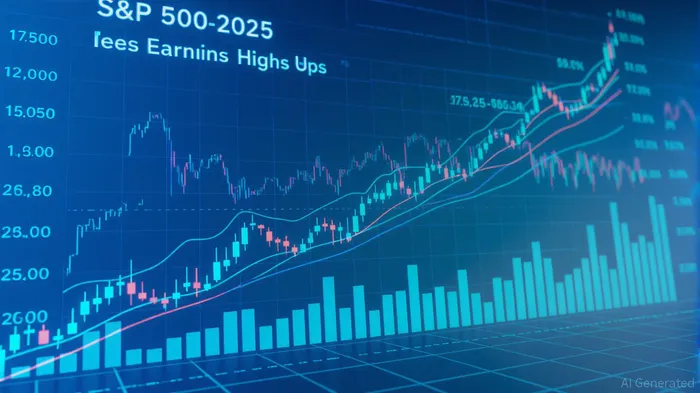
The S&P 500's relentless climb to record highs in July 2025 has captivated investors, but beneath the surface lies a complex interplay of macroeconomic signals, corporate performance, and geopolitical shifts. As the index closed at a historic 5,200+ level, it underscored a market in transition—one where strategic positioning is critical for capitalizing on opportunities while mitigating risks.
Corporate Earnings: The Bedrock of Bullish Momentum
The S&P 500's performance has been underpinned by robust corporate earnings. Over 82% of S&P 500 companies that reported in Q2 2025 exceeded Wall Street expectations, driven by cost discipline, pricing power, and demand in technology and industrial sectors. Giants like Alphabet and VerizonVZ-- exemplified this trend, with Alphabet's AI-driven ad revenue and Verizon's 5G infrastructure investments outperforming forecasts.
However, the earnings story is not uniform. Sectors like agriculture and consumer discretionary face headwinds from trade tensions and margin compression. Investors must distinguish between “tariff winners” (e.g., industrials, semiconductors) and “tariff losers” (e.g., construction, automotive).
Trade Dynamics: A Double-Edged Sword
The U.S.-China trade landscape has been a wildcard in 2025. While a 90-day tariff truce and renewed talks in Stockholm offered temporary relief, the long-term outlook remains uncertain. The U.S. imposed 50% tariffs on Chinese semiconductors, while China retaliated with duties on U.S. agricultural exports. Meanwhile, the U.S.-EU 15% tariff agreement and trade pacts with Japan and Indonesia have reduced short-term volatility.
For investors, this duality creates opportunities. Domestic industrials (e.g., Lockheed MartinLMT--, Eaton) and energy companies (e.g., NucorNUE--, Schlumberger) have thrived under protectionist policies, while global-facing sectors face margin erosion. The energy sector, in particular, has benefited from a rebound in oil prices and AI-driven infrastructure demand, as evidenced by the VanEck Energy ETF (XLE) rising 18% year-to-date.
Macroeconomic Signals: A Delicate Balance
The U.S. economy navigates a fragile equilibrium. First-quarter GDP contracted 0.5%, partly due to tariff front-running and fiscal tightening, but second-quarter projections suggest a rebound. Inflation remains a concern, with the core PCE index at 3.6% YOY, driven by supply chain bottlenecks and higher import costs. The Federal Reserve's cautious approach—maintaining rates between 4.25% and 4.5%—has preserved liquidity while signaling a gradual easing path in 2026.
This environment favors companies with pricing power and operational flexibility. For instance, CaterpillarCAT-- managed to offset $250–350 million in Q2 tariff costs through reshoring and pricing adjustments, highlighting the importance of resilience in a policy-driven market.
Strategic Positioning: Sector Rotations and Hedging
Investors must adopt a nuanced approach to positioning:
- Domestic Industrials and Energy: These sectors are prime beneficiaries of reshoring and protectionist policies. ETFs like the Industrial Select Sector SPDR (XLI) and Energy Select Sector SPDR (XLE) offer exposure to companies poised to capitalize on infrastructure spending and commodity demand.
- Semiconductors and AI: The VanEck Semiconductor ETF (SMH) has rebounded 18% YTD, driven by AI infrastructure and CHIPS Act incentives. Firms like NVIDIANVDA-- and AMDAMD-- remain critical to long-term growth.
- Inflation Hedges: Gold (SPDR Gold Shares ETF, GLD) and Treasury bonds have surged as safe-haven assets, reflecting market uncertainty.
- Hedging Global Risks: While sectors like agriculture and consumer discretionary face margin pressures, upstream players (e.g., seed and fertilizer firms) may benefit from protectionist policies.
The Inflection Point: Timing and Agility
The S&P 500's performance in 2025 suggests a market pricing in a resolution to trade tensions and a soft landing for the economy. However, the August 1 U.S.-EU tariff deadline and August 12 U.S.-China truce expiration introduce volatility. Investors should remain agile, favoring sectors with strong balance sheets and adaptability to shifting policy environments.
Conclusion: A Market at a Crossroads
The S&P 500's record highs reflect a confluence of strong earnings, strategic trade agreements, and cautious monetary policy. Yet, the path forward is fraught with uncertainty. For investors, the key lies in balancing exposure to growth sectors (e.g., industrials, AI) with hedging against global risks. As macroeconomic signals and corporate performance align toward a potential inflection point, strategic positioning—rooted in agility and sector-specific insights—will separate winners from laggards in this dynamic market.

Delivering real-time insights and analysis on emerging financial trends and market movements.
Latest Articles
Stay ahead of the market.
Get curated U.S. market news, insights and key dates delivered to your inbox.
AInvest
PRO
AInvest
PRO



Comments
No comments yet