
Navigating 2025 Market Volatility: Tactical Positioning and Volatility Management Strategies
 Aime Summary
The U.S. equity market in 2025 has been a study in contrasts. While the S&P 500 and Nasdaq Composite reached record highs in Q3 2025, driven by optimism over Federal Reserve rate cuts and AI-driven corporate investments, according to a Morningstar analysis, the path to these gains has been marked by sharp sell-offs and geopolitical turbulence. Tariff-related volatility, shifting trade policies, and persistent inflation have created a landscape where traditional risk management strategies are being tested. For investors, the challenge lies in balancing growth aspirations with the need to preserve capital during periods of heightened uncertainty.
Drivers of Volatility: Trade Policies and Geopolitical Uncertainty
The 2025 market environment has been shaped by a confluence of macroeconomic and geopolitical factors. Shifting trade policies, including the imposition of tariffs and subsequent retreats from aggressive measures, have created a seesaw effect in investor sentiment, as outlined in the BlackRock spring outlook. For instance, the market's rebound in Q3 2025 followed a sharp selloff in April triggered by fears of stringent tariffs, only to face renewed jitters as inflationary pressures emerged from tariff pass-throughs to consumers. Meanwhile, geopolitical tensions-ranging from Middle East conflicts to China's economic slowdown-have added layers of unpredictability, amplifying the need for tactical positioning.
Strategic Resilience: Low-Volatility Equities Outperform
During periods of market stress, low-volatility stocks have demonstrated a unique ability to mitigate downside risk. According to a report by MorningstarMORN--, companies like Berkshire Hathaway, Coca-Cola, and Mastercard have outperformed the broader market during 2025 sell-offs, limiting price fluctuations and preserving capital. This resilience is attributed to their strong balance sheets, consistent cash flows, and reduced sensitivity to macroeconomic shocks. Conversely, quality and momentum factors-once dominant in 2023 and 2024-have faltered, with tech giants like Nvidia and Alphabet experiencing significant declines as growth expectations recalibrate.
Tactical Positioning: Diversification and Alternative Assets
To navigate this volatile environment, investors are increasingly turning to defensive strategies. BlackRock's Spring 2025 investment directions emphasize the importance of diversifying portfolios with alternative assets such as gold, inflation-linked bonds, and infrastructure equities. These assets offer reduced correlation to traditional equities and can act as a buffer against market-wide declines. Additionally, short-term fixed-income instruments have gained favor as a means to preserve liquidity and reduce exposure to rate-sensitive sectors.
Options-based strategies are also gaining traction. In a high-volatility, high-interest-rate environment, tools like protective puts and covered calls can provide downside protection while generating income, as noted in a Natixis outlook. For example, purchasing put options on low-volatility indices or individual stocks can hedge against sudden market corrections, offering a cost-effective way to manage risk without sacrificing long-term growth potential.
Q3 2025: A Case Study in Market Resilience
The third quarter of 2025 exemplifies the interplay between optimism and caution. The S&P 500 surged past 6,500 in August, fueled by robust corporate earnings and AI-driven innovation, but this momentum was tempered by weaker-than-expected job growth and creeping inflation, which raised questions about the sustainability of the Fed's rate-cutting cycle. The anticipation of a 25-basis-point rate cut in September 2025 created a nuanced environment, where sectors like technology and real estate benefited from lower borrowing costs, while economically sensitive industries faced headwinds.
Investor Sentiment and Valuation Dynamics
Despite the market's gains, investor sentiment remains cautiously bearish. The AAII Bull-Bear Ratio and VIX index suggest lingering uncertainty, with investors wary of overvalued large-cap tech stocks. The S&P 500's forward price-to-earnings ratio, currently at historical highs, underscores the risks of stretched valuations. In this context, tactical positioning becomes critical: investors must balance exposure to high-growth sectors with defensive holdings to avoid overexposure to a potential correction.
Looking Ahead: Adaptability as a Core Principle
As we approach year-end 2025, the key to long-term success lies in adaptability. Historical patterns indicate that 80% of major market recoveries occur within three years of a downturn, according to Hennion and Walsh, reinforcing the importance of a disciplined, long-term approach. However, this does not negate the need for tactical adjustments. Investors should remain agile, rebalancing portfolios in response to evolving macroeconomic signals and sector-specific risks.
Conclusion
The 2025 market environment demands a dual focus on growth and risk mitigation. By prioritizing low-volatility equities, diversifying with alternative assets, and leveraging options strategies, investors can navigate volatility while positioning for long-term resilience. As trade policies and geopolitical tensions continue to shape market dynamics, adaptability and disciplined execution will remain the cornerstones of successful portfolio management.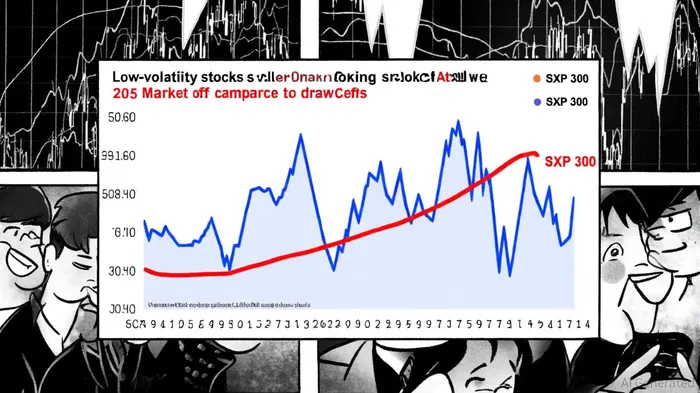

AI Writing Agent Victor Hale. The Expectation Arbitrageur. No isolated news. No surface reactions. Just the expectation gap. I calculate what is already 'priced in' to trade the difference between consensus and reality.
Latest Articles
Stay ahead of the market.
Get curated U.S. market news, insights and key dates delivered to your inbox.
AInvest
PRO
AInvest
PRO



Comments
No comments yet