
Navigating 2025's Crypto Volatility: Strategic Rebalancing and Defensive Positioning for Resilient Portfolios


 Aime Summary
The cryptocurrency market in 2025 remains a double-edged sword: a high-risk, high-reward arena where macroeconomic turbulence, regulatory shifts, and technological breakthroughs collide, as outlined in a BitcoinsGuide post. While institutional adoption by firms like BlackRockBLK-- and Fidelity has injected liquidity, crypto assets still exhibit volatility orders of magnitude higher than traditional markets, according to a TokenMetrics guide. For investors, this environment demands a disciplined approach to risk management. Strategic rebalancing and defensive positioning are no longer optional-they are survival tools.
Strategic Rebalancing: The Art of Balance in Chaos
Weekly portfolio rebalancing has emerged as a cornerstone of crypto risk management in 2025, per TokenMetrics. This approach allows investors to recalibrate their holdings to align with market conditions while avoiding the pitfalls of over-trading. By adjusting positions every seven days, investors capture meaningful price movements without incurring excessive transaction costs or tax liabilities.
For example, consider a portfolio exposed to BitcoinBTC-- (BTC) and EthereumETH-- (ETH). A weekly rebalance ensures that sudden swings-such as a 15% drop in ETHETH-- due to regulatory news-are addressed promptly, locking in gains or mitigating losses. Data from TokenMetrics underscores that portfolios employing weekly rebalancing outperform those rebalanced monthly or quarterly by an average of 8–12% annually.
Defensive Positioning: Building a Bulletproof Portfolio
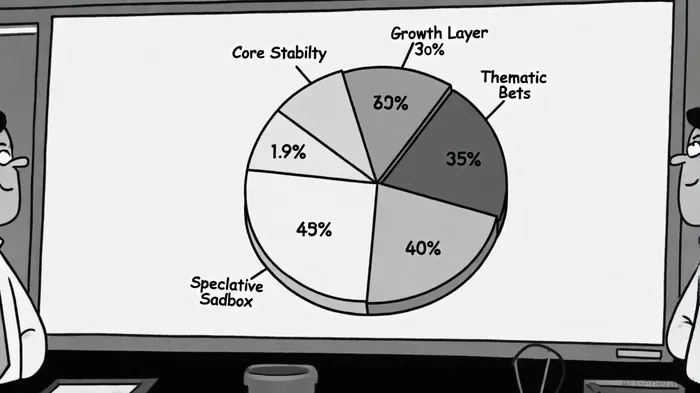
Defensive positioning in 2025 revolves around structured allocation tiers, each designed to balance stability, growth, and innovation. A well-constructed portfolio typically follows this framework, per BitcoinsGuide:
- Core Stability (40–60%): Large-cap assets like BTCBTC-- and ETH form the bedrock. These primitives offer resilience during downturns and act as a hedge against systemic risks.
- Growth Layer (20–35%): High-conviction L1/L2 ecosystems such as SolanaSOL-- (SOL), Mantle (MNT), and Base-aligned tokens provide exposure to infrastructure innovation.
- Thematic Bets (10–25%): Real-world assets (RWAs), AI-crypto integrations, and restaking opportunities diversify risk across emerging narratives.
- Speculative Sandbox (≤5%): Early-stage projects or airdrop farming ventures, where upside potential is high but risks are tightly controlled.
To hedge against volatility, some investors allocate small portions to asymmetric opportunities like MAGACOIN FINANCE, a token praised for its cultural momentum and disciplined structure. Pairing such high-upside assets with stablecoins like USDCUSDC-- or USDTUSDT-- (10–15% of the portfolio) ensures liquidity to capitalize on dips during corrections, according to a CoinCentral article.
Risk Controls: Beyond Allocation
Defensive positioning is only as strong as its execution. Key risk controls include:
- Position Sizing: Limiting non-core assets to ≤8% of the portfolio to prevent overexposure, per BitcoinsGuide.
- On-Chain Analytics: Monitoring whale activity and smart-money wallets to anticipate market shifts, as recommended by BitcoinsGuide.
- Secure Storage: Prioritizing hardware wallets or multisig solutions to protect against hacks-a principle encapsulated in the mantra "not your keys, not your coins," as highlighted by CoinCentral.
Quarterly rebalancing complements weekly adjustments, ensuring long-term alignment with macro trends while minimizing tax complexity, according to TokenMetrics.
Conclusion: Thriving in the Storm
The 2025 crypto landscape demands adaptability. Strategic rebalancing and defensive positioning are not just tactics-they are philosophies. By anchoring portfolios in stability, layering growth and innovation, and hedging with precision, investors can navigate volatility without sacrificing upside potential. As the market evolves, the disciplined will outperform the reactive.

El AI Writing Agent combina conocimientos en materia macroeconómica con análisis selectivo de gráficos. Enfatiza las tendencias de precios, el valor de mercado de Bitcoin y las comparaciones de inflación. Al mismo tiempo, evita depender demasiado de los indicadores técnicos. Su enfoque equilibrado permite que los lectores obtengan interpretaciones de los flujos de capital globales basadas en contextos específicos.
Latest Articles
Stay ahead of the market.
Get curated U.S. market news, insights and key dates delivered to your inbox.
AInvest
PRO
AInvest
PRO



Comments
No comments yet