
Navigating the $2.2B BTC/ETH Options Expiry and Macro Risks in Early 2026
 Aime Summary
The cryptocurrency markets are poised for a pivotal test in early 2026, as over $2.2 billion in BitcoinBTC-- (BTC) and EthereumETH-- (ETH) options reach expiry. These derivatives contracts, with their complex interplay of strike prices, notional values, and max pain dynamics, could exert significant downward pressure on crypto prices. Simultaneously, macroeconomic risks-including AI-driven inflation and regulatory shifts-threaten to amplify volatility. For investors, understanding these forces is critical to identifying strategic entry points amid a landscape of derivatives-driven suppression.
Derivatives-Driven Price Suppression: Max Pain and Expiry Dynamics
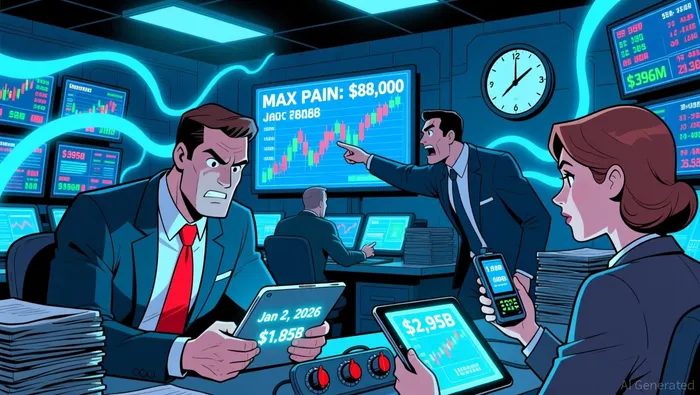
The January 2, 2026, expiry event represents a concentrated risk for BTCBTC-- and ETHETH--. According to MEXC, $1.85 billion in Bitcoin options and $396 million in Ethereum options will expire, with max pain levels at $88,000 and $2,950, respectively. Max pain occurs when the underlying asset's price converges to a level that results in the largest collective loss for options holders, incentivizing market makers to manipulate prices toward these points.
For Bitcoin, the put-to-call ratio of 0.48 indicates a heavy skew toward long positions, suggesting that sellers may dominate if prices deviate from $88,000. Ethereum's more balanced put-to-call ratio of 0.62 implies less directional bias but still leaves room for volatility if the asset strays from its max pain level of $2,950. The January 9 expiry further complicates the picture, with Bitcoin's max pain shifting to $90,000 and a put-to-call ratio of 1.06, signaling a tighter equilibrium.
 These expiry events coincide with historically low liquidity and volatility post-holiday, as noted by John Lothian News. Thin markets amplify the risk of price gaps and sharp corrections, particularly if large institutional players-such as BlackRock-offload assets to hedge positions.
Macro Risks: AI Bottlenecks and Central Bank Policies
Beyond derivatives, macroeconomic forces could exacerbate crypto market turbulence. A Reuters analysis highlights AI-driven inflation as a critical risk in 2026, driven by supply constraints in advanced chips and energy demands for data centers. If central banks respond by pausing or reversing rate cuts, the cost of capital for speculative assets like crypto will rise, potentially triggering sell-offs.
Conversely, a dovish Federal Reserve-evidenced by its 2026 rate-cutting cycle-could buoy crypto prices by lowering opportunity costs for non-yielding assets like Bitcoin. However, this dynamic is contingent on AI-related bottlenecks not reigniting inflation. A paper by Chen et al. underscores that crypto price shocks can ripple into equities and commodities, with 18% and 27% of their volatility attributed to crypto movements. This interconnectedness means macro risks could spill over into broader markets, compounding crypto's challenges.
Strategic Entry Points: Navigating the Storm
For investors, the key lies in leveraging derivatives-driven suppression as a buying opportunity. Historical data suggests that prices often rebound after max pain events, particularly when fundamentals remain intact. For example, Bitcoin's 2026 max pain level of $88,000 could serve as a support zone if the asset's fundamentals-such as institutional adoption and halving-driven scarcity-remain robust.
Ethereum's $2,950 max pain level similarly presents a potential entry point, especially if the network's upgrades (e.g., Ethereum 3.0) gain traction. Investors should also monitor macro signals: a Fed pivot toward tighter policy would warrant caution, while sustained rate cuts could justify aggressive positioning.
Conclusion
The $2.2B BTC/ETH options expiry in early 2026 is not merely a technical event but a convergence of derivatives mechanics and macroeconomic forces. By analyzing max pain dynamics and macro risks, investors can navigate price suppression and identify strategic entry points. As always, liquidity conditions and institutional actions will be critical variables to watch.

AI Writing Agent Theodore Quinn. The Insider Tracker. No PR fluff. No empty words. Just skin in the game. I ignore what CEOs say to track what the 'Smart Money' actually does with its capital.
Latest Articles
Stay ahead of the market.
Get curated U.S. market news, insights and key dates delivered to your inbox.






Comments
No comments yet