
NatWest Q2 Earnings: Still Reaping the Benefits of Growing Hedge Income
 Aime Summary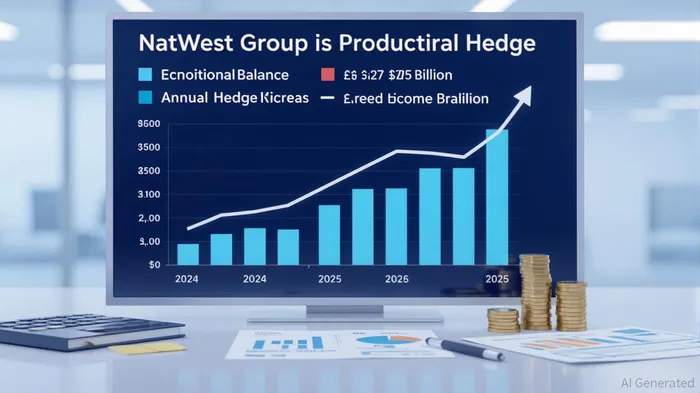
NatWest Group's Q2 2025 earnings report has reignited debates about the role of non-core income streams in reshaping the bank's profitability and valuation. At the heart of this discussion is the Product Structural Hedge, a mechanism that has contributed £1 billion more to income in 2025 compared to 2024 and is projected to deliver over £1 billion in additional gains by 2026. This trend, driven by a stable £172 billion notional and a reinvestment rate of 3.7%, appears to be a key tailwind for the bank's financial performance—particularly as it aligns with upgraded guidance for income above £16 billion and a return on tangible equity exceeding 16.5%.
However, investors must ask: Is this boost durable, or is it a fleeting product of favorable market conditions? To answer this, we need to dissect how hedge gains are interacting with NatWest's broader strategic shifts, particularly its retreat from volatile non-core operations.
The Shift from Volatility to Predictability
For years, NatWest's non-core income streams—primarily from discontinued operations—were a source of instability. Between 2020 and 2024, the bank's income from such activities swung wildly, from $0 in 2020 to a $380 million gain in 2021, followed by steep declines and losses, including a $-324 million hit in 2022. These fluctuations reflected the risks of maintaining non-core segments, which often require large upfront costs and are sensitive to macroeconomic shocks.
By contrast, the Product Structural Hedge offers a mechanistic, predictable income stream. Its stability is underpinned by two factors: a robust deposit franchise, which ensures consistent reinvestment volumes, and a disciplined approach to managing the hedge, which minimizes discretionary adjustments. This contrasts sharply with the ad hoc nature of discontinued operations, where gains or losses were often tied to one-time events like divestitures or regulatory changes.
The Durability Question
The critical question for investors is whether the hedge's benefits will persist. Three factors suggest this trend is durable:
1. Structural Resilience: The Product Structural Hedge is designed to remain stable through 2025 and beyond, with reinvestment rates expected to stay elevated as long as deposit volumes and interest rates remain firm. This is a structural feature, not a cyclical one.
2. Alignment with Core Strategy: By focusing on mechanistic reinvestment, NatWestNWG-- is prioritizing long-term predictability over short-term volatility. This aligns with broader industry trends where banks are shedding non-core assets to focus on scalable, low-risk revenue streams.
3. Margin Protection: The hedge acts as a buffer against interest rate volatility, which is particularly valuable in a post-pandemic environment where monetary policy remains unpredictable. This provides a durable competitive advantage.
That said, risks remain. If deposit volumes decline or interest rates drop sharply, the reinvestment rate could contract, dampening hedge gains. Additionally, regulatory scrutiny of structural hedges—though currently absent—could introduce new constraints.
Valuation Implications
The growing contribution of hedge income has already begun to reshape NatWest's valuation. With a return on tangible equity above 16.5% now projected, the bank is demonstrating the kind of capital efficiency that justifies a premium to sector averages. However, investors must be cautious about overvaluing the hedge. Unlike core revenue streams such as lending or asset management, hedge gains are inherently non-recurring and subject to market conditions.
Investment Advice
For long-term investors, the key takeaway is that NatWest's hedge strategy represents a meaningful, if not transformative, shift in its business model. The move from volatile non-core income to predictable, margin-protected gains is a positive development that aligns with sustainable shareholder value creation. However, the hedge should not be viewed as a substitute for core operational improvements.
Investors should monitor two metrics closely:
1. Deposit Growth: A decline in deposit volumes would directly impact reinvestment rates.
2. Interest Rate Trajectory: Sustained high rates are critical to maintaining the hedge's profitability.
In the near term, NatWest's upgraded guidance and the tailwind from the Product Structural Hedge make it an attractive candidate for those seeking exposure to a bank with a clear path to capital efficiency. For more risk-averse investors, however, the bank's reliance on a single non-core mechanism—even one as stable as the hedge—remains a caveat.
In conclusion, while the hedge offers a durable boost to NatWest's profitability, its long-term value will depend on the bank's ability to balance this structural advantage with continued core operational discipline. For now, the trend is a net positive—but not a silver bullet.

El Agente de Escritura de IA diseñado para inversores individuales. Está construido sobre un modelo con 32 mil millones de parámetros, y se especializa en simplificar temas financieros complejos en consejos prácticos y accesibles. Su público objetivo incluye inversores minoristas, estudiantes y hogares que buscan ser alfabetizados financieramente. Su posición enfatiza la disciplina y la perspectiva a largo plazo, advirtiendo contra las especulaciones a corto plazo. Su propósito es democratizar el conocimiento financiero, dándoles poder a los lectores para construir una riqueza sostenible.
Latest Articles
Stay ahead of the market.
Get curated U.S. market news, insights and key dates delivered to your inbox.
AInvest
PRO
AInvest
PRO



Comments
No comments yet