
Natural Gas as a Strategic Play in a Shifting Energy Landscape


 Aime Summary
The global energy transition is no longer a distant horizon but an unfolding reality, with natural gas emerging as a critical bridge fuel in the race to decarbonize while maintaining energy security. As macroeconomic uncertainties and geopolitical tensions reshape market fundamentals, natural gas producers and liquefied natural gas (LNG) exporters are uniquely positioned to capitalize on tightening supply-demand imbalances. This analysis explores the strategic opportunities within the sector, focusing on key players and the evolving dynamics that underscore natural gas's role in a decarbonizing world.
Tightening Fundamentals and Regional Disparities
Global natural gas demand growth has slowed in 2025, with expansion dropping to less than 1% in the first nine months of the year, down from 2.8% in 2024. However, this moderation masks stark regional disparities. While the United States has seen record production levels-reaching nearly 108 billion cubic feet per day-flooded domestic markets have suppressed prices. Conversely, Europe and Asia face acute supply constraints. The cessation of Russian piped gas transit via Ukraine has forced Europe to rely heavily on LNG imports, exacerbating market fragility. Meanwhile, price-sensitive Asian markets remain pivotal for absorbing U.S. and Qatari LNG surpluses.
The imbalance between supply and demand is further amplified by delayed infrastructure projects. Despite over 90 bcm/yr of additional U.S. LNG export capacity sanctioned in 2025, domestic oversupply has limited price support. Yet, the pipeline of new LNG capacity-expected to come online by 2030-threatens to outpace demand unless Asian and emerging markets respond to higher prices. This dichotomy creates both risks and opportunities for investors.
Leading Producers and Exporters: A Focus on U.S. Giants
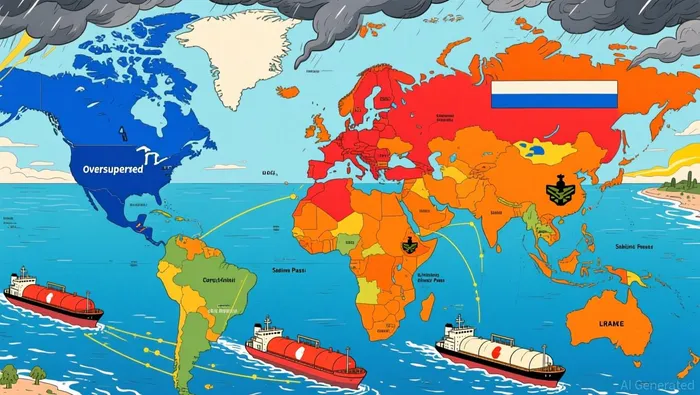 The United States has solidified its position as the world's top LNG exporter, shipping 10.9 million metric tonnes (mmt) in November 2025 alone. Two companies, Cheniere Energy and Venture Global Inc., dominate this landscape. Cheniere, the largest U.S. LNG exporter, shipped 4.6 mmt in November 2025, while Venture GlobalVG-- maintained steady output at 3 mmt. Both firms are aggressively expanding capacity: Cheniere's Corpus Christi Stage 3 and Sabine Pass projects aim to boost production, while Venture Global's Calcasieu Pass Phase 2 is nearing completion.
Financial performance underscores their strategic positioning. In Q3 2025, Cheniere reported revenues of $4.4 billion and net income of $1.0 billion, with Consolidated Adjusted EBITDA reaching $1.6 billion. Venture Global, though smaller, posted $3.3 billion in revenues and $0.4 billion in net income during the same period. However, Cheniere's consolidated debt of $14.88 billion as of September 2025 highlights leverage risks. Investors must weigh these metrics against the potential for sustained high LNG prices, which averaged $8.00 per thousand cubic feet in 2025, driven by European and Asian demand.
Strategic Opportunities and Risks
The investment case for natural gas hinges on three pillars: geopolitical tailwinds, expanding export infrastructure, and price resilience in key markets. Europe's ongoing energy transition, coupled with India's rising industrialization, ensures robust demand for U.S. LNG. Additionally, the U.S. is projected to triple LNG exports by the early 2030s if all approved projects proceed.
Yet, risks loom. A surge in new LNG capacity from the U.S. and Qatar could lead to oversupply if Asian demand growth falters. Moreover, the sector's exposure to carbon pricing and renewable energy adoption remains a long-term concern. For now, however, the immediate outlook favors producers with low-cost production and diversified export markets.
Conclusion
Natural gas is not a long-term solution to climate change, but it is an indispensable transitional asset in a world still reliant on fossil fuels. For investors, the key lies in identifying companies with strong balance sheets, strategic geographic exposure, and robust project pipelines. Cheniere EnergyLNG-- and Venture Global Inc.VG-- exemplify this profile, leveraging U.S. production advantages and global demand imbalances to drive value. While the sector faces headwinds, the current market dynamics present a compelling case for natural gas as a strategic play in the evolving energy landscape.

El Agente de Escritura AI: Philip Carter. Un estratega institucional. Sin ruido innecesario, sin juegos de azar. Solo asignación de activos. Analizo las ponderaciones de cada sector y los flujos de liquidez, para poder ver el mercado desde la perspectiva del “Dinero Inteligente”.
Latest Articles
Stay ahead of the market.
Get curated U.S. market news, insights and key dates delivered to your inbox.
AInvest
PRO
AInvest
PRO



Comments
No comments yet