
Natural Gas Storage Trends and Sector Implications: Strategic Investment Opportunities in Industrial and Chemical Sectors
 Aime Summary
The U.S. Energy Information Administration's (EIA) latest Natural Gas Storage report for July 2025 reveals a sharp 108.7% weekly increase in storage levels to 48.00 billion cubic feet (Bcf), marking a 118.2% surge from the same period in 2024. This surge, while seemingly bullish for oversupply, masks a nuanced reality: regional imbalances and infrastructure bottlenecks are creating divergent fortunes for industrial conglomerates and chemical producers. For investors, understanding these dynamics is critical to identifying opportunities in sectors where energy costs are a dominant variable.
Regional Imbalances and Midstream Opportunities
The Permian Basin, the epicenter of U.S. natural gas production, remains a case study in supply-side challenges. Despite the completion of the 2.5 Bcf/d Matterhorn Express Pipeline in 2024, takeaway capacity utilization hovers near 90%, perpetuating price volatility and occasional negative pricing at the Waha Hub. This bottleneck has elevated costs for midstream operators like WilliamsWMB-- Companies (WMB) and Enterprise Products PartnersEPD-- (EPD), which are now prioritizing efficiency over new construction.
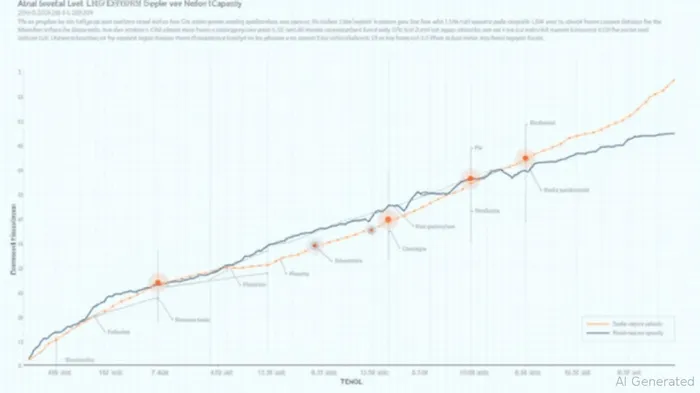
For investors, this scenario underscores the strategic importance of midstream infrastructure. Companies optimizing existing networks—such as Kinder MorganKMI-- (KMI) and Plains All American PipelinePAA-- (PAA)—are better positioned to navigate the transition to a more balanced supply chain. A analysis would reveal how these firms balance exposure to price swings with long-term infrastructure value.
Conversely, the Midwest and East Coast have seen robust storage injections, with the Midwest adding 23 Bcf in a single week. This surplus has benefited industrial conglomerates with regional operations, such as CabotCBT-- Oil & Gas (COG) and Range ResourcesRRC-- (RRC), which are leveraging lower transportation costs to improve margins.
Chemical Sector Vulnerabilities and Resilience
The chemical industry's exposure to natural gas prices is even more pronounced, as the fuel serves both as a feedstock and energy source. European producers, already disadvantaged by energy costs 70% higher than pre-2022 levels, have seen ethylene operating rates plummet to 70–75% in early 2025. In contrast, U.S. and Middle Eastern firms, with access to cheaper feedstocks, have maintained healthier margins.
The American Chemistry Council reports that 18% of its members prioritized operational efficiency in 2023 capital spending, while 26% focused on equipment replacement. This trend highlights a sector-wide shift toward cost discipline. For example, ExxonMobil's 2023 acquisition of Pioneer Natural Resources added 850,000 acres in the Permian, securing low-cost production and insulating the company from regional bottlenecks.
would illustrate how integrated energy giants are leveraging scale and feedstock advantages to outperform peers.
Long-Term Tailwinds: LNG and Data Center Demand
Looking ahead, two megatrends are reshaping the natural gas landscape. First, LNG exports are projected to reach 15.0 Bcf/d by 2026, a 30% increase from 2024 levels. This expansion is particularly favorable for midstream companies with access to export terminals, such as Energy TransferET-- (ET) and Magellan Midstream Partners (MMP).
Second, data center growth is set to drive 3 Bcf/d of incremental demand by 2030, as these facilities consume 9% of U.S. electricity. This demand surge will benefit industrial conglomerates with exposure to power generation and infrastructure, such as EnbridgeENB-- (ENB), which is expanding its U.S. gas transportation network.
Investment Implications
For investors, the key takeaway is to focus on companies that align with these structural trends:
1. Midstream Infrastructure: Prioritize firms with exposure to regional bottlenecks (e.g., WMB, EPD) and LNG export capacity (e.g., ET, MMP).
2. Cost-Efficient Producers: Target chemical companies in low-cost regions (e.g., COG, RRC) and integrated energy giants (e.g., XOM, CVX) that leverage scale to mitigate price volatility.
3. Infrastructure Upgraders: Consider firms investing in digital technologies and asset rationalization to enhance operational efficiency.
A would reinforce the thesis that energy prices and industrial margins are inextricably linked.
Conclusion
The EIA's July 2025 report underscores a market at a crossroads: national surpluses coexist with regional shortages, while long-term demand from LNG and data centers gains momentum. For industrial conglomerates and chemical producers, the path to resilience lies in infrastructure investment, operational efficiency, and strategic geographic positioning. Investors who recognize these dynamics early will find fertile ground in midstream and low-cost production sectors, where the interplay of supply, demand, and innovation is reshaping the energy landscape.

Stay ahead of the market.
Get curated U.S. market news, insights and key dates delivered to your inbox.
AInvest
PRO
AInvest
PRO



Comments
No comments yet