
Natural Gas Market Volatility: Navigating the Impact of Weather Forecasts and Inventory Levels
 Aime Summary
In the summer of 2025, the U.S. natural gas market is caught in a delicate balancing act. On one hand, storage levels are rising, providing a buffer against price swings. On the other, record-breaking heat and surging power demand threaten to tighten supply chains just as liquefied natural gas (LNG) exports reach record highs. For investors, this creates a unique opportunity to position portfolios for both short-term volatility and long-term structural shifts.
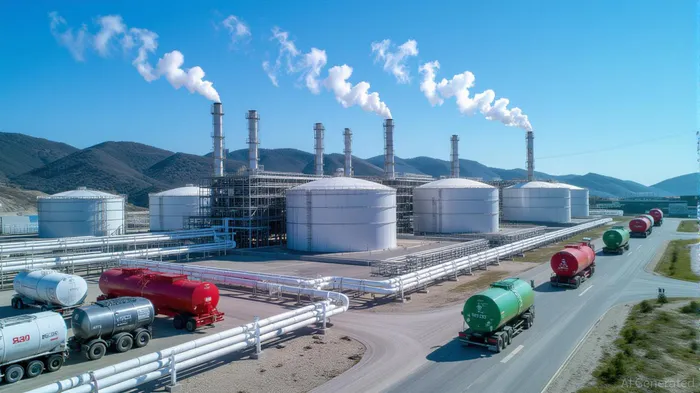
Inventory Levels: A Shield Against Volatility
The U.S. Energy Information Administration (EIA) reported a net injection of 23 billion cubic feet (Bcf) in the week ending July 18, 2025, pushing total working gas in storage to 3,075 Bcf. While this is 5% below the same period in 2024, it remains 6% above the five-year average. This surplus has been a stabilizing force for prices, reducing the historical volatility index from 81% in Q4 2024 to 69% by mid-2025.
However, regional disparities persist. The South Central Salt region experienced a 5 Bcf withdrawal, highlighting localized bottlenecks. In contrast, the Midwest and East regions added 23 Bcf and 634 Bcf, respectively, underscoring the importance of infrastructure investments in midstream operators like WilliamsWMB-- Companies (WMB) and Enterprise Products PartnersEPD-- (EPD).
The EIA projects that if current injection rates continue, inventories will reach 3,924 Bcf by October 31, 2025—171 Bcf above the five-year average. This trajectory suggests a market that is less prone to sudden price shocks but not immune to seasonal or geopolitical disruptions.
Weather Forecasts: The Wild Card in Demand
The National Oceanic and Atmospheric Administration (NOAA) predicts above-normal temperatures for much of the U.S. through early July, with coastal areas of the Carolinas and Virginia facing an 80% likelihood of heat waves. Cooling degree days (CDDs) have already surged, with Louisiana and Texas recording 136 and 129 CDDs, respectively, as of early July.
This has driven natural gas consumption in the power sector to 49.1 billion cubic feet per day (bcfd) in July, a record high. The EIA forecasts that June power consumption will rise 25.7% compared to May, with production expected to grow 0.4% month-over-month. While residential and commercial consumption dipped 10.5% week-over-week, industrial demand softened by just 0.7%, indicating resilience in manufacturing sectors.
Investors should monitor weather patterns closely. A prolonged heatwave could force a drawdown on inventories, pushing prices higher. Conversely, a return to normal temperatures could ease demand pressures and stabilize prices.
Long-Term Dynamics: Production, Exports, and Storage
Looking ahead, the EIA forecasts that U.S. natural gas production will remain stable at 116 bcfd through 2026, with the Permian Basin leading growth at 27.0 bcfd in 2025. However, production is expected to flatten in 2026 as gains from the Permian and Appalachia regions offset declines elsewhere.
LNG exports, meanwhile, are set to rise to 16 bcfd in 2026, driven by expanding export terminals in the Gulf of Mexico. This growth is a double-edged sword: while it boosts U.S. revenue, it also tightens the domestic supply-demand balance, particularly during peak summer demand.
Storage levels will play a critical role in mitigating this tension. The EIA projects that by October 31, 2025, inventories will reach 3,910 Bcf—3% above the five-year average. This buffer could cushion the market against unexpected supply shocks, but it may not be enough if summer cooling demand remains elevated.
Strategic Positioning for Investors
For energy investors, the key lies in diversifying exposure across sectors and geographies:
Midstream Infrastructure: Companies like Kinder MorganKMI-- (KMI) and Plains All American PipelinePAA-- (PAA) are well-positioned to benefit from regional bottlenecks and pipeline expansions. The completion of the Matterhorn Express Pipeline, adding 2.5 Bcf/d of capacity, is a case in point.
LNG Exporters: Cameron LNG (CAML) and Elba Island LNG (EIL) are set to capitalize on the global demand for U.S. natural gas. With exports projected to reach 16 bcfd in 2026, these firms could see significant revenue growth.
Regional Producers: The Permian Basin, now producing 27.0 bcfd, remains a cornerstone of U.S. production. Producers like Exxon MobilXOM-- (XOM) and ChevronCVX-- (CVX) are expanding operations through acquisitions and operational efficiency.
Power Sector Exposure: As data centers consume 9% of U.S. electricity by 2030, adding 3 bcfd of natural gas demand, utilities with strong gas-fired generation capacity could see long-term growth.
Conclusion: Balancing Risk and Reward
The natural gas market in 2025 is a study in contrasts: stable inventories versus surging demand, regional bottlenecks versus national infrastructure growth, and short-term volatility versus long-term structural trends. For investors, the challenge is to anticipate these shifts and position portfolios accordingly.
Those who focus on midstream operators, LNG exporters, and regional producers are likely to weather the storm. Meanwhile, a diversified approach—combining infrastructure plays with exposure to power sector demand—offers a hedge against both price corrections and supply shocks.
In this dynamic environment, patience and precision will be rewarded. The key is to stay ahead of the curve, not just in terms of market moves, but in understanding the forces that drive them.

Delivering real-time insights and analysis on emerging financial trends and market movements.
Latest Articles
Stay ahead of the market.
Get curated U.S. market news, insights and key dates delivered to your inbox.
AInvest
PRO
AInvest
PRO



Comments
No comments yet