
Natural Gas Market Resurgence: Is Now the Time to Buy In?


 Aime Summary
Commodity Momentum: Cold Weather, LNG Demand, and Storage Dynamics
The immediate catalyst for the price surge is the interplay of winter demand and supply constraints. Colder-than-normal temperatures in the Northeast have pushed Algonquin Citygate prices to $25.00/MMBtu, a $16.92 spike, as heating demand outstripped supply. Meanwhile, U.S. LNG exports hit 10.7 million tonnes annually in November 2025, a 40% year-over-year increase, as Europe's reduced reliance on Russian gas redirects demand to U.S. producers.
Storage levels, however, remain a mixed signal. While working gas in storage sits in the top 6% of its five-year range, analysts argue that infrastructure resilience-particularly in Texas-has mitigated supply shocks. This suggests that the market's current tightness is not merely a function of inventory depletion but also of logistical and geopolitical factors.
Energy Transition Dynamics: Natural Gas as a Bridge Fuel
Natural gas's role in the energy transition is reshaping long-term demand fundamentals. Major energy firms like ExxonMobilXOM-- and ShellSHEL-- are doubling down on LNG as a transitional asset. ExxonMobil plans to allocate $30 billion of its 2025–2030 CAPEX to lower-emissions initiatives, including carbon capture and hydrogen projects, while expanding advantaged natural gas assets. Shell, meanwhile, aims to grow LNG sales by 4–5% annually through 2030, positioning itself as the "leading integrated gas and LNG business." 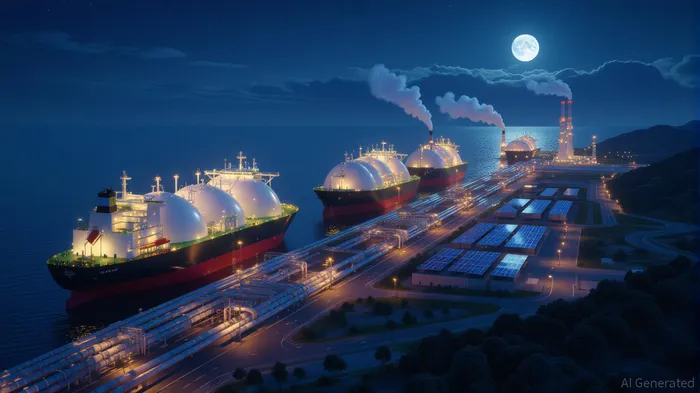
The U.S. Energy Information Administration (EIA) projects that natural gas demand will rise to $4.20/MMBtu in 2026, driven by new LNG export projects like Golden Pass and Corpus Christi Stage 3, which will add 2.1 Bcf/d of capacity by year-end. This aligns with broader trends: BloombergNEF forecasts a 25% increase in global natural gas demand from 2024 to 2050, driven by its lower emissions profile compared to coal and its role in balancing intermittent renewables.
Speculative Trading and Market Volatility
Speculative activity further amplifies price volatility. Money managers' long positions in natural gas futures have surged, with traders bracing for winter demand and the December 12 storage report. Historical data shows that speculative bets can precede price movements, particularly in bearish markets, but during bullish phases, long positions tend to stabilize explosive gains. This duality suggests that while short-term momentum is robust, overleveraged positions could trigger corrections if fundamentals weaken.
Sustainability of the Rally: Balancing Risks and Opportunities
The question of sustainability hinges on three factors:
1. Winter Weather and Storage Replenishment: The EIA forecasts a peak winter price of $4.25/MMBtu in January 2026, but milder-than-expected temperatures or rapid storage replenishment could curb prices.
2. LNG Export Capacity: With U.S. LNG exports exceeding 17 Bcf/day, new projects will sustain demand through 2026. However, global competition from Russia and Qatar could temper U.S. market share.
3. Energy Transition Trade-offs: While natural gas is a bridge fuel, its long-term role is clouded by decarbonization goals. Only 32% of energy executives now expect net-zero emissions by 2050, down from prior years, signaling potential regulatory and technological headwinds.
Price Forecasts and Strategic Implications
Major firms and analysts offer a range of forecasts:
- EIA: Averaging $3.90/MMBtu in winter 2025–2026, with a peak of $4.25/MMBtu in January 2026.
- Morgan Stanley: A $5.00/MMBtu target by early 2026, citing cold weather and record LNG flows.
- BloombergNEF: A 25% demand increase through 2050, with LNG as a key driver.
For investors, the current rally reflects both cyclical and structural forces. Short-term gains are likely supported by winter demand and LNG dynamics, but long-term exposure requires confidence in natural gas's role amid accelerating renewables adoption.
Conclusion: A Calculated Entry Point
The natural gas market's resurgence is underpinned by immediate demand pressures and energy transition tailwinds. While speculative trading and weather volatility pose risks, the sector's alignment with LNG expansion and decarbonization strategies suggests a durable bull case through 2026. Investors should monitor storage reports, geopolitical developments, and firm CAPEX plans-particularly from ExxonMobil and Shell-to gauge the trend's longevity. For now, the confluence of momentum and transition logic makes natural gas a compelling, though cautiously timed, investment.

Delivering real-time insights and analysis on emerging financial trends and market movements.
Latest Articles
Stay ahead of the market.
Get curated U.S. market news, insights and key dates delivered to your inbox.
AInvest
PRO
AInvest
PRO



Comments
No comments yet