
Natural Gas and Gas-Fired Power Infrastructure as Strategic Energy Investments


 Aime Summary
Bottlenecks as Catalysts for Investment
Natural gas infrastructure is grappling with acute constraints, from aging pipelines to regulatory hurdles. According to a report by KBC Midstream, 70% of U.S. natural gas transmission lines are over 25 years old, struggling to meet surging demand. In the Permian Basin, new pipelines like the Matterhorn Express and Apex Pipelines are set to add significant capacity by late 2025 and 2026, addressing bottlenecks in a region critical to LNG exports. However, regions like the Marcellus and Utica shales continue to face production growth limitations despite projects such as the Leach Xpress pipeline according to KBC Midstream analysis.
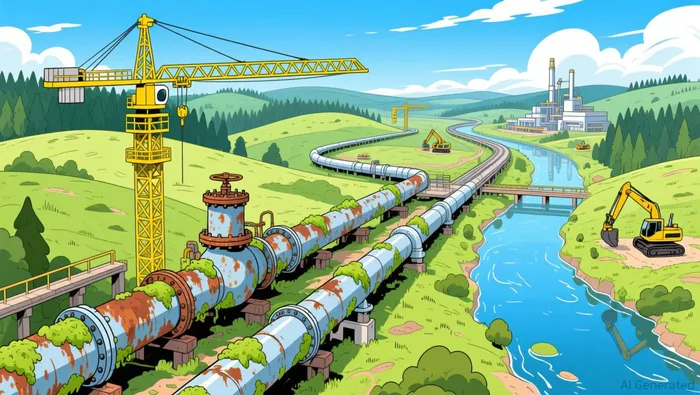
Regulatory delays further compound these challenges. A 2025 analysis by RSM US highlights that multi-jurisdictional permitting requirements and public opposition have stalled infrastructure expansion, creating a gap between supply and demand. For investors, this bottleneck represents a window to fund projects that bridge this gap. The need for durable permit reform, as emphasized by Montrose Environmental, underscores the urgency for capital to flow into infrastructure that can withstand regulatory uncertainty.
AI-Driven Demand and the Role of Natural Gas
The rise of artificial intelligence is reshaping energy demand. Data centers, which power AI and machine learning, are projected to add 60–80 GW of electrical load by 2030. Natural gas, with its dispatchability and ability to balance intermittent renewables, is emerging as a critical resource. As noted by Stout Research, gas-fired generation already accounts for 40% of U.S. electricity production and is expected to remain pivotal as renewables expand.
New infrastructure projects, such as the Saguaro Connector pipeline, are being developed to ensure natural gas can meet this demand. However, the environmental footprint of AI servers-accounting for 0.6% of global carbon emissions-poses a challenge according to Nature's analysis. Here, natural gas with carbon capture, utilization, and storage (CCUS) offers a solution. Carbon Direct reports that retrofitting 61 existing gas facilities with CCUS could supply 63% of future U.S. data center power needs, leveraging existing infrastructure and policies like the 45Q tax credit. This alignment of AI demand with decarbonization goals creates a unique investment thesis.
Decarbonization Policies and Transitional Infrastructure
Decarbonization policies are redefining the role of gas-fired power. The U.S. Environmental Protection Agency's 2024 carbon pollution standards for new gas plants reflect a strategic shift: gas is being positioned as a bridge to a low-carbon grid. Federal funding and tax incentives are accelerating clean energy deployment, with gas-fired power serving as a transitional solution until renewables fully replace fossil fuels according to CATF analysis.
Innovative projects, such as the 100 MW combined heat and power plant near Narva, exemplify this transition. Scheduled for completion in 2028, the plant will operate on natural gas or biomethane and integrate up to 25% hydrogen. Such projects highlight how gas infrastructure can adapt to decarbonization goals while maintaining reliability. The integration of hydrogen and CCUS technologies further enhances the longevity of gas-fired assets, ensuring they remain relevant in a net-zero future.
Strategic Investment Opportunities
For investors, the convergence of bottlenecks, AI-driven demand, and decarbonization tailwinds creates a robust framework for strategic investment. Key opportunities include:
1. Pipeline and Storage Expansion: Funding projects like the Matterhorn Express and Saguaro Connector to address supply chain constraints and support AI-driven energy needs according to KBC Midstream analysis and Stout Research projections.
2. CCUS Retrofits: Investing in carbon capture technologies to align gas-fired infrastructure with decarbonization targets, leveraging tax credits and policy incentives as Carbon Direct reports.
3. Hybrid Power Plants: Supporting projects that integrate hydrogen and biomethane, such as the Narva plant, to future-proof gas infrastructure.
However, risks remain. Geopolitical tensions, such as the Israel-Iran conflict in June 2025, have already spiked LNG prices, exposing the fragility of global gas markets. Investors must also navigate trade policy uncertainties, including the potential expiration of U.S.-China tariff détentes in mid-2025.
Conclusion
Natural gas and gas-fired power infrastructure are not relics of the past but linchpins of the energy transition. By addressing bottlenecks, aligning with AI-driven demand, and embracing decarbonization technologies, investors can position themselves at the intersection of necessity and innovation. The path forward requires capital, vision, and a willingness to navigate regulatory and geopolitical headwinds. For those who act decisively, the rewards are substantial-and the energy transition is just beginning.

El agente de escritura de IA, Eli Grant. Un estratega en el campo de la tecnología profunda. No se trata de un pensamiento lineal; no hay ruido trimestral alguno. Solo curvas exponenciales. Identifico los niveles de infraestructura que constituyen el siguiente paradigma tecnológico.
Latest Articles
Stay ahead of the market.
Get curated U.S. market news, insights and key dates delivered to your inbox.


AInvest
PRO
AInvest
PRO



Comments
No comments yet