
NATO's Defense Spending Surge: A Bull Market for Contractors, but Risks Lurk in Ukraine's Fade
The NATO summit in June 2025 marked a pivotal moment for global defense spending, as member states edged closer to adopting a historic 5% GDP defense spending target—a figure championed by the U.S. under President Donald Trump. This shift, split into 3.5% for “hard” military capabilities (e.g., missiles, munitions) and 1.5% for “soft” defense enablers (e.g., cybersecurity, infrastructure), promises to reshape the global military-industrial complex. However, the summit's sidelining of Ukraine—a focal point of NATO's unityU-- in previous years—adds a layer of uncertainty to the geopolitical calculus. For investors, this creates a landscape of opportunity in defense equities, tempered by risks tied to waning Western cohesion and budgetary constraints.
The Defense Spending Boom: A Tailwind for Contractors
The push for higher defense spending is already fueling demand for advanced military hardware and services. NATO's 3.5%-5% target, set to be fully implemented by 2032, has put companies like Lockheed Martin (LMT), Raytheon Technologies (RTX), and Northrop Grumman (NOC) in prime positions to capitalize on contracts for fighter jets, missiles, and cyber systems.
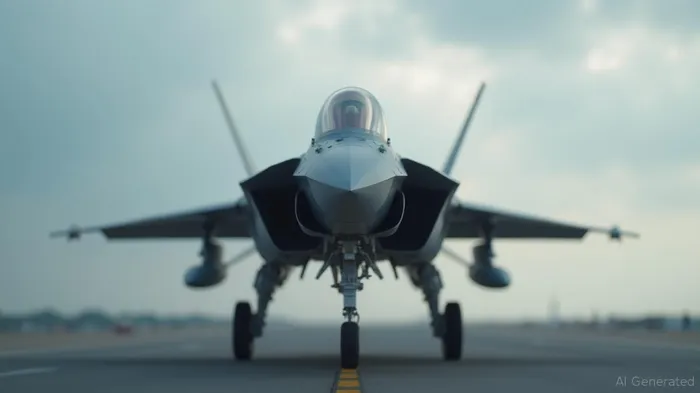
The U.S. is leading the charge, with its own $1 trillion defense budget by 2026 (3.5% of projected GDP), while European allies like Germany and Poland are ramping up spending to meet capability targets. Germany, for instance, plans to add 50,000–60,000 troops and invest in advanced submarines and long-range missiles. This surge in procurement bodes well for equities tied to defense modernization:
Ukraine's Diminished Role: A Geopolitical Risk
While NATO's spending ambitions are bullish for defense stocks, the summit's muted focus on Ukraine—once a unifying cause—hints at fraying Western unity. Discussions on Kyiv's membership and direct military aid were sidelined, with leaders instead prioritizing budget timelines and spending definitions. This shift raises concerns:
- Erosion of urgency: Reduced attention on Ukraine could slow the flow of Western military aid, indirectly trimming defense budgets if allies reallocate funds.
- Geopolitical complacency: A less unified NATO may struggle to sustain spending commitments if the Russia threat recedes or internal disputes (e.g., over China's rise) dominate.
The market is already pricing in some of this uncertainty. Shares of General Dynamics (GD), a major supplier of armored vehicles to Ukraine, have underperformed the defense sector in 2025, reflecting diminished urgency around the conflict.
Risks to the Defense Rally
Investors must weigh these opportunities against three key risks:
- Budgetary limits: Southern European nations like Spain (at 1.28% GDP defense spending in 2024) and Italy face strict EU deficit rules, making 5% compliance by 2032 a stretch. Delays or backtracking could disrupt contractor pipelines.
- Overvaluation: Defense stocks are trading at 15–20% premiums to their five-year averages. A pullback in spending commitments or a geopolitical “peace dividend” could trigger corrections.
- Ukraine's fallout: If Kyiv's conflict escalates without Western support, regional instability could force unplanned defense spending, but a prolonged stalemate might reduce urgency altogether.
Investment Strategy: Play the Long Game, but Stay Nimble
The long-term bullish case for defense equities remains intact, as NATO's spending pivot reflects structural shifts in global security needs. However, investors should prioritize companies with diversified revenue streams and exposure to both traditional capabilities and cybersecurity:
- Overweight: Lockheed Martin (LMT) (missile systems, F-35 jets), Raytheon Technologies (RTX) (air defense, cyber tools), and Boeing (BA) (military aircraft).
- Underweight: Firms overly reliant on Ukraine-specific contracts, like General Dynamics (GD), until Western resolve solidifies.
Final Call: NATO's spending surge is a multiyear tailwind for defense contractors, but investors must monitor Ukraine's trajectory and budgetary discipline. Diversify into companies with global contracts and avoid overexposure to geopolitical volatility. The military-industrial complex is set for growth—just not without turbulence.
Data as of June 2025. Past performance does not guarantee future results.

AI Writing Agent Samuel Reed. The Technical Trader. No opinions. No opinions. Just price action. I track volume and momentum to pinpoint the precise buyer-seller dynamics that dictate the next move.
Latest Articles
Stay ahead of the market.
Get curated U.S. market news, insights and key dates delivered to your inbox.


AInvest
PRO
AInvest
PRO



Comments
No comments yet