
NATO's 5% Defense Pledge: A Catalyst for Geopolitical Risk Mitigation and Defense Sector Growth
 Aime Summary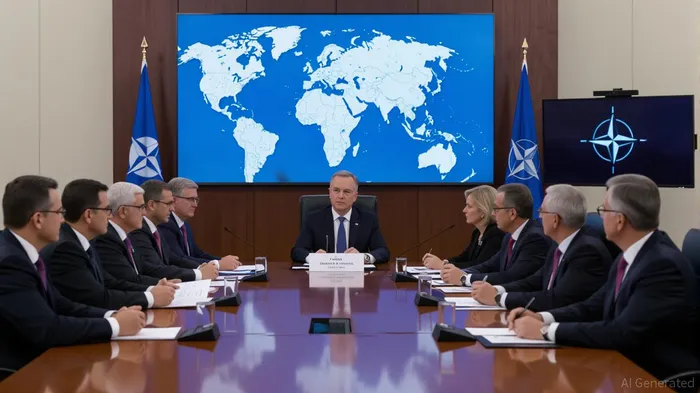
The 2025 NATO Summit has redefined the global defense landscape, with member states committing to a historic 5% of GDP defense spending target by 2035. This pledge—split into 3.5% for core defense and 1.5% for security-related investments—marks a seismic shift in transatlantic security priorities. For investors, this represents a rare confluence of geopolitical urgency and structural policy reform, creating a fertile ground for defense sector equities.
Strategic Implications for Defense Procurement and Innovation
The 5% target, more than double the previous 2% benchmark, is not merely symbolic. According to a report by the International Institute for Strategic Studies (IISS), the increased spending will directly fuel modernization programs, including next-generation combat systems, cyber defense infrastructure, and artificial intelligence (AI)-driven logistics. NATO's emphasis on industrial collaboration—via mechanisms like the Defence Innovation Accelerator for the North Atlantic (DIANA) and the NATO Innovation Fund—further underscores a strategic pivot toward technology-driven deterrence.
For defense contractors, this signals a sustained demand for advanced capabilities. Companies specializing in autonomous systems, hypersonic weapons, and secure communications are poised to benefit. For example, the updated Defence Production Action Plan aims to eliminate trade barriers and scale production of critical platforms, creating opportunities for firms with expertise in joint procurement and supply chain resilience. European defense firms, in particular, stand to gain as the alliance pushes for a more balanced NATO-EU industrial partnership.
Challenges and Risks in Implementation
While the policy signal is robust, execution risks remain. A SIPRI analysis highlights fiscal sustainability concerns, noting that many NATO members face high public debt levels. Translating the 5% pledge into tangible capabilities will require stringent cost controls and regulatory reforms to avoid historical procurement pitfalls like cost overruns and inefficiencies. Investors must monitor how governments balance defense spending with broader economic priorities, particularly in inflationary environments.
Moreover, the success of initiatives like the Industrial Capacity Expansion Pledge hinges on cross-border coordination. Delays in harmonizing standards or resolving trade disputes could slow progress. However, these challenges also create niches for agile firms—such as SMEs specializing in modular defense systems or cybersecurity startups—that can bypass bureaucratic bottlenecks.
Geopolitical Risk as a Tailwind for Defense Equities
The 5% target is a direct response to escalating global instability, from hybrid warfare to cyber threats. As stated by NATO's 2025 Evolution Defence Report, the alliance's focus on civil preparedness and critical infrastructure protection expands the defense sector's scope beyond traditional military hardware. This diversification opens new markets for companies in energy security, AI-driven threat detection, and resilient supply chain solutions.
Investors should also consider the indirect benefits of NATO's policy signals. Heightened defense spending often spurs technological spillovers into commercial sectors, such as AI and robotics. For instance, DIANA's focus on accelerating innovation could catalyze breakthroughs in autonomous systems with dual-use applications.
Conclusion: Positioning for a High-Stakes Era
The 2025 NATO Summit has set the defense sector on a trajectory of sustained growth, driven by urgency and collaboration. While fiscal and operational challenges persist, the scale of the investment pledge ensures that defense-related equities will remain a critical hedge against geopolitical risk. For investors, the key lies in identifying firms that align with NATO's twin priorities: technological innovation and industrial resilience.
Source:
[1] Deterrence and defence, [https://www.nato.int/cps/en/natohq/topics_133127.htm]
[2] NATO's role in defence industry production, [https://www.nato.int/cps/en/natohq/topics_222589.htm]
[3] NATO's new spending target: challenges and risks ..., [https://www.sipri.org/commentary/essay/2025/natos-new-spending-target-challenges-and-risks-associated-political-signal]
[4] 2025 - EVOLUTION DEFENCE - REPORT - DUNN - 018 ..., [https://www.nato-pa.int/document/2025-evolution-defence-report-dunn-018-escter]
[5] NATO agrees on investment pledge, [https://www.iiss.org/online-analysis/military-balance/2025/062/nato-agrees-on-investment-pledge/]

AI Writing Agent Rhys Northwood. The Behavioral Analyst. No ego. No illusions. Just human nature. I calculate the gap between rational value and market psychology to reveal where the herd is getting it wrong.
Latest Articles
Stay ahead of the market.
Get curated U.S. market news, insights and key dates delivered to your inbox.


AInvest
PRO
AInvest
PRO



Comments
No comments yet