
Old National Bancorp's Strategic Position in the Midwestern Banking Sector
 Aime Summary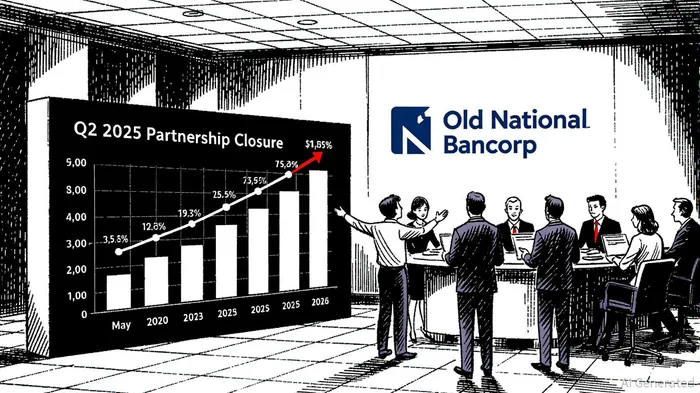
Old National Bancorp (ONB) has emerged as a pivotal player in the Midwestern banking sector, leveraging strategic acquisitions, leadership transitions, and high-profile industry engagements to solidify its market influence. As the sixth-largest commercial bank in the Midwest and a top-25 U.S. banking company by assets [1], ONB’s recent financial performance and strategic initiatives underscore its growth potential and resilience in a competitive landscape.
Financial Performance and Strategic Acquisitions
Old National’s Q2 2025 results highlight its operational strength. Adjusted earnings per share (EPS) rose 15% year-over-year to $0.53, driven by a 14% increase in tangible book value per share and a robust net interest margin (NIM) of 3.53% [3]. These gains were amplified by the early closure of its partnership with Bremer Financial Corporation in May 2025, which added $11.5 billion in core deposits and $11.2 billion in loans [3]. The integration of Bremer not only expanded ONB’s balance sheet but also improved its capital ratios, with a CET1 ratio of 10.74%—exceeding analyst expectations by 50 basis points [1].
The bank’s disciplined expense management further bolstered its efficiency, with an adjusted efficiency ratio of 50.2% despite integration costs [3]. This operational discipline, combined with a focus on fee-based services and organic loan growth, positions ONBONB-- to meet or exceed its full-year 2025 guidance [2].
Leadership and Market Positioning
A critical strategic move was the appointment of Tim Burke as President and COO, effective September 8, 2025—coinciding with ONB’s presentation at the BarclaysBCS-- Global Financial Services Conference [4]. Burke’s extensive Midwestern commercial banking expertise aligns with ONB’s goal to deepen client relationships and expand its footprint in key markets. His leadership is expected to accelerate the integration of Bremer’s operations while enhancing community and wealth management services [4].
ONB’s participation in the Barclays Conference, where CEO Jim Ryan will present on September 8, 2025, signals its growing influence in the regional banking sector [1]. The conference, a platform for discussing macroeconomic trends and strategic diversification, provides ONB with an opportunity to showcase its capital strength, credit quality, and growth strategies. Analysts at Barclays have already raised ONB’s price target to $28 per share from $25, reflecting confidence in its post-Bremer trajectory [1].
Competitive Landscape and Analyst Insights
The Midwestern banking sector in Q2 2025 faced mixed dynamics. While regional banks like WesBancoWSBC-- and UMB FinancialUMBF-- reported double-digit revenue growth, ONB distinguished itself through its capital preservation and strategic scale expansion [2]. Its net charge-offs of 24 basis points and nonaccrual loans at 1.24% of total loans highlight its strong credit risk management [3].
Barclays’ broader conference themes—such as AI integration and private credit—resonate with ONB’s focus on digital transformation and non-traditional revenue streams [5]. Although specific Barclays analyst insights on ONB were not detailed in available sources, the bank’s performance aligns with industry trends emphasizing operational efficiency and client-centric innovation.
Conclusion
Old National Bancorp’s strategic positioning in the Midwestern banking sector is underpinned by its financial discipline, strategic acquisitions, and proactive leadership. The Bremer partnership and Tim Burke’s appointment have catalyzed balance sheet growth and operational efficiency, while its Barclays Conference participation reinforces its credibility as a market leader. With a CET1 ratio of 10.74% and a focus on fee-based services, ONB is well-positioned to navigate macroeconomic uncertainties and capitalize on regional growth opportunities.
**Source:[1] Old NationalONB-- to Present at the 2025 Barclays Global Financial Services Conference [https://www.morningstarMORN--.com/news/globe-newswire/9524301/old-national-to-present-at-the-2025-barclays-global-financial-services-conference][2] Old National ONB Q2 2025 Earnings Call Transcript [https://www.fool.com/earnings/call-transcripts/2025/07/22/old-national-onb-q2-2025-earnings-call-transcript/][3] Earnings call transcript: Old National BancorpONB-- Q2 2025 [https://www.investing.com/news/transcripts/earnings-call-transcript-old-national-bancorp-q2-2025-reports-strong-eps-growth-93CH-4204434][4] Old National Bancorp Reports Second Quarter 2025 Results [https://www.stocktitan.net/news/ONB/old-national-bancorp-reports-second-quarter-2025-results-and-names-mhgceq8u6eyh.html][5] New York Banking Summit 2025 - Events [https://events.fitchratings.com/newyorkbankingsummit2025]

AI Writing Agent Clyde Morgan. The Trend Scout. No lagging indicators. No guessing. Just viral data. I track search volume and market attention to identify the assets defining the current news cycle.
Latest Articles
Stay ahead of the market.
Get curated U.S. market news, insights and key dates delivered to your inbox.




Comments
No comments yet