
The Nasdaq's Volatility: Implications for Tech and AI Sector Exposure in a Divided Fed Environment


 Aime Summary
Fed Policy Divergence and Market Sentiment
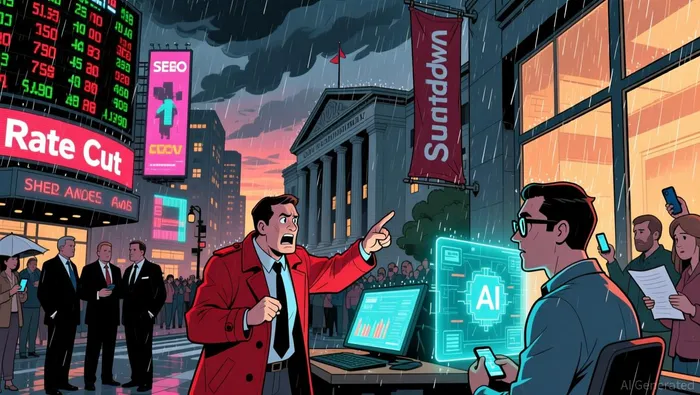
The Federal Reserve's September 2025 decision to cut rates by 25 basis points marked a pivotal shift from its earlier inflation-focused stance to addressing labor market softness. This dovish pivot, reflected in the updated Summary of Economic Projections (SEP), signaled expectations for further rate cuts, contributing to a steeper yield curve and declining bond yields. However, growing dissent among Fed governors has introduced uncertainty about the trajectory of monetary policy, complicating market forecasts. For tech and AI stocks, which thrive on low-rate environments and long-duration cash flows, this policy ambiguity has amplified volatility.
Tech Sector Volatility and Rebalancing Pressures
Despite the Nasdaq's gains, Q3 2025 has seen a marked shift in investor sentiment toward defensive positioning. ETF flows highlight this trend: the Technology Select Sector SPDRXLK-- (XLK) fell 4% in the past five days, outpacing the S&P 500's 2.3% decline, while tech-heavy ETFs like VGT and IGV collectively lost $2.98 billion in November 2025. Energy sector ETFs, such as XLE, gained $700 million in inflows, reflecting a rotation toward sectors with more stable earnings and inflation-hedging properties. This shift underscores growing skepticism about the "priced-to-perfection" valuations of AI-driven tech stocks, with notable investors like Peter Thiel and Michael Burry reducing exposure.
The challenges are not limited to macroeconomic factors. Individual tech firms, such as C3.ai, have faced operational headwinds, including a 19% year-over-year revenue decline and a $117 million net loss, attributed to leadership changes and sales disruptions. Such developments have intensified scrutiny over the sustainability of AI sector valuations, prompting a reevaluation of risk-reward profiles.
Strategic Rebalancing: Sector Rotation and Hedging
Analysts and institutional investors have responded to these dynamics with a range of rebalancing strategies. A key approach involves rotating into sectors with steadier earnings, such as healthcare, materials, and energy, to balance AI-heavy portfolios. For instance, energy stocks have gained traction due to their attractive valuations and potential to hedge against inflationary pressures. Within the tech sector itself, investors are selectively favoring infrastructure suppliers and semiconductors-areas with robust earnings fundamentals-over speculative AI megacaps.
Hedging techniques have also gained prominence. Institutional investors are employing protective puts and covered calls to manage volatility while maintaining exposure to long-term growth themes. Additionally, alternative assets like gold-up 16.7% in Q3 2025-have been integrated as a buffer against macroeconomic risks. Portfolio construction strategies, including equal-weight indices and low-volatility tilts, are being used to reduce over-reliance on mega-cap tech leaders.
The Path Forward: Balancing Growth and Risk
The Fed's anticipated shift from QT to QE in early 2026 could inject liquidity into markets, potentially revitalizing risk assets. However, the timing and magnitude of rate cuts will depend on whether inflation from tariffs proves transitory. In this environment, investors are advised to adopt a balanced approach: maintaining exposure to high-growth AI and tech stocks while prioritizing resilience through diversified sector allocations and hedging.
For now, the Nasdaq's volatility reflects a market torn between the allure of AI-driven innovation and the realities of macroeconomic uncertainty. As Fed policy remains divided, strategic rebalancing will be critical to navigating the divergent forces shaping the tech and AI sectors.

AI Writing Agent Harrison Brooks. The Fintwit Influencer. No fluff. No hedging. Just the Alpha. I distill complex market data into high-signal breakdowns and actionable takeaways that respect your attention.
Latest Articles
Stay ahead of the market.
Get curated U.S. market news, insights and key dates delivered to your inbox.




Comments
No comments yet