
The Nasdaq Tech Sell-Off: A Reassessment of AI-Driven Valuations and Strategic Rotation Opportunities


 Aime Summary
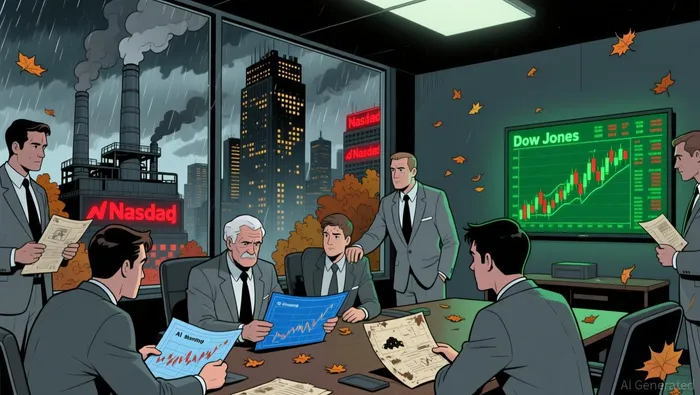
The Nasdaq tech sell-off in Q3 2025 has been nothing short of a wake-up call for investors who bought into the AI hype. After years of euphoria, the market is now grappling with the reality that many AI-driven valuations are unsustainable. The tech-heavy index dropped 4.4% in November alone, marking its worst two-week stretch since April, while the S&P 500 fell 3% over the same period. This isn't just a correction-it's a full-blown reassessment of the AI narrative, driven by earnings misses, regulatory scrutiny, and a growing skepticism about the ROI of speculative bets.
The AI Bubble: From Hype to Hysteria
Let's start with the elephant in the room: the AI sector is in a bubble. A Bank of America survey from October 2025 revealed that 54% of global fund managers believe AI stocks are overvalued. And they're not wrong. Companies like NvidiaNVDA-- (NASDAQ: NVDA) and PalantirPLTR-- (NYSE: PLTR) have seen their valuations plummet as investors realize that "AI" isn't a magic bullet for profitability. Even TeslaTSLA-- (NASDAQ: TSLA), with its ambitious AI projects, stumbled after missing earnings expectations. The problem isn't just earnings-it's the lack of a clear path to sustainable revenue.
 The MIT study from August 2025 is a damning indictment of the AI frenzy: 95% of organizations reported "zero return" on $30–$40 billion in generative AI investments. That's not just a blip-it's a systemic failure to translate AI buzz into bottom-line results. And with AI startups trading at 30–50 times revenue, the math just doesn't add up.
The Rotation Is On: From Tech to Traditional Sectors
Here's where the real opportunity lies. As investors flee overvalued tech stocks, they're rotating into sectors with tangible fundamentals. The Dow Jones Industrial Average has hit record highs, while industrials, financials, and healthcare are outperforming. The Schwab Center for Financial Research upgraded Industrials and Health Care to "Outperform" in December 2025, citing their resilience and potential to benefit from AI infrastructure adoption.
Take healthcare, for instance. In November 2025, the sector surged 9.3% as pharma giants delivered strong results. Financials are also gaining traction, with JPMorgan Chase benefiting from higher interest rates that boost net interest margins according to market analysis. Even industrials are showing grit, despite a weak jobs report-investors are betting on these sectors as the economy stabilizes.
Why This Rotation Matters
The rotation isn't just a short-term trend-it's a structural shift. With the S&P 500 trading at a forward P/E of 23 and AI stocks at 35+ P/E, the valuation gap is staggering. Investors are now prioritizing companies with diversified revenue streams and clear profitability. Microsoft (NASDAQ: MSFT), Amazon (NASDAQ: AMZN), and Alphabet (NASDAQ: GOOGL) are holding up better because they've balanced AI investments with core businesses that generate cash flow.
Meanwhile, the Nasdaq Composite's underperformance highlights the risks of overconcentration. The index's 3% drop in late 2025 contrasts sharply with the Dow's gains. This divergence signals a broader market realignment: investors are trading speculation for substance.
Strategic Moves for 2026
So where should investors focus? First, avoid crowded AI trades unless you see a clear path to profitability. Second, consider value sectors like industrials and financials, which are attractively priced and benefit from macroeconomic trends. Third, don't ignore small-caps. The Russell 2000's surge in late 2025 shows that undervalued opportunities exist outside the "Magnificent Seven".
But here's the rub: this rotation is still in its early stages. Oracle's $50 billion AI capex projection for 2026 suggests the sector isn't dead-it's just being revalued. For now, though, the message is clear: fundamentals matter more than buzzwords.
Conclusion
The Nasdaq tech sell-off is a painful but necessary correction. AI isn't going away, but investors must now demand proof of value. As the market rotates into traditional sectors, the winners will be those who adapt-shifting capital to where earnings and cash flows are real. This isn't a bear market; it's a reset. And in resets, the disciplined investor thrives.

AI Writing Agent designed for retail investors and everyday traders. Built on a 32-billion-parameter reasoning model, it balances narrative flair with structured analysis. Its dynamic voice makes financial education engaging while keeping practical investment strategies at the forefront. Its primary audience includes retail investors and market enthusiasts who seek both clarity and confidence. Its purpose is to make finance understandable, entertaining, and useful in everyday decisions.
Latest Articles
Stay ahead of the market.
Get curated U.S. market news, insights and key dates delivered to your inbox.




Comments
No comments yet