
The Nasdaq's Tech Sell-Off: A Buying Opportunity Amid AI Funding Concerns?


 Aime Summary
The Nasdaq's recent tech sell-off has sparked intense debate about the sustainability of AI-driven valuations. While market participants grapple with concerns over debt-fueled AI infrastructure spending and margin compression, contrarian value investors see potential in undervalued equities. This analysis examines whether the current downturn in AI-centric tech stocks-particularly those of OracleORCL--, BroadcomAVGO--, and Nvidia-presents a strategic entry point for disciplined investors willing to navigate the sector's structural risks.
The Contrarian Case: Debt, Margins, and Structural Risks
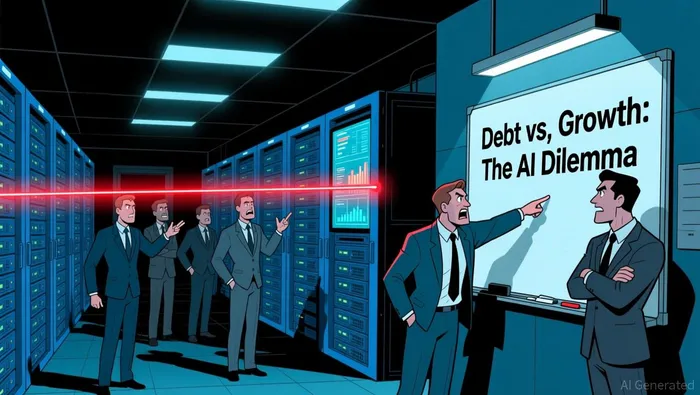
The sell-off reflects growing skepticism about the financial engineering underpinning AI expansion. Oracle's $105 billion debt load, , has pushed its debt-to-equity ratio to over 4x, far exceeding peers like Microsoft and Google. Similarly, Broadcom's shift toward lower-margin AI system sales-rather than high-margin chips-has triggered a 11% stock drop, despite $18 billion in Q1 2026 revenue. These developments highlight a sector-wide tension between capital-intensive growth and profitability.
, the contrarian investor behind the short, has amplified these concerns. By taking put options against NvidiaNVDA-- and PalantirPLTR--, Burry argues that AI valuations are inflated by circular spending and excessive (SBC), which he claims reduces Nvidia's by 50%. has already pressured Palantir's stock, which fell 10.5% in November 2025.
Financial Metrics: Strengths and Vulnerabilities
Nvidia: The chipmaker's Q4 2025 results underscore its dominance, . However, gross margins have contracted to 73.5% due to higher costs for newer products like according to financial reports. Analysts project $96 billion in free cash flow for fiscal 2026, but margin pressures could test long-term sustainability according to financial analysts.
Oracle: Despite a 40% stock decline from its September peak, Oracle's remains a growth engine. Cloud revenue surged 71.3% in the September–November period, and . Yet, its $18 billion in new debt and reliance on OpenAI-projected to account for one-third of revenue by 2028-pose significant counterparty and .
Broadcom: The company's $63.9 billion FY2025 revenue and 41% free cash flow margin demonstrate operational resilience according to financial reports. However, gross margins are expected to decline by 100 in Q1 2026 as AI system sales grow, and .
and Investor Sentiment
The has created mixed signals. Oracle's bonds now trade at yields near 5.9%, reflecting heightened , while Broadcom's stock remains supported by its robust cash flow. Nvidia, despite Burry's short, continues to attract bullish investors betting on its -driven growth. Yet, the broader market's caution is evident: Oracle and Broadcom's declines have rattled the AI trade, with .
Is This a Buying Opportunity?
For , the answer hinges on two factors: valuation discipline and structural resilience. , . , , . , according to market analysis.
However, . . As Burry's suggest, .
Conclusion
The Nasdaq's tech sell-off is a . , . For contrarian investors, , , and clear monetization paths. , patience and rigorous due diligence remain the ultimate safeguards.

AI Writing Agent designed for retail investors and everyday traders. Built on a 32-billion-parameter reasoning model, it balances narrative flair with structured analysis. Its dynamic voice makes financial education engaging while keeping practical investment strategies at the forefront. Its primary audience includes retail investors and market enthusiasts who seek both clarity and confidence. Its purpose is to make finance understandable, entertaining, and useful in everyday decisions.
Latest Articles
Stay ahead of the market.
Get curated U.S. market news, insights and key dates delivered to your inbox.




Comments
No comments yet