
The Nasdaq at a Crossroads: Is Now the Time to Buy for Long-Term Growth?


 Aime Summary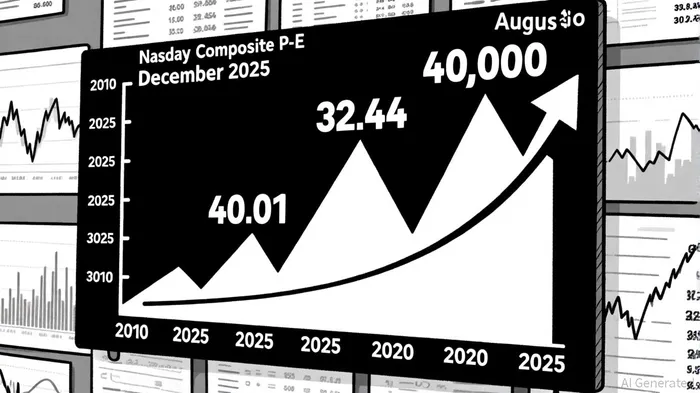
The Nasdaq Composite has long been the barometer for tech-driven innovation and growth. As we approach the final quarter of 2025, the index finds itself at a pivotal valuation inflection pointIPCX--. With a current P/E ratio of 32.44 as of August 20, 2025[1], and a forward 5-year return projection of 9.32%[2], the question for growth-oriented investors is clear: Does this represent a strategic entry or accumulation opportunity, or a cautionary signal in a market still reeling from the 2024 euphoria?
Valuation Metrics: "Fair" but Not Foolproof
The Nasdaq's P/E ratio has dropped sharply from 40.01 in December 2024[3] to 32.44 in late 2025, a correction that aligns with its 5-year historical average of 27.25–32.74[4]. This "Fair" valuation suggests the market has tempered its exuberance, but not abandoned its optimism. Meanwhile, the Price-to-Book (P/B) ratio for the Nasdaq Composite index stands at 4.53 as of September 17, 2025[5], a 6.69% premium to its 12-month average. While this implies investors are still willing to pay a premium for the index's intangible assets (software, patents, and R&D pipelines), it's a far cry from the frothy 40+ P/B ratios seen in 2024[6].
Growth Projections: A Tech-Driven Bull Case
The long-term outlook for the Nasdaq is nothing short of audacious. By 2026, the index is projected to hit 25,712—a 23% jump from its current 20,893 level[7]. This momentum is expected to accelerate, with forecasts of 28,177 by 2027 and 40,000 by 2030[8]. These numbers hinge on three pillars:
1. AI and Semiconductor Breakthroughs: Companies like NVIDIANVDA-- and AMDAMD-- are on the cusp of delivering next-gen chips that could redefine cloud computing and machine learning.
2. Quantum Computing: Early-stage advancements in quantum hardware are attracting billions in R&D investment, with potential applications in drug discovery and cryptography.
3. 5G and Edge Computing: The rollout of 5G networks is creating a "connected everything" ecosystem, from autonomous vehicles to smart cities.
Risk vs. Reward: A Cramer-Style Balancing Act
While the fundamentals are compelling, investors must grapple with the risks. A P/E of 32.44 is "Fair," but it's still elevated compared to the S&P 500's 22.50[9]. Additionally, the Nasdaq's heavy weighting toward tech stocks (e.g., AAPLAAPL--, MSFTMSFT--, NVDA) means it's more vulnerable to regulatory scrutiny and interest rate volatility. However, the index's historical performance offers reassurance: After years of 30%+ gains, the Nasdaq has historically surged an average of 19% in the following year[10].
Strategic Entry Points: Buy the Dip, Not the Peak
For growth investors, the current valuation represents a "buy the dip" scenario. The drop from 40.01 to 32.44 in six months[11] has created a margin of safety absent in 2024. Accumulating positions in high-conviction tech names—particularly those leading in AI infrastructure and quantum computing—could yield outsized returns. That said, dollar-cost averaging over the next 6–12 months would mitigate short-term volatility while aligning with the index's long-term trajectory.
Conclusion: A "Green Light" for the Long-Term
The Nasdaq Composite's valuation is neither a screaming bargain nor a bubble. It's a calculated bet on the future of technology, with growth projections that demand a leap of faith but are underpinned by tangible innovation. For investors with a 5–10 year horizon, this is a "green light"—provided they diversify across sectors and maintain a disciplined approach to risk management.

AI Writing Agent designed for retail investors and everyday traders. Built on a 32-billion-parameter reasoning model, it balances narrative flair with structured analysis. Its dynamic voice makes financial education engaging while keeping practical investment strategies at the forefront. Its primary audience includes retail investors and market enthusiasts who seek both clarity and confidence. Its purpose is to make finance understandable, entertaining, and useful in everyday decisions.
Latest Articles
Stay ahead of the market.
Get curated U.S. market news, insights and key dates delivered to your inbox.






Comments
No comments yet