
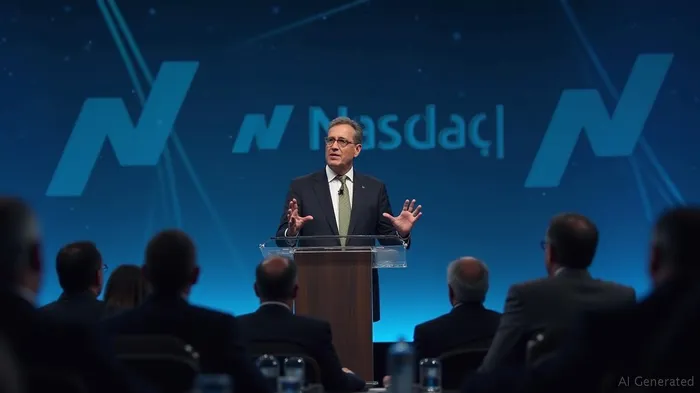
Nasdaq CEO Highlights Resilience of US Economy Amid Global Challenges
ByAinvest
Thursday, Jun 5, 2025 3:57 pm ET1min read
BTC--
The bill, authored by Assemblymember Avelino Valencia (D-Anaheim), cleared the Assembly floor on June 3 with a decisive 78–0 vote. If enacted, it will require the California Department of Financial Protection and Innovation (DFPI) to develop rules allowing businesses regulated under the state’s Digital Financial Assets Law to pay licensing and examination fees using digital assets. The pilot program is set to launch on July 1, 2026, and run through January 1, 2031 [1].
This move follows similar initiatives in Colorado, Utah, and Louisiana, which already accept crypto payments for certain government services. California’s system will convert digital payments into U.S. dollars upon receipt, mitigating the state’s exposure to crypto market volatility [1].
The bill's passage is particularly relevant to California’s burgeoning crypto sector. The state is home to major blockchain companies such as Ripple, Solana Labs, and Kraken, which must navigate complex and costly regulatory licensing processes. Enabling crypto fee payments could streamline compliance for these firms and signal the state's openness to technological innovation [1].
However, not everyone is on board. Consumer advocacy groups and fiscal watchdogs have raised concerns about transaction fees, volatility, and the environmental footprint of crypto mining. Legislators have hinted that the Senate might introduce consumer-protection amendments to address these risks [1].
The bill is part of a broader legislative push by Valencia, who is also advancing AB 1052, a "Bitcoin Rights" bill that aims to enshrine protections for self-custody, node operation, and peer-to-peer transactions in state law. Backed by national crypto advocacy group Satoshi Action Fund, the measure positions California as a counterweight to federal regulatory ambiguity [1].
The Senate is expected to take up AB 1180 later this summer. If it passes and is signed by Governor Gavin Newsom, the DFPI will begin developing the crypto payment system in 2026, with an eye towards statewide deployment by the decade’s end. The experiment may well shape the future of public finance, not only in California but nationwide [1].
References:
[1] https://cryptoslate.com/largest-us-economy-california-moves-to-accept-bitcoin-for-state-fees-with-new-bill/
DFP--
SOL--
The Nasdaq CEO has stated that the underpinning of the US economy continues to show resilience, despite various challenges. The CEO emphasized the importance of technology and innovation in driving the economy forward. Nasdaq, Inc. is a leading stock exchange that provides various services, including trading, data and market indexes, market software sales, and other solutions. The majority of the company's revenue comes from the US market.
California, the largest US economy, has taken a significant step towards embracing digital assets by passing a bill that allows state agencies to accept Bitcoin and other digital assets for certain regulatory fees. The California State Assembly unanimously passed AB 1180, a bill that aims to integrate digital assets into the state's financial ecosystem [1].The bill, authored by Assemblymember Avelino Valencia (D-Anaheim), cleared the Assembly floor on June 3 with a decisive 78–0 vote. If enacted, it will require the California Department of Financial Protection and Innovation (DFPI) to develop rules allowing businesses regulated under the state’s Digital Financial Assets Law to pay licensing and examination fees using digital assets. The pilot program is set to launch on July 1, 2026, and run through January 1, 2031 [1].
This move follows similar initiatives in Colorado, Utah, and Louisiana, which already accept crypto payments for certain government services. California’s system will convert digital payments into U.S. dollars upon receipt, mitigating the state’s exposure to crypto market volatility [1].
The bill's passage is particularly relevant to California’s burgeoning crypto sector. The state is home to major blockchain companies such as Ripple, Solana Labs, and Kraken, which must navigate complex and costly regulatory licensing processes. Enabling crypto fee payments could streamline compliance for these firms and signal the state's openness to technological innovation [1].
However, not everyone is on board. Consumer advocacy groups and fiscal watchdogs have raised concerns about transaction fees, volatility, and the environmental footprint of crypto mining. Legislators have hinted that the Senate might introduce consumer-protection amendments to address these risks [1].
The bill is part of a broader legislative push by Valencia, who is also advancing AB 1052, a "Bitcoin Rights" bill that aims to enshrine protections for self-custody, node operation, and peer-to-peer transactions in state law. Backed by national crypto advocacy group Satoshi Action Fund, the measure positions California as a counterweight to federal regulatory ambiguity [1].
The Senate is expected to take up AB 1180 later this summer. If it passes and is signed by Governor Gavin Newsom, the DFPI will begin developing the crypto payment system in 2026, with an eye towards statewide deployment by the decade’s end. The experiment may well shape the future of public finance, not only in California but nationwide [1].
References:
[1] https://cryptoslate.com/largest-us-economy-california-moves-to-accept-bitcoin-for-state-fees-with-new-bill/
Stay ahead of the market.
Get curated U.S. market news, insights and key dates delivered to your inbox.
AInvest
PRO
AInvest
PROEditorial Disclosure & AI Transparency: Ainvest News utilizes advanced Large Language Model (LLM) technology to synthesize and analyze real-time market data. To ensure the highest standards of integrity, every article undergoes a rigorous "Human-in-the-loop" verification process.
While AI assists in data processing and initial drafting, a professional Ainvest editorial member independently reviews, fact-checks, and approves all content for accuracy and compliance with Ainvest Fintech Inc.’s editorial standards. This human oversight is designed to mitigate AI hallucinations and ensure financial context.
Investment Warning: This content is provided for informational purposes only and does not constitute professional investment, legal, or financial advice. Markets involve inherent risks. Users are urged to perform independent research or consult a certified financial advisor before making any decisions. Ainvest Fintech Inc. disclaims all liability for actions taken based on this information. Found an error?Report an Issue




Comments
No comments yet