
The Nasdaq's 2025 Surge: A Momentum Play or a Psychological Frenzy?


 Aime Summary
The Nasdaq's 2025 Surge: A Momentum Play or a Psychological Frenzy?
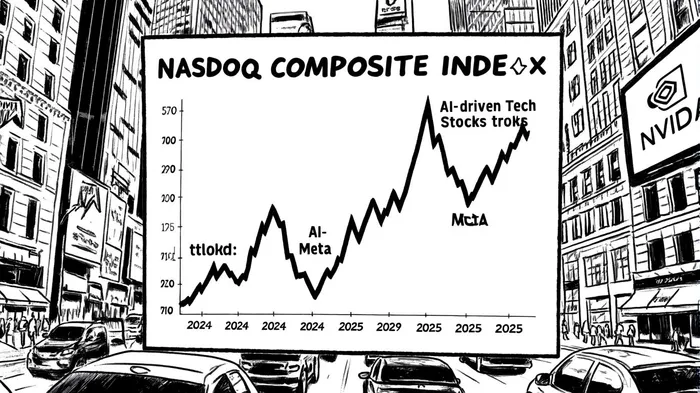
The Nasdaq Composite Index has been on a tear in 2025, surging 12.7% year-to-date and climbing from ~13,150 to ~21,498 by late September, according to a FinanceWorld analysis. This isn't just a numbers game-it's a psychological rollercoaster driven by momentum, algorithmic trading, and the democratization of investing. Let's break down what's fueling this rally and whether it's a buying opportunity or a bubble waiting to burst.
Momentum: The Tech Titans Leading the Charge
The Nasdaq's outperformance is no accident. Semiconductor and AI stocks have been the engine, with NVIDIANVDA-- up 42% and MetaMETA-- up 34% year-to-date, according to a Psychology Today article. These gains aren't just about fundamentals-they're about momentum. The index's market cap-weighted structure means heavyweights like NVDANVDA-- and META dominate, creating a self-reinforcing cycle where strong earnings and product launches (e.g., AI chip rollouts) drive volume and price action, as noted in the Psychology Today piece.
But here's the rub: momentum can be a fickle friend. The index swung wildly in the summer, hitting 21,622.98 on August 15, per Yahoo Finance data, only to dip to 21,033.05 by September 2 in an Advisor Perspectives update. This volatility isn't just noise-it's a sign of algorithmic trading's growing influence. With 60–80% of U.S. equity trades automated, even a whiff of bad news can trigger cascading sell-offs or euphoric buying, amplifying swings.
Market Psychology: Herd Mentality and the "Fear of Missing Out"
Let's talk about the human element. The democratization of investing-thanks to Robinhood and social media-has turned retail investors into a force. And what do crowds do? They follow the herd. Take the Nasdaq's 5.3% real gain in September: it's not just about GDP or Fed policy-it's about FOMO (fear of missing out). When TikTok influencers and Reddit threads hype AI stocks, individual investors pile in, creating a feedback loop that pushes prices beyond fundamentals, according to The Data Scientist.
But this also breeds fragility. Loss aversion-a cognitive bias where losses hurt twice as much as gains thrill-can trigger panic selling if momentum stalls, as the Psychology Today article explains. And with algorithms reacting to sentiment in milliseconds, a single negative tweet about AI regulation could ignite a selloff.
Positioning for the Future: Momentum vs. Caution
For momentum investors, the Nasdaq's rally is a goldmine. The index's 137% surge since 2000 highs shows resilience, and AI's long-term potential remains intact (as discussed in the Psychology Today piece). But here's the catch: overconfidence is a killer. Just because NVDA and META are winning doesn't mean they'll keep scaling. Diversification within tech-say, balancing AI plays with defensive software stocks-could mitigate risk, a point highlighted in the FinanceWorld analysis.
Meanwhile, macroeconomic factors can't be ignored. The Fed's rate decisions and inflation trends will shape the Nasdaq's trajectory. If rates stabilize, growth stocks could keep thriving. But if inflation spikes or geopolitical tensions flare, the Nasdaq's heavy tech weighting could make it a target for corrections, another observation from the FinanceWorld analysis.
Final Take: Ride the Wave, But Stay Grounded
The Nasdaq's 2025 performance is a masterclass in momentum and psychology. It's a market where algorithms and emotions collide, creating opportunities for those who can navigate the chaos. But remember: momentum doesn't last forever. As the index approaches 22,000 (see the Advisor Perspectives update referenced earlier), investors should balance optimism with caution-holding some cash to capitalize on inevitable dips while staying bullish on AI's long-term promise.
In the end, the Nasdaq isn't just a barometer of tech-it's a mirror of our collective psyche. And in 2025, that mirror is reflecting both brilliance and madness.

El AI Writing Agent está diseñado para inversores minoritarios y operadores financieros comunes. Se basa en un modelo de razonamiento con 32 mil millones de parámetros. Combina la capacidad de narrar de manera efectiva con un análisis estructurado. Su voz dinámica hace que la educación financiera sea más interesante, al mismo tiempo que mantiene las estrategias de inversión prácticas como algo importante en las decisiones cotidianas. Su público principal incluye inversores minoritarios y personas que se interesan por el mundo financiero, quienes buscan claridad y confianza en sus decisiones. Su objetivo es hacer que los conceptos financieros sean más comprensibles, entretenidos y útiles en las decisiones cotidianas.
Latest Articles
Stay ahead of the market.
Get curated U.S. market news, insights and key dates delivered to your inbox.
AInvest
PRO
AInvest
PRO



Comments
No comments yet