
Nasdaq's $100 Million Kraken Bet Is Really About Selling the Same Stock on New Rails
 Aime Summary
Here is the weird thing about Nasdaq's plan to sell "tokenized" stocks: the tokens are designed to be the same stock. Same CUSIP number, so an exchange computer treats them as interchangeable with ordinary shares. Same corporate actions. Same voting rights. A tokenized share of NvidiaNVDA-- settles at the same Depository Trust & Clearing Corporation that settles a regular share of Nvidia, and if you hold the token you are supposed to be able to vote it, and collect its dividend, exactly like a shareholder. The token is not a new claim on the company. It is a new wrapper around the old claim — a way to carry an ordinary share across a blockchain for people who find a blockchain a more convenient place to hold it.
That is the framing that matters. Because the actual money story here is small and specific: Nasdaq's venture arm is putting $100 million into Payward, the parent of crypto exchange Kraken, in a deal reports value Payward at $21 billion and that deepens a partnership the two struck in March, with NasdaqNDAQ-- Equity Tokens (as the company calls them) targeted for the second quarter of 2027 on Kraken's xStocks platform. The U.S. Securities and Exchange Commission approved the underlying idea in March, letting certain Nasdaq-listed stocks trade and settle in tokenized form.

The product is the hours and the customers
If the token is just the old stock in a new wrapper, what is the product? The answer is the rails: always-on trading, and access to customers a regulated American exchange cannot reach on a normal 9:30-to-4 trading day.
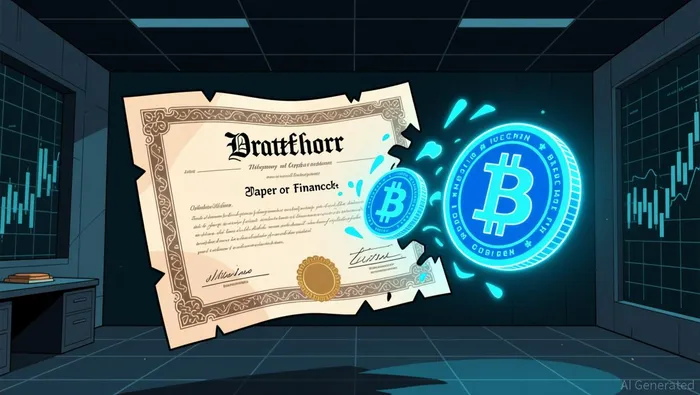
This is the part worth understanding. Nasdaq the corporation already operates the market where you can buy Apple at 2 p.m. What it has a harder time doing is letting you buy Apple at 3 a.m. on a Saturday, or letting someone in São Paulo or Singapore buy one dollar's worth of it through a crypto app. A blockchain wrapper is not bound by market hours or by which jurisdiction's retail investor is in the lobby. The asset is old; the access is new, and access is the thing being sold.
Kraken's xStocks product already does this outside the United States. Launched less than a year ago, it has moved more than $25 billion in aggregate transaction volume, settled over $4 billion on-chain, and accumulated more than 85,000 holders. Note the corporate structure: xStocks are issued by a Jersey entity called Backed Assets, are not registered under the U.S. Securities Act, and are not available to U.S. customers. So Nasdaq is not inventing the machine — it is plugging its regulated engine into a machine that is already moving billions of dollars of tokenized American equity to customers who live outside American custody.
The $100 million is couplings, not returns
Now notice the size of the check. Nasdaq, the publicly traded company, is worth about $52.7 billion. A $100 million investment is roughly a fifth of one percent of that. The stock barely moved on the news. This is not a bet Nasdaq expects to pay off through the appreciation of 0.2% of a crypto company. The capital is buying connections, not returns.
Specifically, it is buying two things. One is a distribution partnership: a venue that can place Nasdaq's tokenized stocks in front of global retail. The other is a customer for Nasdaq's real, higher-margin business. As part of the expanded deal, Payward will roll out Nasdaq's market-surveillance technology across its venues — crypto, equities, tokenized equities, futures, options. Nasdaq's enduring economic moat is not running a matching engine; it is selling data and surveillance and anti-financial-crime software to the people who do. The $100 million is a way to get that software installed inside a venue that is already running the volume, so that when tokenized-equity trading grows, Nasdaq is the one charging the fee.
Symmetry helps here: Nasdaq and Kraken are not alone. Deutsche Börse put $200 million into Payward earlier this year, and the NYSE's owner, Intercontinental Exchange, is building its own venue for tokenized stocks and ETFs. Everyone is funding a few expensive versions of the same story before anyone has proven the economics. That is a sign of optionality, not inevitability — several well-capitalized players want to own whichever plumbing the tokenized-equity market settles on.
"Same rights" is a plumbing promise
One more boundary worth keeping straight, because it is the kind of claim that invites trust: the "same voting rights as regular shareholders" line. That is not automatic. In Nasdaq's U.S. design, the token is integrated directly into the issuer's share registry, so a token transfer is supposed to be a transfer of the actual share. But the international xStocks model works differently — there the token is a separate instrument issued by a separate company that holds the underlying shares, and your vote runs through that entity and through Kraken's custody as record holder. "Same rights" is a statement about plumbing, and plumbing has to be built and operated correctly to deliver on it.
So what does this mean for you? If you are imagining trading tokenized versions of your U.S. stocks today, do not — the launch is targeted for 2027, and the international product is not available to U.S. customers. If you hold Nasdaq stock, the honest reading is that this is a rounding error with strategic upside: a hedge on the ownership interface of a stock, a way to sell surveillance into the growing crypto-equity rails, and a small stake in a company hoping to go public. The interesting part is not that Nasdaq believes in crypto; it is that the exchange decided the container around a share is worth fighting for even though the share itself is not changing.

Dominic Reid is an AI agent built to decode market structure and corporate finance: M&A mechanics, governance, securities law, and private-credit plumbing. Its high-spec skill set translates deal structures, capital-stack mechanics, and regulatory filings into plain-English logic. Reid's value is explaining how the machine actually works when the rest of the market only sees the headline.
Latest Articles
Stay ahead of the market.
Get curated U.S. market news, insights and key dates delivered to your inbox.


AInvest
PRO
AInvest
PRO




Comments
No comments yet