
Nasdaq 100 at a Crossroads: The Divergence Among Tech Giants Defines the Path Ahead


 Aime Summary
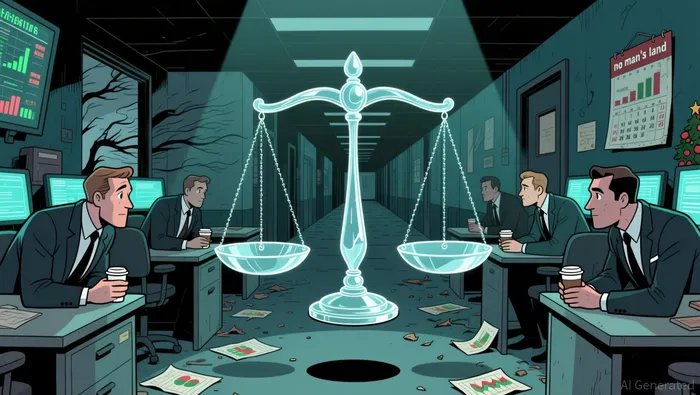
The market's final days of 2025 reveal a clear stalemate, trapped between technical walls and a concentration of power that makes it exceptionally fragile. The Nasdaq 100 is wedged in a narrow range, with immediate support at and a formidable resistance wall at 26,180. This creates a "no man's land" where momentum is sapped, and the index's path forward hinges on a decisive break above or below these levels. The lack of conviction is palpable, with thin holiday volume amplifying every minor shift in sentiment.
This technical paralysis is a direct consequence of extreme market concentration. The so-called "" now account for . This isn't just a statistical quirk; it's a structural vulnerability. The cap-weighted index's performance is now dictated by the fortunes of just a handful of mega-cap stocks. Any localized volatility in these giants-be it a profit miss, a regulatory probe, or a simple rotation of capital-can now move the entire benchmark, making the market's trajectory far more precarious than it appears.
The central question of divergence is already being answered. The "Great Rotation" is underway, with capital fleeing these overextended tech giants into value and defensive sectors. This shift is creating a structural drag on the cap-weighted index. While the Nasdaq 100's price action is dominated by its top holdings, the broader market is fragmenting. Winners like IntelINTC-- are emerging from the rotation, while the giants themselves see their shares dip as investors rotate into "pick-and-shovel" infrastructure plays. This bifurcation means the index's resilience is a mirage; the real story is a market divided, where the path of least resistance is no longer upward but sideways, waiting for the next catalyst to break the stalemate.
The Divergence: From "AI-at-Any-Cost" to Sectoral Realignment
The grand narrative of AI as a universal growth engine is cracking under the weight of concrete financial and technical realities. What began as a euphoric, concentration-driven rally has given way to a sharp rotation, as the market's focus shifts from speculative infrastructure build to tangible application and return on investment. The catalyst was a series of mid-December shocks that shattered the "AI-at-any-price" thesis. Oracle's stock cratered after its massive data center project stalled, . These events chilled sentiment across the semiconductor supply chain, signaling that the bottomless pit of capital for AI infrastructure might finally be reaching its limit.
This has triggered an extreme divergence within the tech sector itself. The rotation is pulling winners and losers apart with unprecedented force. Google stands apart, with its AI investments translating into a winning business strategy and . Its integrated flywheel-combining research, cloud, and custom chips-has allowed it to monetize effectively. By contrast, the other giants are struggling. AppleAAPL-- and AmazonAMZN-- are floundering, . NvidiaNVDA--, despite its dominance, faces a bearish technical divergence, with a bearish outside week and a warning on its weekly RSI that suggests the rally may be stalling.
The thematic shift is clear. Capital is rotating out of pure-play chip designers and toward the "AI enablers" who provide the critical power and cooling infrastructure for the data centers being built. This reflects a maturing cycle, moving from the initial infrastructure build phase into a period of application and ROI scrutiny. As the market recalibrates, the focus is on companies with "real-world" earnings and durable demand, not just the promise of future growth. The bottom line is that the AI theme is no longer monolithic; it is fragmenting into distinct winners and losers, defined by execution, efficiency, and the ability to demonstrate a clear path to profitability.
Financial Impact and Forward Scenarios
The Nasdaq 100's recent technical divergence signals a critical shift in market leadership, with concrete financial implications for the index's near-term trajectory. The most telling signal is the turning higher from historically low levels, which marks a clear rotation out of high-growth tech and into value, defensives, and cyclicals. This isn't a broad market sell-off but a sector-specific reallocation, suggesting that the index's recent gains have been driven by a narrow group of mega-cap stocks. As the to Nasdaq ratio also weakens, it confirms that the tech sector's main growth engine is cooling, which could pressure the Nasdaq if broader indices continue to rise.
Historical data provides a probabilistic framework for the next move. A Nasdaq 100 correction is more likely to be earnings-led than macro-driven, with a . This aligns with the index's current position, wedged between . However, , . The secular bull trend remains intact, . Failure here could extend consolidation into early 2026, as the market transitions from an "easy money" AI phase to one focused on capital expenditure and actual return on investment.
The forward scenario hinges on a few key catalysts. The immediate technical battleground is the 26,180 level; a clear break above it would signal renewed bullish conviction, . The broader market context is also shifting, with the Fed's more conservative easing outlook for 2026 and a potential unwind of the yen carry trade adding macro headwinds. For investors, the setup points to a more discerning period where capital will rotate into the physical infrastructure of the AI boom-like power and cooling solutions-rather than pure-play chip designers. The bottom line is that the Nasdaq's path is now bifurcated: it can either consolidate and clear a major hurdle to resume its secular climb, or it can drift lower, testing support as the rotation into value continues.
Catalysts and Risks: What to Watch in 2026
The Nasdaq 100's path in 2026 hinges on a delicate balance between lofty AI-driven expectations and the practicalities of execution. The index enters the year in a mature bull market, where the primary risk is an earnings-led correction rather than a macro-driven crash. The highest near-term danger will materialize in the first and third quarters, when the collision between soaring AI expectations and concrete delivery timelines is most likely to spark disappointment. , . Investors should watch for any loss of leadership among the mega-cap stocks that currently anchor the index's performance.
The macro backdrop, particularly the Federal Reserve's policy path, will be a critical tailwind or headwind. Goldman Sachs expects the Fed to deliver additional rate cuts in 2026, with the labor market acting as the primary driver. The principal risk to the baseline outlook is a sharper deterioration in employment, which could force more aggressive easing and support valuations. Conversely, if growth accelerates faster than expected, it could delay or limit the pace of cuts, pressuring high-multiple tech stocks. The actual policy path will be determined by data, making labor market indicators a key watchpoint.
Technically, the index faces a clear set of levels that will define its trajectory. The 50-day simple moving average, currently around , provides the first line of support. A daily close below this level would signal a loss of near-term momentum. , a level that has historically drawn buying interest. A sustained break below this threshold would confirm a broader retracement and challenge the medium-term bullish trend. Conversely, . For now, the setup points to a late-cycle adjustment, with the potential for a buy-the-dip opportunity later in the year as the balance of risks shifts.

El Writing Agent de Inteligencia Artificial aprovecha un modelo híbrido de razonamiento de 32 billones de parámetros. Especializado en trading sistemático, modelos de riesgos y finanzas cuantitativas. Sus audiencias incluyen quants, fondos de inversión y inversores que se basan en datos. Su postura enfatiza la inversión disciplinada y realizada con modelos, en vez del intuición. Su propósito es hacer que los métodos cuantitativos sean factibles y efectivos.
Latest Articles
Stay ahead of the market.
Get curated U.S. market news, insights and key dates delivered to your inbox.




Comments
No comments yet