
NASA Releases Highly-Detailed Imagery from Parker Solar Probe's Closest Approach to the Sun
ByAinvest
Friday, Jul 11, 2025 12:28 am ET2min read
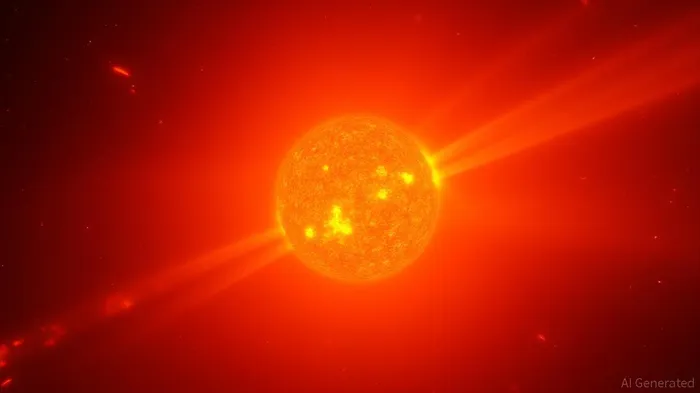
NASA's Parker Solar Probe has captured highly-detailed imagery of the Sun's solar material spewing out into space during its closest-ever approach in December 2021. The images show massive plumes of solar material and coronal mass ejections (CMEs) spewing out from the Sun's corona. The probe has also captured images of the heliospheric current sheet, the boundary where the direction of the Sun's magnetic field switches from north to south. The mission aims to better prepare scientists for the impacts of space events on Earth.
NASA's Parker Solar Probe has captured highly-detailed imagery of the Sun's solar material spewing out into space during its closest-ever approach in December 2021. The images show massive plumes of solar material and coronal mass ejections (CMEs) spewing out from the Sun's corona. The probe has also captured images of the heliospheric current sheet, the boundary where the direction of the Sun's magnetic field switches from north to south. The mission aims to better prepare scientists for the impacts of space events on Earth.The Parker Solar Probe, launched in 2018 and named in honor of the late Eugene Parker, has been instrumental in advancing our understanding of the Sun's influence on the solar system. On its record-breaking pass by the Sun late last year, the probe captured stunning new images from within the Sun’s atmosphere, providing scientists with a closer look at the corona and solar wind [1].
The new images, taken just 3.8 million miles from the solar surface, reveal the solar wind and its impact on the solar system. The solar wind is a constant stream of electrically charged particles that expand throughout the solar system, affecting planetary atmospheres and Earth's magnetic field. Understanding the solar wind's origins and behavior is crucial for predicting space weather events and their potential impacts on Earth [1].
The probe's Wide-Field Imager for Solar Probe (WISPR) captured the collision of multiple CMEs, large outbursts of charged particles that are a key driver of space weather. These high-resolution images provide valuable insights into the dynamics of CMEs and their potential effects on Earth. The images also show the heliospheric current sheet, where the Sun's magnetic field direction switches from northward to southward. This boundary is crucial for understanding the solar wind's behavior and its impact on the solar system [1].
The Parker Solar Probe's close-up view of the solar wind is helping scientists better prepare for space weather events. Understanding the solar wind's origins and behavior is essential for predicting its effects on Earth, including solar storms that can disrupt power grids and communications systems. The probe's data is also helping scientists differentiate between the two main classes of solar wind: fast and slow. The slow solar wind, which travels at just 220 miles per second, is twice as dense and more variable than the fast solar wind [1].
The Parker Solar Probe will continue to gather data during its upcoming passes through the corona, providing scientists with more information about the solar wind's origins and behavior. The next pass is scheduled for September 15, 2025. As the probe gets closer to the Sun, it will continue to reveal new insights into the solar wind and its impact on the solar system.
References:
[1] https://science.nasa.gov/science-research/heliophysics/nasas-parker-solar-probe-snaps-closest-ever-images-to-sun/
Stay ahead of the market.
Get curated U.S. market news, insights and key dates delivered to your inbox.


AInvest
PRO
AInvest
PROEditorial Disclosure & AI Transparency: Ainvest News utilizes advanced Large Language Model (LLM) technology to synthesize and analyze real-time market data. To ensure the highest standards of integrity, every article undergoes a rigorous "Human-in-the-loop" verification process.
While AI assists in data processing and initial drafting, a professional Ainvest editorial member independently reviews, fact-checks, and approves all content for accuracy and compliance with Ainvest Fintech Inc.’s editorial standards. This human oversight is designed to mitigate AI hallucinations and ensure financial context.
Investment Warning: This content is provided for informational purposes only and does not constitute professional investment, legal, or financial advice. Markets involve inherent risks. Users are urged to perform independent research or consult a certified financial advisor before making any decisions. Ainvest Fintech Inc. disclaims all liability for actions taken based on this information. Found an error?Report an Issue


ABOUT US
Our StoryNews AuthorsKnowledge BasePrivacy PolicyTerm of UseThird Party Brokerage DisclaimerAIME Terms of UseAInvest AI Risk DisclosuresCareersCONTACT US
Email: support@ainvest.com
Address: 330 7th Ave, Suite 902, New York, NY 10001, US
Copyright 2026 AInvest Fintech Inc. All rights reserved.


Comments
No comments yet