
NASA Maven Loses Contact: What It Means for Mars Exploration and Investors


 Aime Summary
NASA’s Mars Atmosphere and Volatile Evolution (MAVEN) spacecraft has lost contact with Earth, sending ripples through the space community and raising questions about the future of its Mars missions. The spacecraft, which has been orbiting Mars since 2014, abruptly cut off communications on December 6, 2025, as it passed behind the planet. Despite attempts to reestablish contact, the signal remains lost, prompting NASA to announce the issue on December 9. This outage has sparked concerns about the spacecraft’s critical role in relaying data from NASA’s Curiosity and Perseverance rovers on the Martian surface.
What Is MAVEN, and Why Does It Matter?
MAVEN is one of NASA’s most important tools for studying the Martian atmosphere. Launched in 2013, it has spent over a decade analyzing how Mars has lost much of its atmosphere over time. It has provided crucial data on interactions and atmospheric escape, helping scientists piece together Mars’ climatic history. 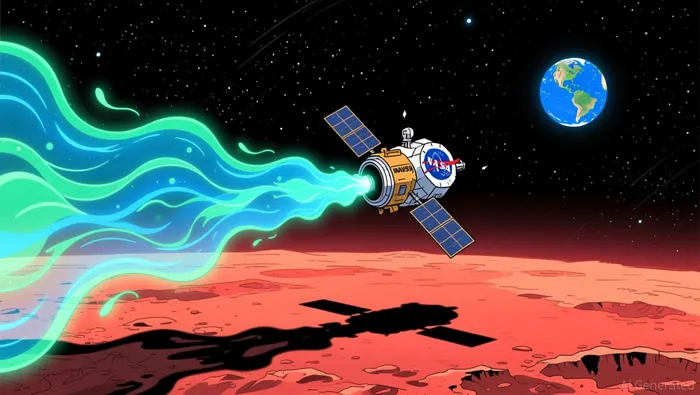 But perhaps just as vital, MAVEN has served as a key communications relay, transmitting data between the rovers on Mars and mission control on Earth. In this role, it’s been instrumental in ensuring the steady flow of scientific information and rover status reports back to NASA.
The spacecraft is not the only orbiter in this role—others, like the Mars Reconnaissance Orbiter and the European Space Agency’s Mars Express, also assist—but MAVEN’s long-standing contribution to Mars missions makes the loss particularly concerning. The sudden communication failure is unusual, especially given that the spacecraft was functioning normally before it passed behind Mars. That said, the exact cause of the outage remains unclear, and NASA is currently investigating the anomaly.
What’s at Stake, and How Big Is the Problem?
The communication loss is not just a technical hiccup—it’s a potential disruption to NASA’s ongoing Mars exploration efforts. Curiosity and Perseverance both rely on relays like MAVEN to send high-resolution images, scientific data, and even basic health checks back to Earth.
Moreover, the incident highlights the inherent risks of operating spacecraft in deep space. While NASA has decades of experience managing such systems, even the most robust technology can fail unexpectedly. The Mars orbit is crowded with satellites and rovers, but each mission depends on complex coordination. A single failure can ripple across the entire network, impacting the timeline and data output of multiple projects.
For investors tracking the broader space industry, this event serves as a reminder of the challenges and costs involved in long-term space exploration. While NASA is a government-funded agency, many private companies are now eyeing Mars as the next frontier. Companies like SpaceX and Blue Origin are working on future missions, and disruptions like the MAVEN outage underscore the technical hurdles that even the most seasoned spacefaring nations face.
Looking Ahead: What’s Next for NASA and Mars Missions?
NASA is currently conducting an engineering investigation into the cause of the communication loss, and teams are working to reestablish contact with MAVEN. The spacecraft is equipped with automated systems designed to handle such situations, including switching to backup systems or repositioning itself to reacquire a signal. Still, with the spacecraft now silent and no immediate solution in sight, the situation remains unresolved.
Even so, the has contingency plans and has deployed multiple relays, so the impact on daily rover operations may be limited for now. That said, if the issue persists, it could delay some key scientific goals or require a shift in how data is managed until the problem is resolved according to sources.
The MAVEN situation also highlights the importance of redundancy in space systems. As NASA and private companies plan more ambitious missions, including crewed flights to Mars, the reliability of communication and data transmission systems will be critical. For now, the focus remains on restoring contact with MAVEN and ensuring that continues without major disruptions.

Delivering real-time insights and analysis on emerging financial trends and market movements.
Latest Articles
Stay ahead of the market.
Get curated U.S. market news, insights and key dates delivered to your inbox.


AInvest
PRO
AInvest
PRO



Comments
No comments yet