
NASA Asteroid Tracking: What Investors Need To Know
 Aime Summary
- NASA continues to refine its asteroid tracking capabilities with a focus on detecting objects that could pose a future threat to Earth.
- Recent data indicates no immediate impact risk from known near-Earth objects as of March 2026.
- Government funding for planetary defense remains a stable component of the federal budget, supporting aerospace and defense contractors.
- Investors should distinguish between sensationalized news of "approaching" asteroids and the actual scientific probability of impact.
While headlines about space rocks often trigger a momentary spike in public anxiety, the reality for the financial markets is far more grounded. The National Aeronautics and Space Administration maintains a rigorous, data-driven approach to monitoring celestial bodies, ensuring that the narrative of an impending disaster remains largely theoretical rather than imminent. For investors, the primary takeaway is that planetary defense is a long-term strategic priority rather than a short-term catalyst for volatile market swings. Understanding the distinction between routine monitoring and genuine threat levels is crucial for making rational decisions in the space and defense sectors. The following analysis breaks down the current state of asteroid detection and what it means for the broader economy.
Is NASA Tracking An Asteroid Approaching Earth Right Now?
As of late March 2026, NASA's Planetary Defense Coordination Office (PDCO) continues its systematic survey of near-Earth objects (NEOs). The agency's primary goal is to catalog 90% of all NEOs larger than 140 meters, which are large enough to cause regional devastation in the event of an impact. While the phrase "asteroid approaching Earth" frequently appears in search queries, the scientific reality is that thousands of asteroids constantly pass by our planet. Most of these are small, harmless, and detected well in advance of their closest approach. The term "approaching" is technically accurate for any object moving toward our orbital distance, but it does not imply a collision course.
Recent monitoring efforts have focused on objects that pass within the Moon's distance or closer to our planet, known as Earth grazers. These events are often highlighted in the media, creating a perception of heightened risk. However, the data indicates that none of the currently tracked objects pose a significant threat in the foreseeable future. The agency utilizes advanced radar and optical telescopes to refine the trajectories of these objects, often reducing uncertainty to a level where a collision is ruled out with high confidence. This continuous monitoring serves as a critical infrastructure for global safety, ensuring that any potential threat is identified years, or even decades, in advance. The distinction between a close flyby and an impact risk is the key factor investors must understand when evaluating news coverage.
Why Does NASA Asteroid Detection Matter For The Economy?
The economic implications of asteroid detection extend far beyond the immediate safety of the planet. While the probability of a catastrophic impact is extremely low, the cost of being unprepared is theoretically infinite. Consequently, the U.S. government allocates significant funding to NASA's planetary defense initiatives, which in turn supports a network of contractors and research institutions. This funding flows into the aerospace and defense sectors, benefiting companies involved in satellite manufacturing, deep-space communication, and advanced sensor technology. These investments are not driven by short-term speculation but by a long-term strategic necessity to protect global assets.
Furthermore, the technology developed for asteroid tracking often finds applications in other high-growth industries. The optical systems, AI-driven trajectory prediction models, and radar technologies honed for planetary defense can be adapted for terrestrial uses, such as improving satellite collision avoidance in Low Earth Orbit (LEO). As the LEO market expands with the proliferation of commercial satellite constellations, the demand for robust tracking and avoidance systems grows. This creates a symbiotic relationship between government-funded planetary defense and private sector space logistics. Investors looking at the broader space economy should recognize that asteroid monitoring is a foundational element of the industry's infrastructure, rather than an isolated niche. The stability of these government contracts provides a baseline of revenue for many defense and technology firms, contributing to their long-term financial health.
How Do Recent Developments In Space Safety Impact Investment Strategy?
The landscape of space safety is evolving rapidly, with new missions and technological upgrades being deployed to enhance detection capabilities. Recent years have seen the launch of dedicated space telescopes and the integration of machine learning algorithms to process vast amounts of observational data. These developments are not merely scientific achievements; they represent tangible milestones that drive demand for specific technologies within the defense and commercial space markets. Companies that provide the hardware for these missions or the software for data analysis are positioned to benefit from increased government and private sector spending.
For the retail investor, the challenge lies in filtering out noise from signal. Sensationalized reports about asteroids can create a false narrative of immediate danger, leading to knee-jerk reactions. However, the fundamental drivers for investment in this sector remain the long-term growth of the space economy and the steady, non-discretionary nature of government funding for national security and planetary defense. The key is to focus on companies with diversified revenue streams that include space technology, rather than betting on the outcome of a specific asteroid event. As detection capabilities improve, the industry will likely shift focus toward mitigation technologies, such as deflection missions, which will open new avenues for investment and innovation. The bottom line is that space safety is a permanent fixture of the global economic landscape, offering steady growth opportunities for those who understand the underlying mechanics of the sector.
Ultimately, while the universe is vast and filled with moving rocks, the risk to human civilization remains managed through rigorous science and sustained investment. The narrative of an "asteroid approaching Earth" serves as a reminder of our vulnerability, but it also highlights the strength of the global response systems in place. For investors, the opportunity lies in supporting the technologies that keep us safe, rather than reacting to the transient headlines that accompany every close pass. By understanding the distinction between routine monitoring and genuine threat, stakeholders can make informed decisions that align with the long-term trajectory of the space and defense industries.
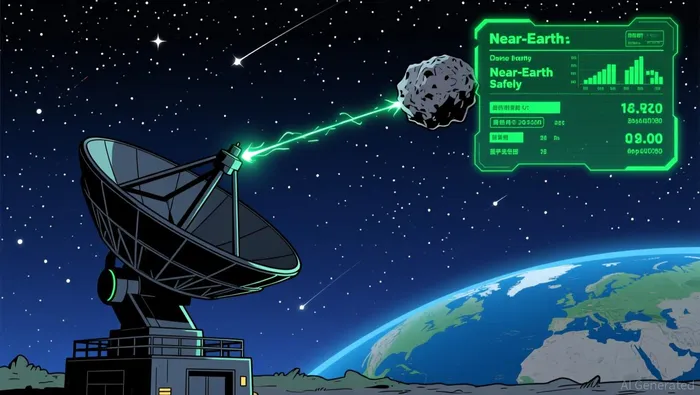
NASA continues to refine its asteroid tracking capabilities with a focus on detecting objects that could pose a future threat to Earth.
The National Aeronautics and Space Administration maintains a rigorous, data-driven approach to monitoring celestial bodies, ensuring that the narrative of an impending disaster remains largely theoretical rather than imminent. For investors, the primary takeaway is that planetary defense is a long-term strategic priority rather than a short-term catalyst for volatile market swings. Understanding the distinction between routine monitoring and genuine threat levels is crucial for making rational decisions in the space and defense sectors. The following analysis breaks down the current state of asteroid detection and what it means for the broader economy.

Stay ahead of the market.
Get curated U.S. market news, insights and key dates delivered to your inbox.


AInvest
PRO
AInvest
PRO



Comments
No comments yet