
NASA Artemis Launches April 1: Which Space Exploration Stocks Offer Investment Opportunities?
 Aime Summary
NASA is actively preparing to launch the Artemis II mission from Florida's Kennedy Space Center as early as April 1. This 10-day mission will carry four astronauts—Reid Wiseman, Victor Glover, Christina Koch, and Jeremy Hansen—around the moon and back. The mission serves as a critical validation step for the Space Launch System (SLS) rocket and the Orion crew capsule.
The financial scale of this endeavor is massive. By 2025, overall Artemis-related expenditures are expected to reach $93 billion. Furthermore, the cost of utilizing the SLS and the Orion capsule will exceed $4 billion for each of the first four launches. This clearly demonstrates that the return to the moon is not a one-time performance, but rather a long-term space exploration investment cycle. Consequently, a specific network of supply chain companies stands to capture substantial cash flow from these sustained government budgets. A breakdown of these financial allocations and their distribution among primary contractors can be reviewed below. According to Ainvest analysis, the funding trajectory illustrates a clear reliance on established aerospace infrastructure.
The Artemis Supply Chain: Solving Critical Deep Space Challenges
The Artemis program relies on a vast network of contractors addressing highly complex technical hurdles.
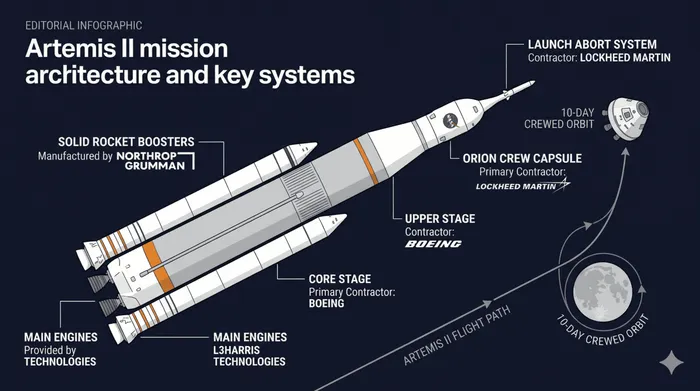
- Deep Space Launch Systems: The SLS rocket must propel the crew capsule and massive payloads into a lunar transfer orbit. This requires extreme reliability across the core stage, solid rocket boosters, and main engines, which has been a primary source of timeline delays. BoeingBA-- serves as the primary contractor for the SLS core stage and the upper stage. Northrop GrummanNOC-- is responsible for manufacturing the solid rocket boosters. Additionally, L3Harris TechnologiesLHX-- provides the main engine systems and maneuvering propulsion.
- Crew Flight and Deep Space Infrastructure: The Orion spacecraft must successfully complete a 10-day crewed orbit, validate deep space communication, and execute a safe reentry. Lockheed MartinLMT-- is the primary contractor building the Orion crew capsule and its launch abort systems. Airbus supports this architecture by constructing the European Service Module, which provides propulsion, power, and life support resources like water and oxygen. Furthermore, Jacobs provides long-term services for the launch site and ground support systems.
- Next-Generation Landers and Infrastructure: To handle the actual lunar descent in future missions, NASA has outsourced development to private enterprises. SpaceX and Blue Origin are developing separate lunar landing systems that require complex in-space refueling. Axiom Space holds the contract to build innovative lunar spacesuits for surface exploration.
Which Stocks Will Benefit Most from the NASA Artemis Return?
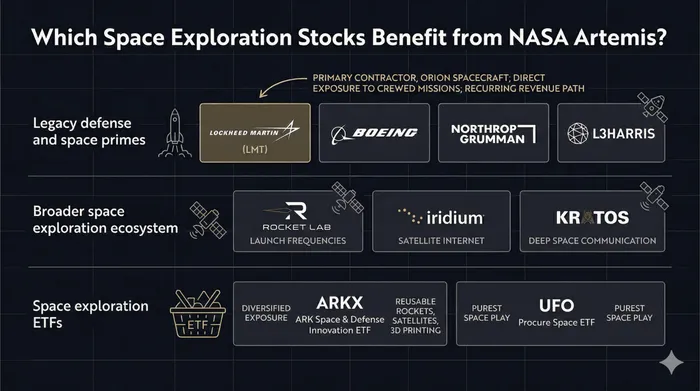
- Legacy Defense and Space Primes: Companies such as Lockheed Martin, Boeing, Northrop Grumman, and L3HarrisLHX-- form the foundation of the space infrastructure. Boeing, while currently managing commercial aircraft controversies, gains long-term order visibility through its SLS contracts. Northrop Grumman and L3Harris represent classic "low-profile, high-tech" space exploration component leaders.
- Focus on Lockheed Martin (LMT): Among the legacy primes, Lockheed Martin benefits most directly from the crewed mission parameters. As the lead contractor for the Orion spacecraft, the company is central to multiple deep-space contracts. Its core defense business provides a stable revenue floor, while the Artemis program introduces an additional, highly visible growth curve. Because the Orion capsule is mandatory for transporting astronauts safely to lunar orbit and back, Lockheed Martin secures recurring revenue across the $93 billion budget timeline, positioning it as a fundamental beneficiary of the lunar return.
- Broader Space Exploration Ecosystem: Smaller, specialized firms are also positioned for growth. Companies like Rocket LabRKLB--, Iridium, and Kratos have direct exposure to increased launch frequencies, satellite internet demands, and deep space communication requirements.
- Space Exploration Thematic ETFs: For investors seeking diversified exposure without selecting individual stocks, thematic ETFs are highly relevant. The ARK Space & Defense Innovation ETF (ARKX) is an actively managed fund covering reusable rockets, satellites, and 3D printing. Alternatively, the Procure Space ETF (UFO) is viewed as a purer space play, offering a basket of satellite operators and related hardware companies based on revenue percentage screening.
Investor Reminders: Do Not View the "Moon Story" as a One-Time Event
As the timeline extends, investors must maintain a structural perspective on the aerospace sector.
- Extended Timelines Do Not Mean a Broken Narrative: The Artemis program has faced multiple delays over the years, primarily due to heightened safety requirements and technical redundancies. However, the program's budget has not been withdrawn; instead, it has steadily accumulated toward the $93 billion mark. For major contractors, these schedule shifts effectively act as an elongation of the order curve rather than a loss of revenue.
- Strategic Trading Execution: Comprehensive defense and space conglomerates—such as Lockheed Martin, Boeing, Northrop Grumman, and L3Harris—are well-suited to serve as medium-to-long-term portfolio foundations. Conversely, pure-play space exploration stocks and specialized ETFs like ARKX and UFO are more appropriate for rhythmic trading strategies aligned with specific launch windows and major contract announcements.
- Risk Warning: The space exploration sector is inherently a high-volatility track. Investment risks include congressional budget disputes, severe technical failures, and extended high valuations. Therefore, strict position management and portfolio sizing are far more critical than attempting to predict exact launch dates.

Tianhao Xu is currently a financial content editor, focusing on fintech and market analysis. Previously, he worked as a full-time forex trader for several years, specializing in global currency trading and risk management. He holds a master’s degree in Financial Analysis.
Latest Articles
Stay ahead of the market.
Get curated U.S. market news, insights and key dates delivered to your inbox.
AInvest
PRO
AInvest
PRO



Comments
No comments yet