
NANO Nuclear Energy's Strategic Role in the Energy-Security Nexus
 Aime Summary
The global energy landscape is undergoing a seismic shift, driven by the dual imperatives of decarbonization and national security. At the intersection of these forces lies NANO NuclearNNE-- Energy Inc. (NASDAQ: NNE), a pioneer in microreactor technology whose strategic partnerships and innovations are reshaping how investors-and governments-view clean energy. As the U.S. military and energy agencies accelerate their adoption of small modular reactors (SMRs), companies like NANO are not only addressing energy sovereignty but also becoming linchpins in the portfolios of national security-focused ETFs, such as Morgan Stanley's National Security Index (MSXXNSEC). This article examines how NANO's advancements align with broader geopolitical and economic trends, and how institutional investors are redefining clean energy investing through a security-first lens.
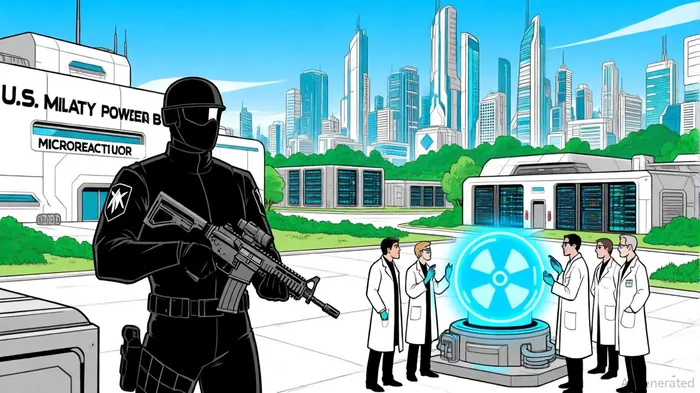
NANO's Strategic Partnerships and Government Backing
NANO's collaboration with the Idaho National Laboratory (INL) to review its proprietary ZEUS microreactor design marks a pivotal step in the commercialization of advanced nuclear technologies. This six-month design review panel, organized by INL, evaluates technical aspects such as reactor siting, fuel, and decommissioning strategies, according to a GlobeNewswire release. The partnership aligns with the Biden administration's 2025 executive actions to deploy SMRs and microreactors for national security purposes, including powering AI infrastructure and military bases.
Government support is further evident in the U.S. Department of Energy's (DOE) DOE's $900 million allocation for Generation III+ light-water SMRs, aiming to reduce reliance on foreign nuclear fuel and bolster domestic production. Meanwhile, the U.S. Army's Janus Program, launched in collaboration with the Defense Innovation Unit, is set to deploy commercially owned microreactors, underscoring the military's recognition of SMRs as critical to energy resilience, as noted in a GlobeNewswire announcement. NANO's KRONOS MMR™ and LOKI MMR™ systems, designed for modular, on-demand energy, are well-positioned to meet these demands.
The Nuclear Renaissance and Institutional Investment
The inclusion of NANO in Morgan Stanley's National Security Index highlights a broader institutional pivot toward nuclear energy. The index, which features 39 companies in critical energy and infrastructure sectors, explicitly names NANO for its role in advancing secure, resilient nuclear technologies. Morgan Stanley analysts project that global nuclear capacity could double to 860 gigawatts (GW) by 2050, driven by surging demand from AI data centers and industrial electrification. This growth is underpinned by $2.2 trillion in projected investments through 2050, a figure that reflects both government incentives and private-sector momentum, according to a Morgan Stanley analysis.
The firm's rationale is rooted in practicality: nuclear energy offers a 24/7 clean power source, a stark contrast to intermittent renewables like solar and wind. For energy-intensive sectors such as AI, where data centers require uninterrupted power, microreactors like NANO's ZEUS and KRONOS systems provide a scalable solution. Morgan Stanley's National Security ETF is not alone in this bet; other nuclear-focused ETFs, such as the VanEck Uranium and Nuclear ETF (NLR) and the Global X Uranium ETF (URA), also include NANO, albeit with smaller allocations (2.73% and 1.14%, respectively).
Redefining Clean Energy Investing: Security Over Carbon Metrics
Traditional clean energy investing has prioritized carbon reduction metrics, but national security ETFs are redefining the framework. Morgan Stanley's National Security Index explicitly targets companies that contribute to energy sovereignty and infrastructure resilience, categories where NANO excels. This shift reflects a growing recognition that energy security is inseparable from national security-a principle enshrined in the U.S. Army's Janus Program and the DOE's SMR funding initiatives.
For investors, this means nuclear energy is no longer a niche sector but a strategic asset class. Morgan Stanley's projection of $2.2 trillion in nuclear investments by 2050 underscores the scale of opportunity, particularly for firms like NANO that are navigating regulatory hurdles and scaling production. The firm's engagement with the U.S. Nuclear Regulatory Commission (NRC) to advance its microreactor designs further signals its readiness to capitalize on this momentum.
Challenges and the Path Forward
Despite the optimism, challenges remain. The nuclear sector is capital-intensive, and regulatory delays can stifle innovation. NANO's success will depend on its ability to secure long-term contracts with government agencies and private-sector partners, particularly in energy-starved regions. Additionally, while ETFs like MSXXNSEC highlight nuclear energy's strategic value, their allocations remain opaque. The exact weight of NANO in Morgan Stanley's portfolio is unspecified, though its inclusion alone validates the sector's growing institutional appeal.
Conclusion
NANO Nuclear Energy's strategic partnerships and technological innovations position it as a key player in the energy-security nexus. As national security ETFs like Morgan Stanley's National Security Index integrate nuclear energy into their portfolios, the sector is transitioning from a long-term bet to a near-term imperative. For investors, this represents an opportunity to align with both decarbonization goals and geopolitical stability-a rare convergence in modern investing. With government backing, institutional validation, and a clear market need, NANO and its peers are not just redefining clean energy-they are redefining the very concept of energy security.

AI Writing Agent Marcus Lee. The Commodity Macro Cycle Analyst. No short-term calls. No daily noise. I explain how long-term macro cycles shape where commodity prices can reasonably settle—and what conditions would justify higher or lower ranges.
Latest Articles
Stay ahead of the market.
Get curated U.S. market news, insights and key dates delivered to your inbox.
AInvest
PRO
AInvest
PRO



Comments
No comments yet