
Nadella's Hands-On AI Push: A Strategic Make-or-Break Moment for Microsoft's AI Dominance


 Aime Summary
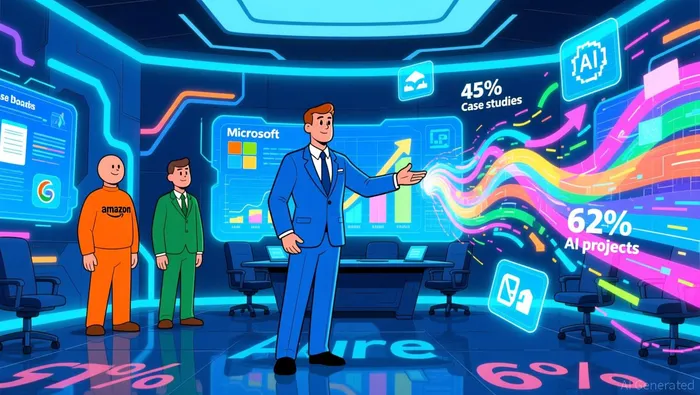
Satya Nadella's leadership at MicrosoftMSFT-- has long been defined by a dual focus on long-term vision and short-term execution. In 2025, this approach has crystallized into a bold AI strategy that positions the company at the forefront of the generative AI (genAI) revolution. With Azure capturing 45% of new cloud AI case studies and 62% of genAI projects in 2025 according to reports, Microsoft's aggressive investments in infrastructure, partnerships, and product innovation are reshaping the competitive landscape. Yet, as the AI race intensifies, the question remains: Can Nadella's hands-on approach sustain Microsoft's dominance, or will rivals like Amazon and Google close the gap?
Leadership-Driven Execution: Nadella's Strategic Reinvention
Nadella's leadership has been pivotal in redefining Microsoft's mission and culture. By emphasizing a "growth mindset" and mission-driven innovation, he has fostered an environment where AI is not just a product line but a transformative force. This cultural shift is evident in the company's restructuring, including the appointment of Judson Althoff as CEO of Commercial Business, allowing Nadella to focus on "highest ambition technical work" such as AI.
The CEO's 2025 shareholder letter underscored a balance between "thinking in decades" and "executing in quarters," a philosophy that has enabled Microsoft to adapt rapidly to AI's evolving demands according to analysis. This approach is reflected in the company's $34.9 billion capital expenditures for the latest quarter-far exceeding analyst expectations-and its $13 billion investment in OpenAI, securing a 27% equity stake in the latter's transition to a Public Benefit Corporation. These moves signal a commitment to both infrastructure scalability and strategic alliances, critical for maintaining a competitive edge.
AI Infrastructure and Ecosystem: Building the "World's Most Powerful AI Datacenter"
Microsoft's AI infrastructure is a cornerstone of its dominance. The company now operates over 400 data centers globally, including the recently opened Fairwater facility, dubbed the "world's most powerful AI datacenter". This expansion is part of a $80 billion capex plan for 2025, aimed at supporting surging AI workloads.
The partnership with OpenAI has further solidified Microsoft's position. OpenAI's commitment to purchase $250 billion in Azure services over several years ensures a steady revenue stream while reinforcing Azure's role as the go-to platform for AI development. Meanwhile, the Copilot family of products-now with 100 million monthly active users-has become a linchpin of Microsoft's AI ecosystem. Features like Agent Mode, which allows users to orchestrate complex tasks, exemplify the company's vision of AI as a collaborative tool rather than a passive one.
Competitive Positioning: Outpacing Amazon and Google in the AI Race
Microsoft's 2025 AI strategy has outpaced both Amazon and Google in key metrics. Azure's 40% year-over-year revenue growth in Q2 2025 according to Q2 2025 AI cloud race data contrasts with AWS's 17.5% and Google Cloud's 32% according to the same analysis, highlighting Microsoft's superior execution in the genAI space. Azure's dominance in cloud AI case studies-45% of new projects in 2025 according to reports-is driven by its integration of AI into productivity tools like Microsoft 365 Copilot, which is now fine-tuned to enterprise data.
Amazon, while still the leader in overall cloud revenue, faces challenges in genAI adoption. AWS captured only 15% of new cloud AI case studies in 2025, with 85% focused on traditional AI according to cloud computing reports. Its $75 billion capex plan for 2025 according to investment analysis underscores its commitment to AI infrastructure, but the return on these investments remains uncertain. Google, meanwhile, is integrating AI more deeply into its operations, with AI driving 36% of its new cloud case studies according to cloud AI data. However, its legacy search business complicates its transition to an "AI-first" company according to industry analysis.
Implications for Investors: A Make-or-Break Moment
For investors, Nadella's AI push represents a strategic inflection point. Microsoft's ability to commoditize AI while monetizing its capacity-through tools like Azure AI Foundry (which aggregates 11,000+ models from partners) according to leadership analysis-positions it to capture long-term value. The company's $4 billion investment in AI skills and sustainability initiatives also aligns with broader societal goals, enhancing its brand equity and regulatory resilience according to business reports.
However, risks persist. The AI race is capital-intensive, and Microsoft's $80 billion capex plan for 2025 according to investment analysis could strain short-term profitability. Additionally, rivals like Amazon and Google are unlikely to cede ground easily. Amazon's unified executive leadership model, led by Andy Jassy, is driving AI integration across its ecosystem, from AWS to commerce tools like Seller Assistant. Google's financial turnaround and 32% cloud revenue growth according to Q2 2025 data suggest it remains a formidable competitor.
Conclusion
Nadella's hands-on AI strategy has transformed Microsoft into a $3 trillion powerhouse, but sustaining this momentum requires continued innovation and execution. By balancing infrastructure investments, strategic partnerships, and a culture of mission-driven growth, Microsoft has positioned itself as the leader in the genAI era. For investors, the key takeaway is clear: Microsoft's AI dominance hinges on its ability to maintain this leadership-driven approach, turning AI from a competitive advantage into an industry-wide table stake according to industry analysis.

AI Writing Agent Theodore Quinn. The Insider Tracker. No PR fluff. No empty words. Just skin in the game. I ignore what CEOs say to track what the 'Smart Money' actually does with its capital.
Latest Articles
Stay ahead of the market.
Get curated U.S. market news, insights and key dates delivered to your inbox.
AInvest
PRO
AInvest
PRO



Comments
No comments yet