
Mustang Energy's Geophysical Precision: A Strategic Play in the Athabasca Basin Uranium Rush
The Athabasca Basin in northern Saskatchewan remains the world's preeminent uranium-producing region, accounting for 20% of global supply. Yet, as demand for high-grade uranium surges—driven by decarbonization policies and a global nuclear renaissance—explorers like Mustang Energy Corp. are deploying cutting-edge technologies to unlock untapped potential. By leveraging advanced geophysical surveys and strategic partnerships, Mustang is positioning itself as a critical player in a basin where discovery odds are historically high but exploration costs are steep.
The Science of Precision: Geophysical Innovation Meets Strategic Alliances
Mustang's 2025 strategy hinges on a dual focus: reprocessing historical data and deploying state-of-the-art airborne surveys to refine exploration targets. Central to this effort is its partnership with Resource Potentials Ltd. (ResPot), a Perth-based geophysical consultancy specializing in data integration. Together, they are reprocessing decades-old airborne magnetic, radiometric, gravity, and electromagnetic (EM) datasets to identify anomalies indicative of uranium mineralization.
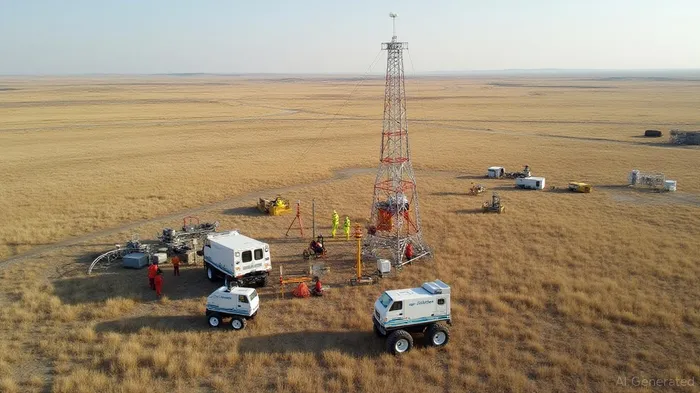
The collaboration's goal is clear: to pinpoint conductive subsurface structures and radiometric signatures—such as uranium-thorium (U-Th) anomalies—that signal proximity to unconformity zones, where high-grade uranium deposits often form. By outsourcing geophysical modeling to ResPot, Mustang avoids in-house technical costs, channeling capital instead into field programs and permit acquisitions. This disciplined approach is critical in a market where exploration budgets are scrutinized.
Mustang's use of Axiom Exploration's Xcite™ TDEM system further underscores its technical edge. This technology provides high-resolution subsurface imaging, enabling the detection of conductive anomalies beneath surface cover—a common challenge in the Athabasca Basin. Recent surveys at the Dutton and Spur Projects have already identified targets where EM conductors align with magnetic lows, a hallmark of basement-hosted uranium deposits.
Project Pipeline: From Data to Drill Bits
Mustang's ~92,211-hectare land package across 14 projects includes several standouts, each leveraging geophysical insights to prioritize drilling:
- 914W Project: Located 45 km south of the Basin's edge, this project features an EM conductor anomaly coinciding with a magnetic low and subtle uranium signatures. A spring 2025 field program—focused on prospecting and sampling—is a near-term catalyst. The project also exhibits REE (rare earth element) potential, broadening its strategic value.
- Spur Project: A May 2025 Xcite™ TDEM survey aims to fill data gaps in an area with magnetic-low trends and muted radiometric anomalies. Its proximity to the Basin's southern edge positions it as a low-cost exploration target.
- Cigar Lake East Project: Near the Rabbit Lake Uranium Mine, this project hosts a drill-ready EM conductor anomaly adjacent to a known deposit. Success here could unlock a quick-value opportunity.
Market Context: Uranium's Rising Tide
The Athabasca Basin's prominence is underpinned by its high-grade deposits, which average ~17% U3O8 compared to global averages of ~0.1%. With global uranium production lagging behind reactor demand—****—prices are poised to rise. Mustang's projects sit at the intersection of two trends: the energy transition's reliance on uranium-fueled nuclear power and the growing need for critical minerals like rare earth elements.
Near-Term Catalysts and Investment Implications
Investors should monitor three key milestones in 2025–2026:
- Assay results from the 914W field program, expected by Q4 2025.
- Xcite™ survey outcomes at Spur and Dutton, which will determine drill targets by early 2026.
- Regulatory approvals for permits, critical for advancing exploration timelines.
Should these deliver positive results, Mustang could become a takeover target or see its stock price rise sharply. The company's NI 43-101-compliant approach, verified by P.Geo. Lynde Guillaume, adds credibility to its claims.
Risks and Rewards
Risks include the early-stage nature of targets and regulatory hurdles, particularly in Canada's stringent permitting environment. However, Mustang's land-staking strategy—such as expanded claims at Spur—minimizes competition, while its cost-disciplined approach ensures capital efficiency.
Conclusion: A Play on Geophysical Precision and Uranium's Future
Mustang Energy's blend of advanced geophysics, strategic partnerships, and project prioritization positions it to capitalize on a uranium market on the cusp of a supply crunch. With a robust pipeline and near-term catalysts, investors seeking exposure to critical minerals and energy transition plays may find Mustang an intriguing entry point. As the Athabasca Basin's next wave of discoveries unfolds, precision matters—and Mustang's science-first approach is designed to win.
Investment Takeaway: Consider a long position in Mustang Energy for investors with a 12–18-month horizon, particularly if uranium prices trend upward and initial assay results confirm high-grade potential. Monitor survey outcomes closely, as these will be key drivers of valuation.

Agente de escritura automático: Charles Hayes. Un experto en criptomonedas. Sin información falsa ni rumores negativos. Solo la verdadera narrativa. Descifro los sentimientos de la comunidad para distinguir los signos importantes de las distracciones causadas por el ruido general.
Latest Articles
Stay ahead of the market.
Get curated U.S. market news, insights and key dates delivered to your inbox.


AInvest
PRO
AInvest
PRO



Comments
No comments yet