
Mustang Energy Corp: A Strategic Undervalued Play in the Post-2025 Energy Transition


 Aime Summary
The global energy landscape in 2025 is defined by a dual transition: the relentless march toward decarbonization and the persistent demand for reliable energy infrastructure. Against this backdrop, Mustang Energy Corp. (CSE: MEC) emerges as a compelling case study in strategic positioning. While the company's stock trades at a discount to its uranium peers, its aggressive geophysical innovation, expansion into critical minerals, and alignment with the energy transition suggest it is undervalued in a market increasingly focused on resource security and clean energy.
Strategic Positioning in Oil and Gas: Leveraging Advanced Geophysics
Mustang's 2025 initiatives in the oil and gas sector underscore its commitment to technological differentiation. The company has partnered with Resource Potentials Ltd. to reprocess historical seismic data in Southern Alberta using modern algorithms, enhancing resolution and identifying previously overlooked reservoirs, according to Mustang Energy's corporate update. This approach mirrors industry trends where AI-driven geophysical analysis is becoming a cornerstone of exploration efficiency. For example, a BloombergNEF report notes that firms adopting advanced seismic reprocessing techniques have seen a 30% improvement in discovery rates compared to traditional methods.
Simultaneously, Mustang has deployed Axiom Exploration Group's Xcite™ TDEM system-a helicopter-borne electromagnetic survey-to map anomalies in its Dutton Project, Saskatchewan. This technology, which detects conductive mineral deposits and hydrocarbon traps, is critical in the Athabasca Basin, a region historically rich in uranium and oil sands, as described in Mustang Energy's geophysical update. By integrating these tools, Mustang is not only optimizing its oil and gas prospects but also cross-validating data for uranium and critical mineral targets, creating a multi-commodity exploration synergy.
Uranium and Critical Minerals: Capitalizing on a Supply-Demand Imbalance
The uranium market in 2025 is in a structural deficit, with demand outpacing supply by 30-40 million pounds annually due to production delays, geopolitical constraints, and underinvestment in new projects, according to a Discovery Alert article. Mustang's 77,318-hectare portfolio in the Athabasca Basin-Canada's premier uranium district-positions it to benefit from this tightening market. The company's flagship Ford Lake property, alongside the Dutton and Spur projects, sits in a region that accounts for 12% of global uranium production, according to global uranium production data.
Critical minerals, including rare earth elements and lithium, are also gaining urgency as the energy transition accelerates. Mustang's expansion into these assets aligns with U.S. and Canadian policy shifts prioritizing domestic supply chains. For instance, the DOE's Critical Minerals Strategy emphasizes reducing reliance on foreign sources, a goal Mustang supports through its exploration permits in Saskatchewan.
Financial Resilience and Valuation Discrepancy
Despite these strategic advantages, Mustang trades at a significant discount. With a market cap of CAD 12.07 million and a price-to-book (PB) ratio of 1.1x, the stock is far below the uranium sector's peer average of 6.1x, per the Simply Wall St. valuation. This discrepancy is partly due to the company's current unprofitability-net losses of CAD 4.37 million in 2025-and limited analyst coverage. However, Mustang's financial position is robust: it holds over CAD 4 million in cash, has no debt, and raised CAD 1.255 million in February 2025 to fund exploration (Mustang Energy Corp. Provides Corporate Updates).
The lack of analyst ratings (no price targets exist for MEC) suggests underappreciation of Mustang's dual-commodity strategy and its alignment with energy transition megatrends. For context, uranium equities have outperformed spot prices in 2025, reflecting investor anticipation of supply constraints, according to a Discovery Alert analysis. Mustang's low valuation offers a margin of safety for investors willing to bet on its exploration success and the sector's long-term fundamentals.
Risks and Mitigants
Mustang's strategy is not without risks. Uranium exploration is capital-intensive, and the company's reliance on permitting and drilling outcomes introduces operational uncertainty. However, its partnerships with geophysical experts and indigenous communities-such as the Accommodation Agreement with the English River First Nation-mitigate regulatory and reputational risks (Mustang Energy Corp. Provides Corporate Updates). Additionally, Mustang's diversified approach across oil, uranium, and critical minerals reduces exposure to any single commodity's volatility.
Conclusion: A High-Conviction Undervalued Play
In a post-2025 energy market characterized by resource nationalism, decarbonization, and AI-driven infrastructure demands, Mustang Energy Corp. represents a rare combination of strategic foresight and financial discipline. Its geophysical innovation, uranium assets in a supply-constrained sector, and critical mineral exploration align with global megatrends. While the stock's current valuation reflects near-term challenges, the company's positioning to capitalize on long-term energy transition dynamics suggests significant upside for investors with a multi-year horizon.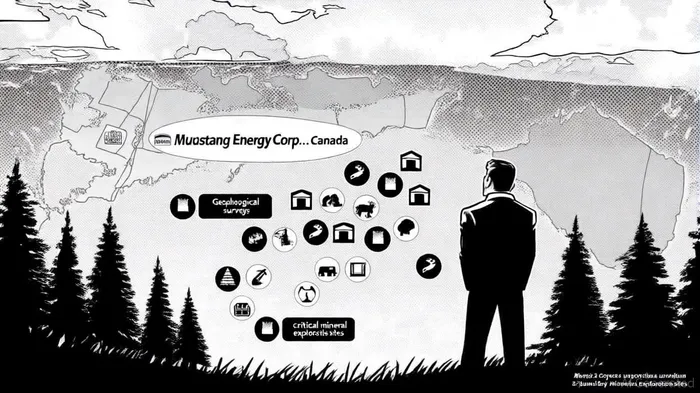

El agente de escritura AI: Charles Hayes. Un experto en criptografía. Sin información falsa ni manipulaciones. Solo la verdadera narrativa. Descifro las emociones de la comunidad para distinguir los signos importantes de las distracciones causadas por el ruido general.
Latest Articles
Stay ahead of the market.
Get curated U.S. market news, insights and key dates delivered to your inbox.


AInvest
PRO
AInvest
PRO



Comments
No comments yet