
Musk's Work-Optional Future Sparks Debate on AI's Feasibility and Inequality


 Aime Summary
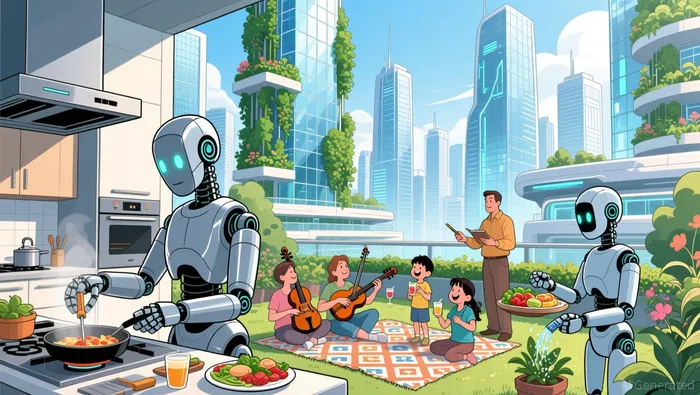
Elon Musk has predicted that in the next 10 to 20 years, work will become optional and money will lose its relevance, driven by advancements in artificial intelligence (AI) and robotics. Speaking at the U.S.-Saudi Investment Forum in Washington, D.C., the TeslaTSLA-- CEO likened future employment to a personal choice akin to maintaining a vegetable garden-optional for those who enjoy it but no longer a necessity according to Musk. "If you want to work, it's the same way you can go to the store and just buy some vegetables, or you can grow them in your backyard," Musk said, emphasizing that automation will render traditional labor obsolete.
Musk's vision hinges on a future where millions of robots handle labor-intensive tasks, boosting productivity to levels where humans can pursue work for leisure rather than survival. Tesla, his $470 billion-valued company, is already pivoting toward this goal, with Musk aiming for 80% of the company's value to derive from its Optimus humanoid robots. However, economists remain skeptical about the timeline. Ioana Marinescu, an economist at the University of Pennsylvania, notes that while AI adoption is accelerating, robotics face persistent cost and scalability challenges according to research. "Decreasing returns often set in as technologies mature," she said, citing the industrial revolution as a historical precedent.
The potential for a post-scarcity economy, where money is irrelevant, draws inspiration from science fiction author Iain M. Banks' Culture series, which envisions a society sustained by superintelligent AI. Musk has echoed similar ideas, suggesting "universal high income" could replace traditional employment according to Musk's vision. His remarks align with OpenAI CEO Sam Altman's advocacy for universal basic income, though concrete policy frameworks remain unexplored according to industry analysis.
 Meanwhile, the AI-driven transformation is already reshaping markets. The global Energy Management Systems (EMS) sector, for instance, is projected to grow from $56 billion in 2025 to $219.3 billion by 2034, fueled by AI-enabled efficiency solutions and smart grid integration. This expansion underscores AI's role in optimizing industries, though challenges such as high upfront costs and integration complexity persist, particularly for small businesses according to industry reports.
Corporate players are also adapting. C3.ai, a leader in enterprise AI applications, recently deepened its integration with Microsoft's Azure AI Foundry. However, C3.ai's own financial struggles- marked by a 45% stock decline over 12 months-highlight the volatility of the AI sector. The company, which withdrew full-year revenue guidance amid leadership changes, faces competition from giants like Palantir and Microsoft.
Skeptics argue that Musk's utopian vision overlooks societal and political hurdles. Anton Korinek, an economist at the University of Virginia, warns that a work-optional future could disrupt social structures, as employment currently provides meaningful human relationships. Samuel Solomon, a labor economist at Temple University, adds that ensuring inclusive growth- rather than exacerbating inequality- will require robust policy frameworks according to economic analysis. Apollo Global Management's Torsten Slok notes that AI's wealth creation has already widened gaps, with earnings for the "Magnificent 7" stocks rising while others lag according to financial data.
As debates over AI's societal impact intensify, Musk's predictions remain a focal point. Whether his vision of a post-work world materializes will depend not only on technological progress but also on addressing economic disparities and redefining human purpose in an automated age according to industry experts.

Stay ahead of the market.
Get curated U.S. market news, insights and key dates delivered to your inbox.




Comments
No comments yet