
Musk Team Secretly Visits China Solar: Which HJT & Perovskite companies Were Targeted?
 Aime Summary
UPDATE: JinkoSolarJKS-- Confirms Visit, Shares Hit 20% Limit
In a significant development, a JinkoSolar representative officially confirmed to local media that the company recently hosted Musk's delegation to inspect "technology reserves and production equipment." The representative further noted that "mainstream domestic photovoltaic enterprises were also visited," though specific cooperation details remain confidential.
Following this confirmation, JinkoSolar (688223.SH) surged in afternoon trading, hitting its 20% daily limit. This official validation has fueled speculation that a broader industry partnership is imminent, rather than an isolated event.
UPDATE2: More Companies Released
On February 4, industry insiders revealed that Musk’s team conducted site visits last week at TCL Zhonghuan, JinkoSolar, and Jingsheng Electromechanical. While the companies have not directly responded to verify these specific details, the inclusion of TCL Zhonghuan is critical for US investors: the firm is the controlling shareholder (>50% stake following a 2024 restructuring) of Maxeon Solar TechnologiesMAXN-- (NASDAQ: MAXN), creating a direct link between this tour and a US-listed entity.
According to Sina Finance close to the matter, Elon Musk’s team recently conducted a secret tour of top-tier Chinese photovoltaic enterprises, specifically targeting manufacturers specializing in Heterojunction (HJT) and Perovskite technologies. The team reportedly inspected production lines involving equipment, silicon wafers, and battery modules, with confirmed contacts stating that "the content of the inspection needs to remain confidential".
This move is a decisive, albeit controversial, masterstroke for Tesla (TSLA). While Washington tightens trade barriers, Musk is likely effectively shorting geopolitical friction to go long on energy physics. Tesla’s energy generation and storage division has long been margin-constrained by high Western component costs. By tapping into China’s hyper-efficient HJT and Perovskite supply chains, Tesla could potentially secure a cost advantage that US competitors—insulated by tariffs—cannot match. This isn't just a procurement trip; it's an attempt to secure the "lithium" of the next decade: high-efficiency solar cells.
The Great Wall of Silicon: Cost and Scale
To understand why Musk is ignoring political headwinds, one must look at the spread in unit economics. As of early 2026, the cost disparity between US and Chinese solar modules is unignorable.
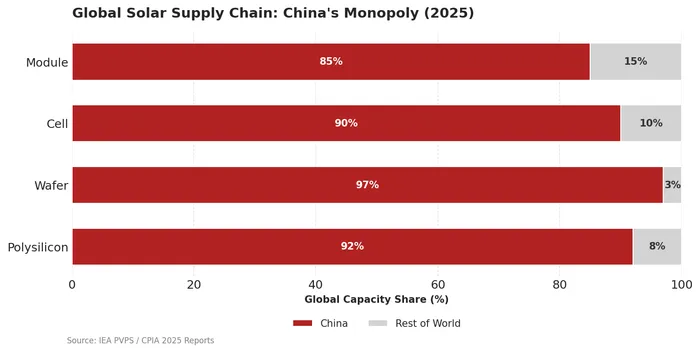
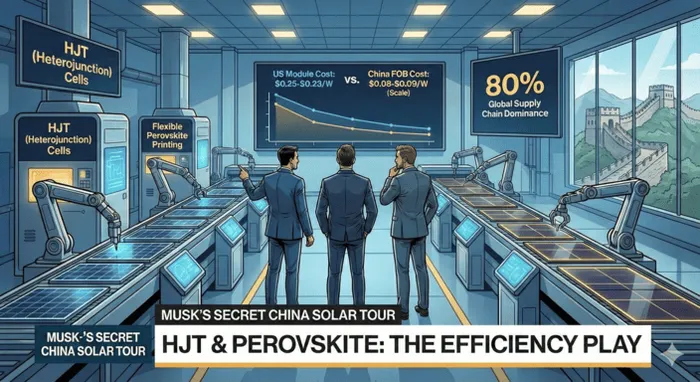
China currently dominates over 80% of the global solar supply chain, from polysilicon to modules. While US protectionist policies have kept domestic module prices elevated—hovering around $0.25–$0.28 per watt due to tariffs—Chinese FOB (Free On Board) prices for top-tier modules have stabilized near a rock-bottom $0.08–$0.09 per watt.
For a company like Tesla, which aims to deploy terawatt-scale energy storage and generation, this 3x cost difference is the difference between a niche product and global ubiquity. Musk’s "Master Plan" requires massive scale, and the data suggests that scale currently resides in China. Leading manufacturers like JinkoSolar (JKS) and Tongwei have ramped up capacity to levels where their "marginal cost" is effectively the global floor. By engaging directly with these giants, Tesla is likely signaling that it refuses to let its energy margins be dictated by US trade inefficiency.
Heterojunction (HJT): The Efficiency Play
The specific interest in Heterojunction (HJT) technology reported in the visit is particularly telling. HJT is not just a buzzword; it is the natural successor to the current PERC and TOPCon standards, offering higher conversion efficiencies (often exceeding 25-26%) and lower degradation rates over time.
For Tesla’s Megapack and Powerwall ecosystem, energy density is paramount. HJT cells perform better in hot climates (lower temperature coefficient) and offer superior bifaciality (generating power from the back side), making them ideal for utility-scale projects where land and balance-of-system (BOS) costs are high.
China is currently the undisputed leader in HJT mass production. Companies like Huasun Energy and Risen Energy have been aggressive in scaling HJT gigafactories, driving down the "green premium" of this advanced tech. If Musk secures a supply of low-cost HJT cells, he could increase the energy density of Tesla’s solar roof and commercial installations without increasing the physical footprint—a critical factor for residential adoption.
Perovskite: The "Holy Grail" for Tesla’s Ecosystem
Perhaps the most intriguing detail is the team's focus on Perovskite . This technology is often called the "holy grail" of solar because it can be printed on flexible substrates and theoretically offers higher efficiencies than silicon when used in tandem layers.
Why is Musk interested? Three words: Vehicle Integrated Photovoltaics (VIPV).
Current silicon cells are rigid and heavy, making them difficult to integrate into the curved, aerodynamic surfaces of a Model Y or the upcoming Cybercab. Perovskites, however, can be flexible and translucent. Leading Chinese players like GCL Perovskite (a subsidiary of GCL Tech) and UtmoLight have been pushing the boundaries of commercial viability, moving from lab records to pilot production lines.
Imagine a Tesla Cybercab coated in a "solar skin" that adds 20-30 miles of range per day, or Starlink terminals with integrated, lightweight power sources. The synergy is obvious. While US firms like First Solar are researching this, Chinese companies are arguably faster at moving to the "pilot manufacturing" phase. A partnership here would give Tesla a proprietary edge in EV efficiency that no other automaker could easily replicate.
Market Reaction:China’s Solar Sector Ignites on "Musk Narrative"
The confirmation of the secret visit, combined with Musk's newly announced ambition to deploy 200GW of photovoltaic capacity and establish space-based data centers following SpaceX's acquisition of xAI, set off a powder keg in the Chinese market on February 4. Investors aggressively repriced assets linked to HJT, Perovskite, and the emerging "Space Solar" concept, betting that Musk’s aggressive targets cannot be met without the scale and technology of Chinese supply chains.
The "Space Solar" & HJT Rally The "Space Photovoltaic" concept sector led the charge, rising over 3% by mid-morning. The market reaction was highly specific, favoring companies with advanced cell technology suitable for high-efficiency and extraterrestrial applications:
- Jolywood (300393.SZ): A leader in n-type technology, hit its 20% daily limit immediately.
- Shuangliang Eco-Energy: Recorded its second consecutive daily limit up, signaling sustained capital inflow into solar equipment providers.
- Junda Shares (02865.HK): Rallied over 6% in Hong Kong trading with heavy volume. Junda is a prime example of the "Musk speculation trade"; the company recently signed a strategic agreement to develop flexible perovskite technology for space energy and invested in CPI film production for low-orbit satellite applications. This aligns perfectly with the reported interest of Musk’s team in flexible perovskite solutions during their tour.
Conclusion
Elon Musk has never played by conventional rules. While Washington builds walls around the US solar market, Musk is building bridges to where the technology and capacity actually exist. This secret visit to China’s HJT and Perovskite leaders signals that Tesla is prioritizing physics and economics over geopolitics.
For investors, the trade is clear: the "China discount" on stocks like JinkoSolar and GCL may be irrational if they become critical suppliers to the world’s most valuable energy company. Meanwhile, the "protectionism premium" on US solar stocks looks increasingly fragile in the face of raw economic gravity.

Tianhao Xu is currently a financial content editor, focusing on fintech and market analysis. Previously, he worked as a full-time forex trader for several years, specializing in global currency trading and risk management. He holds a master’s degree in Financial Analysis.
Latest Articles
Stay ahead of the market.
Get curated U.S. market news, insights and key dates delivered to your inbox.
AInvest
PRO
AInvest
PRO



Comments
No comments yet