
Musk's Political Gambit: A Billionaire's Bid to Redraw the Political and Market Landscape
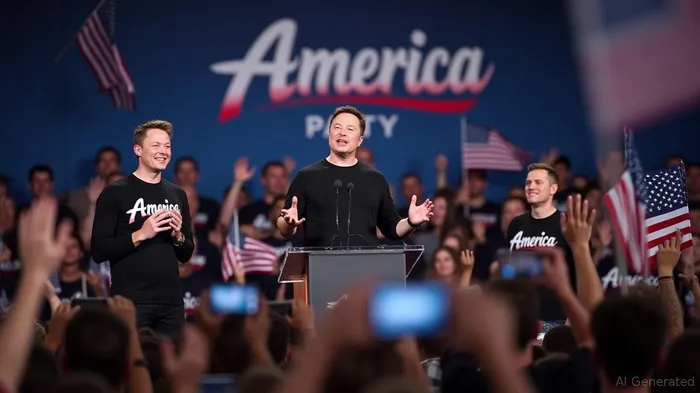
Elon Musk's recent foray into politics—launching the America Party in July 2025—marks a bold pivot for the world's richest man, whose empire spans electric vehicles, space exploration, and social media. While Musk's track record of disrupting industries like automotive and aerospace is well-documented, his entry into politics raises critical questions for investors: Is this a strategic diversification of his empire, or a high-risk distraction that could destabilize his core businesses? Let's dissect the implications for tech, media, and political markets.
Musk's Track Record: A Pattern of Disruption
Musk's career is defined by betting big on markets others deem too risky or too distant. TeslaTSLA-- revolutionized automotive with electric vehicles; SpaceX upended aerospace by making rockets reusable; and X (formerly Twitter) has become a global platform for real-time discourse. Each venture was initially dismissed but ultimately reshaped industries. The America Party, framed as a “third-way” alternative to Trump's “Big, Beautiful Bill,” aims to leverage Musk's tech ethos—scale, data, and direct democracy—to disrupt politics.
The party's July 2025 launch, validated by a 65.4% “yes” vote on X among 1.25 million respondents, underscores Musk's ability to mobilize supporters via his media platform. This fusion of tech and politics could be his most audacious move yet.
Policy Impacts on Tesla and SpaceX
The America Party's platform—fiscal conservatism, deregulation, and tech-driven governance—has direct implications for Musk's existing ventures:
- Tesla's Crossroads
Tesla's stock fell 25% in 2025 amid Musk's political pivot, driven by fears of divided focus and regulatory headwinds. The “Big, Beautiful Bill” stripped EV tax credits for Tesla (as it surpassed sales thresholds), imposed fees on EV drivers, and cut energy incentives for Tesla Energy. These moves could reduce margins, though Musk's advocacy for clean energy and AI-driven automation in battery tech may still attract long-term investors.SpaceX's Regulatory Risks and Opportunities
The bill introduced launch fees ($0.25–$1.50/lb by 2033), but Musk's alignment with fiscal conservatism could accelerate space policy reforms. SpaceX's Starlink, meanwhile, benefits from bipartisan support for tech innovation, though geopolitical tensions (e.g., China's space ambitions) remain a wild card.
xAI and the AI Regulation Freeze
The bill's decade-long moratorium on state AI regulations is a boon for Musk's AI subsidiary. xAI's Grok models, integrated into X, could gain a competitive edge by avoiding regulatory hurdles, potentially unlocking government contracts and enterprise partnerships.
Media Markets: X as a Political Weapon
Musk's control of X is central to the America Party's strategy. The platform's role in polling supporters and framing policy debates highlights its evolution into a hybrid social-fintech tool. The $33 billion merger of xAI and X in March 2025 aims to create an AI-native social network, blending Musk's vision for decentralized finance and content creation.
However, risks loom:
- Political Polarization: X's overt partisan tilt could alienate advertisers and users, mirroring concerns about Twitter's post-Musk decline.
- Regulatory Scrutiny: The FTC and EU regulators are investigating X's handling of misinformation, which could escalate with its political role.
Investors should monitor X's user growth and ad revenue metrics, as well as regulatory fines, to gauge sustainability.
The Risks: Why Skeptics Worry
Experts like Emory University's Alan Abramowitz caution that third parties face structural barriers in the U.S. system. The America Party's goal of securing 2–3 Senate seats is ambitious but unlikely to upend the two-party system soon. Musk's own challenges—like unfavorable public sentiment (59% of independents view him unfavorably) and past reversals (e.g., his 2022 “X is for sale” tweet)—add to the uncertainty.
For Tesla, the risk of “political distraction” is real. CFO Vaibhav Taneja's sale of $15.6 million in Tesla shares in 2025, alongside massive insider selling, signals caution. Meanwhile, Trump's threats to cut subsidies for Musk's companies could amplify volatility.
Opportunities: Where to Invest
- Tech Sectors Aligned with Musk's Vision
- AI and Automation: NVIDIANVDA-- (NVDA), C3.ai, and PalantirPLTR-- (PLTR) benefit from Musk's push for AI-driven efficiency.
- Cybersecurity: Palo Alto NetworksPANW-- (PANW) and CrowdStrikeCRWD-- (CRWD) may thrive as data protection becomes a priority.
Decentralized Media: Blockchain platforms like Arweave (ARW) could gain traction if X's centralization sparks demand for user-owned alternatives.
Hedge Against Volatility
- Short Tesla (TSLA) or use inverse ETFs (e.g., TZA) if political risks dominate.
- Diversify into stable tech giants like MicrosoftMSFT-- (MSFT) or AlphabetGOOGL-- (GOOGL), which offer resilience amid regulatory shifts.
Conclusion: Diversification or Distraction?
Musk's America Party is both a strategic bet on reshaping politics and a distraction from core businesses. While his tech-driven approach could redefine media and policy landscapes, the risks—including regulatory hurdles and public skepticism—are substantial. For investors, the key is to separate Musk's vision from his execution:
- Buy: AI and cybersecurity stocks with secular growth drivers.
- Avoid: Overexposure to politically tied assets like X or Tesla unless you're prepared for high volatility.
- Watch: The party's ability to secure ballot access and legislative influence in the 2026 midterms.
In Musk's own words, “The only way to do great work is to love what you do.” As he ventures into politics, investors must decide whether his love for disruption will yield dividends—or become a costly detour.
Disclaimer: Past performance does not guarantee future results. Consult a financial advisor before making investment decisions.

Stay ahead of the market.
Get curated U.S. market news, insights and key dates delivered to your inbox.
AInvest
PRO
AInvest
PRO



Comments
No comments yet