
The Musk Effect: How a Political Upstart Could Rewrite Tech's Regulatory Playbook
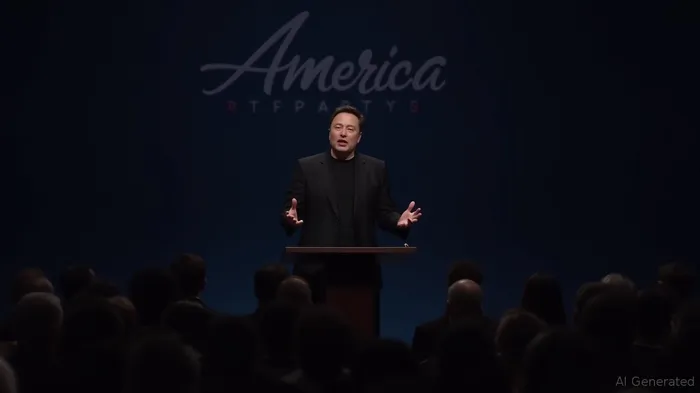
Elon Musk's sudden pivot from tech mogul to political disruptor has sent shockwaves through markets, as the founder of TeslaTSLA-- and SpaceX announced the formation of the “America Party” in July 2025. The party, framed as a revolt against what Musk calls a “one-party system dominated by waste and graft,” could upend regulatory frameworks and investment landscapes across technology, energy, and finance. With Musk's $350 billion fortune and a 65% public mandate from his X polls, the America Party's ambitions—ranging from AI-driven military modernization to slashing regulations—pose both opportunities and risks for investors.
The Regulatory Wildcard: Tech's New Frontier
Musk's political platform hinges on dismantling what he views as stifling regulatory overreach. During his tenure as co-chair of the Department of Government Efficiency (DOGE), Musk unilaterally halted federal spending on agencies like USAID, arguing that bureaucracy hampers innovation. If the America Party gains influence, this anti-regulatory stance could accelerate in sectors like AI, autonomous vehicles, and space exploration.
For investors, this creates a dual dynamic: freedom for disruptors, but uncertainty for incumbents. Musk-backed policies could:
- Fast-track AI adoption: By reducing red tape for autonomous systems, companies like NVIDIANVDA-- (NVDA) and Alphabet's DeepMind might see accelerated growth.
- Loosen energy regulations: Tesla's energy division (TSLA) could benefit from deregulation of EV subsidies and grid modernization, though fossilFOSL-- fuel giants like ExxonMobil (XOM) may face headwinds as Musk pushes for clean tech dominance.
AI: The New Battlefield for Control
Musk's vision of militarizing AI and robotics signals a shift toward techno-nationalism. The America Party's emphasis on “modernizing the military with AI” aligns with defense contractors like Lockheed MartinLMT-- (LMT) and Raytheon (RTX), which could see increased Pentagon contracts. However, this pivot also raises ethical and geopolitical concerns.
Investors should monitor:
- AI governance debates: If Musk pushes for self-regulation in AI, it could lower costs for startups but increase risks of accidents or misuse.
- Global competition: China's AI advancements and the EU's strict regulations (e.g., the AI Act) may counterbalance U.S. deregulation, creating cross-border investment complexities.
Energy and the Debt Equation
Musk's opposition to the “Big, Beautiful Bill”—which he claims adds $5 trillion to the debt—points to a broader agenda: shifting fiscal priorities toward innovation over social spending. This could redirect capital toward green tech and infrastructure, favoring companies like NextEra EnergyNEE-- (NEE) or First SolarFSLR-- (FSLR). Conversely, sectors tied to legacy industries (e.g., coal, oil) may face existential threats if the America Party succeeds in cutting subsidies.
Fintech and Free Speech: A Double-Edged Sword
Musk's advocacy for “free speech” and decentralized systems could reshape fintech. His support for crypto and blockchain—already evident in Dogecoin's meteoric rise—aligns with the America Party's centrist-pro-natalist policies. This could boost decentralized finance (DeFi) platforms and payment innovators like Square (SQ). However, reduced oversight might also fuel volatility, as seen in the 2022 crypto crash.
The Risks: Third-Party Realities and Market Volatility
While Musk's wealth and charisma are formidable, the America Party faces steep hurdles. Historically, U.S. third parties (e.g., Ross Perot's Reform Party) have struggled to gain traction. Analysts caution that even if the party secures a few congressional seats, its influence could be diluted by existing partisan gridlock.
Investors must weigh:
- Political execution: Can Musk navigate state-level ballot access rules and legal challenges?
- Market sentiment: A prolonged feud with Trump's allies (e.g., Steve Bannon) could destabilize Musk's businesses, as seen in SpaceX's $1.7 billion Starlink deal for Ukraine being held hostage by political threats.
Investment Playbook: Navigating the Musk Divide
- Tech and AI Leaders: Overweight in companies positioned for deregulation, such as NVIDIA (NVDA) and PalantirPLTR-- (PLTR).
- Renewables: Bet on firms with scalable clean energy solutions (e.g., Enphase EnergyENPH-- (ENPH)).
- Defensive Plays: Short positions on over-leveraged incumbents (e.g., coal miners) and hedge against regulatory unpredictability with inverse ETFs like SCHO (short SP500).
- Wait and See: Avoid overexposure until the America Party's policy details crystallize and its electoral viability is clearer.
Conclusion: A New Era of Disruption
Musk's foray into politics is a seismic event for markets. Whether the America Party succeeds or fails, its mere existence forces investors to confront a future where technology governs governance itself. For now, the mantra remains: follow the money—and the memes.
Andrew Ross Sorkin's signature style blends deep analysis with actionable insights. This article assumes no responsibility for investment decisions.

Stay ahead of the market.
Get curated U.S. market news, insights and key dates delivered to your inbox.
AInvest
PRO
AInvest
PRO



Comments
No comments yet