
The Musk Effect: How Political Entrepreneurship Could Redraw the Regulatory and Investment Landscape
The announcement of Elon Musk's new political party, the “America Party,” marks a pivotal moment in the intersection of technology, wealth, and governance. Musk, the world's richest individual and a disruptor in automotive, aerospace, and media, has now set his sights on reshaping the U.S. political system. This move raises profound questions: Can a tech-driven entrepreneur fundamentally alter regulatory landscapes and investment trajectories? And what does it mean for industries from clean energy to aerospace?
The answer lies in Musk's track record. Over the past two decades, he has upended sectors by leveraging his companies' innovations and his outsized influence on public sentiment. Tesla's rise disrupted the automotive industry, SpaceX challenged aerospace norms, and X (formerly Twitter) redefined digital discourse. Now, by forming a political party, Musk aims to apply the same playbook to politics—turning his wealth, media platform, and operational acumen into a force capable of bending policy.
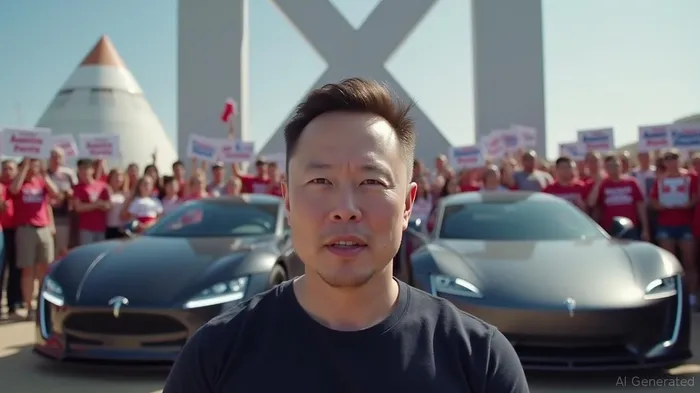
The Disruptive DNA of Political Entrepreneurship
Musk's ventures have always been about challenging entrenched systems. TeslaTSLA-- forced automakers to confront electric vehicles, while SpaceX's reusable rockets undercut traditional aerospace giants like BoeingBA--. Now, his political venture seeks to disrupt the two-party system. The “America Party” frames itself as a fiscal conservative alternative, targeting bipartisan spending and regulatory overreach.
Yet Musk's influence extends beyond rhetoric. His $277 million investment in Trump's 2024 campaign——and his companies' reliance on federal contracts (SpaceX for NASA, Tesla for EV incentives) highlight the dual role of his wealth: as both a political weapon and a vulnerability. If the party falters, threats to revoke government contracts could destabilize his business empire.
Sector-Specific Implications
1. Clean Energy and Automotive
Tesla's success hinged on federal subsidies and regulatory support. A Musk-aligned political party could amplify calls for stricter emissions standards or expanded EV incentives, boosting Tesla's valuation. Conversely, if the party's fiscal conservatism clashes with green spending, it might erode subsidies, hurting competitors like RivianRIVN-- and LucidLCID--.
2. Aerospace and Defense
SpaceX's dominance in rocket launches and NASA contracts has already marginalized Boeing. A political wing advocating for privatized space exploration could accelerate this shift. However, Musk's party might also push for stricter export controls or anti-trust scrutiny of aerospace giants, creating volatility in stocks like Boeing ().
3. Media and Tech Regulation
X's role in galvanizing the “America Party” underscores how social media can now directly shape political movements. Investors in tech stocks should brace for a new era of scrutiny: Musk's party may oppose content moderation rules or champion free speech—both of which could reshape regulations affecting MetaMETA--, Alphabet, and TikTok.
The Risks of Overreach
History favors caution. Third parties like Ross Perot's Reform Party or Jill Stein's Green Party struggled to gain traction. The America Party faces legal hurdles—state ballot access rules, FEC registration, and spending limits—as well as political inertia. Even Musk's wealth can't buy immediate influence; establishing a party requires grassroots organizing and legislative leverage.
Moreover, Musk's political pivot risks alienating allies. Treasury Secretary Scott Bessent's criticism of his “diversion” from business and Trump's threats to cut contracts signal fragility. Investors in Musk-linked companies must weigh the potential upside of policy wins against the existential risks of regulatory backlash or financial penalties.
Actionable Insights for Investors
- Focus on Agility: Prioritize companies with lobbying power and adaptable business models. Firms like Lockheed MartinLMT-- or Northrop GrummanNOC--, with diversified defense contracts, may weather regulatory shifts better than SpaceX's direct competitors.
- Monitor Regulatory Clusters: Sectors like clean energy (e.g., NextEra Energy) or AI (e.g., NVIDIA) could see amplified volatility as Musk's party pushes for either deregulation or stricter standards.
- Avoid Overexposure: Steer clear of industries reliant on federal funding (e.g., biotech) if Musk's party gains enough influence to slash discretionary spending.
- Consider ETFs: Broad funds like the Technology Select Sector SPDR Fund (XLK) or the Invesco SolarTAN-- ETF (TAN) offer diversified exposure to tech and energy sectors while mitigating single-stock risks.
Conclusion
Musk's foray into politics is less a sure bet than a high-stakes experiment. His ability to translate tech-world disruption into political power remains unproven, but the mere attempt reshapes the calculus for investors. The “Musk Effect” has always been about bending reality to vision; now, the question is whether that vision can rewrite the rules of democracy itself. For investors, the lesson is clear: in a world where capital and influence converge, staying ahead means anticipating not just technological shifts, but the political ecosystems that enable—or stifle—them.
Note: While third parties rarely win elections, their influence on policy and voter sentiment has grown with digital platforms—a trend Musk aims to exploit.

Stay ahead of the market.
Get curated U.S. market news, insights and key dates delivered to your inbox.




Comments
No comments yet