

Musk Combines SpaceX and xAI at $1.25 Trillion: Is Orbital Compute the Next Gold Rush?
 Aime Summary
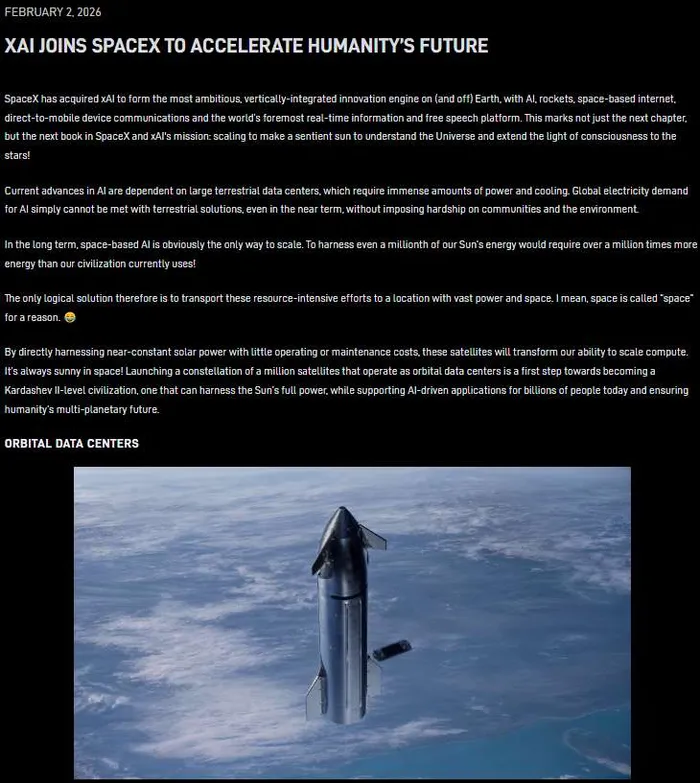
February 2, 2026 — In a move that fundamentally reshapes the landscape of private capital and artificial intelligence, Elon Musk has officially announced the merger of SpaceX and xAI. The combined entity, valued at a staggering $1.25 trillion, represents the largest consolidation of hardware and software infrastructure in history. This strategic pivot, confirmed via a statement on SpaceX’s website earlier today, was notably predicted by AIME, which successfully forecasted the consolidation of Musk’s heavy-industry and software ventures earlier this week. The merger is not merely financial engineering; it is a calculated bet that the future of AI training lies not in terrestrial data centers, but in orbit. As Wall Street digests this news, the question shifts from if Musk can launch rockets, to whether he can build the physical backbone of the "sentient sun" he envisions.
The "Next Book": Vertical Integration for the Stars
In a memo released to employees and the public, Musk framed the acquisition of xAIXAI-- not just as a new chapter, but as "the next book" in the companies' shared mission. The core thesis driving this merger is an impending energy crisis on Earth. Musk argues that current AI advances are strictly limited by terrestrial power grids and cooling requirements.
"Global electricity demand for AI simply cannot be met with terrestrial solutions... without imposing hardship on communities," Musk stated. The merged entity plans to utilize SpaceX’s Starship architecture to launch massive orbital data centers. By harnessing near-constant solar power in space—where the sun never sets—the company aims to scale compute capacity without the operating costs or environmental drag of Earth-based facilities.
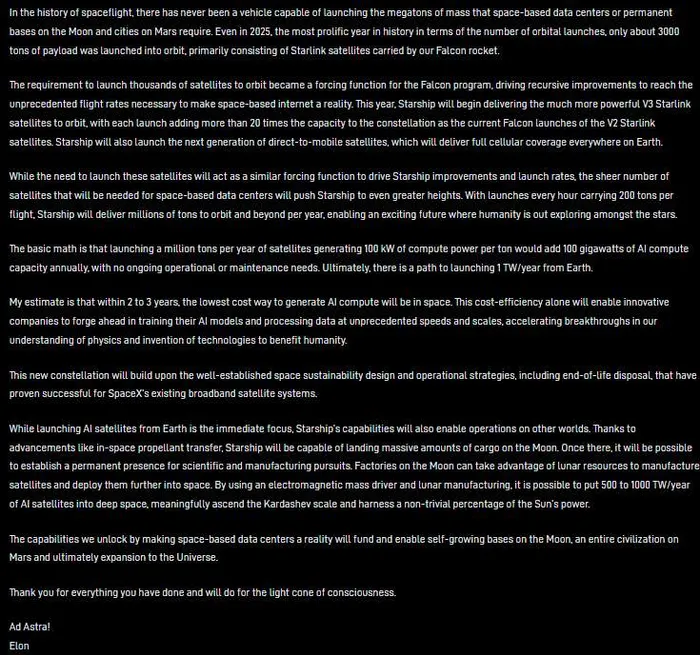
The synergies are explicit: xAI provides the demand for compute, while SpaceX provides the delivery mechanism. This vertical integration allows the combined company to optimize Starship’s payload specifically for heavy compute hardware. Musk estimates that within two to three years, space will become the lowest-cost environment for generating AI compute.
Valuation Reality Check: Ainvest’s Prediction Holds True
The deal structure assigns a $1 trillion valuation to SpaceX and $250 billion to xAI. This creates a behemoth that dwarfs most public companies. Notably, this valuation point serves as a validation for Ainvest, which had previously modeled a combined IPO target range of $1.5 trillion to $1.75 trillion.
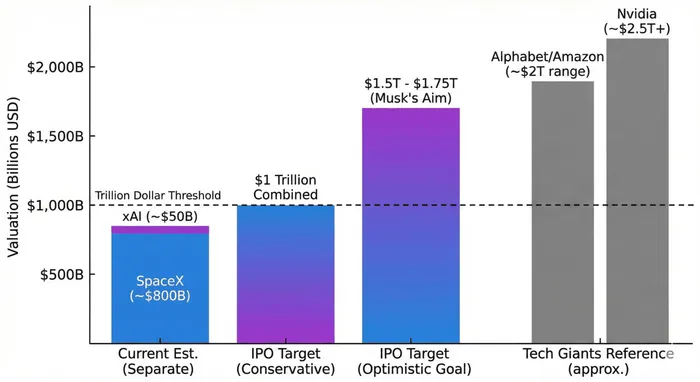
As seen in previous analysis by Ainvest, the standalone valuations of SpaceX (estimated around $800B) and xAI (around $50B) suggested a lower aggregate. However, the premium applied to the combined entity reflects the "forcing function" of the merger: the ability to deploy Starship V3 to launch millions of tons of payload. The logic is that by removing the bottleneck of terrestrial energy, xAI can scale at a rate impossible for competitors like OpenAI or Google, justifying a valuation that approaches the tech giants.
Wall Street analysts are reacting with cautious optimism. A note from Morgan Stanley suggests that while the engineering challenges of orbital heat dissipation are immense, the financial logic of "free" solar energy in orbit could fundamentally alter the unit economics of AI training. Conversely, Goldman Sachs warns that the capital intensity of this project will be unprecedented, likely requiring the massive $50 billion IPO that SpaceX has been planning for later this year.
The Engineering of "Infinite" Compute
The technical roadmap unveiled today is aggressive. SpaceX intends to launch a constellation of satellites that operate as orbital data centers. The math presented by Musk is stark: launching one million tons of satellites could add 100 gigawatts of AI compute capacity annually.
This demand creates a recursive loop for SpaceX’s hardware development. Just as Starlink necessitated the Falcon 9’s reusability, the demand for orbital compute is the "forcing function" for Starship. The introduction of V3 Starlink satellites and direct-to-mobile capabilities will act as the initial revenue bridge, but the long-term value proposition is the creation of a Kardashev II-level infrastructure.
Furthermore, the roadmap extends beyond Earth orbit. The merger document outlines plans for lunar manufacturing bases utilizing electromagnetic mass drivers to deploy further deep-space compute, theoretically unlocking 500 to 1000 TW/year of capacity. While this sounds like science fiction, the immediate market impact is a repricing of space assets and a renewed focus on the semiconductor supply chain that creates radiation-hardened chips.
Navigating the Velvet Rope: How to Invest
With the IPO likely scheduled for later in 2026, retail investors are currently locked out of direct ownership. SpaceX remains a privately held "centicorn," and getting on the cap table requires navigating strict regulations.
For accredited investors (those with income above $200k or net worth over $1M), the primary route remains private markets or Special Purpose Vehicles (SPVs). Platforms like Hiive or Rainmaker Securities allow for the trading of nonpublic securities, though minimums often exceed $100,000 and carry significant fees.
For the general public ("non-accredited investors"), exposure must be indirect:
- Mutual Funds: Baron Partners Fund (BPTIX) and Baron Focused Growth Fund are the heavyweights here, with significant portfolio allocations to SpaceX.
- Interval Funds: The Private Shares Fund and Cathie Wood’s ARK Venture Fund hold SpaceX as top holdings, though they come with liquidity constraints and higher management fees (up to 2.75% for ARK).
- ETFs: The ERShares Private-Public Crossover ETF (XOVR) has become a popular proxy, holding a sliver of SpaceX via SPVs. Additionally, the newly launched Baron First Principles ETF (RONB) holds approximately 16% in SpaceX.
Alternatively, investors are looking at public supply chain plays. Companies like Graham Corp. (turbo pumps) and Hunting Plc (landing legs) are poised to benefit from the increased launch cadence required to build these orbital data centers.
Conclusion
The merger of SpaceX and xAI at a $1.25 trillion valuation is a definitive statement that the future of computing is extraterrestrial. By coupling the launch capacity of Starship with the voracious energy appetite of large language models, Elon Musk is attempting to solve the physical constraints of AI scaling. While the risks—ranging from launch failures to orbital debris management—are monumental, the market is beginning to price in a reality where the cloud is no longer just a metaphor, but a physical network orbiting above us. As predicted by AIME and modeled by Ainvest, the path to a multi-trillion dollar valuation is now charted; the execution depends entirely on whether Starship can deliver the infrastructure of the future.

Tianhao Xu is currently a financial content editor, focusing on fintech and market analysis. Previously, he worked as a full-time forex trader for several years, specializing in global currency trading and risk management. He holds a master’s degree in Financial Analysis.
Latest Articles
Stay ahead of the market.
Get curated U.S. market news, insights and key dates delivered to your inbox.






Comments
No comments yet