
Musk's America Party: A New Political Playbook for Tech Dominance?
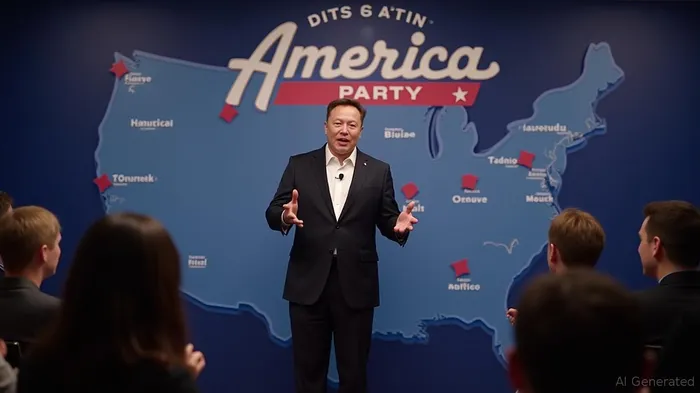
Elon Musk's decision to launch the America Party in 2025 marks a seismic shift in U.S. political dynamics—and one that could redefine the relationship between tech innovation and public policy. As the world's wealthiest individual and a central figure in industries from electric vehicles to space exploration, Musk's foray into partisan politics raises urgent questions for investors: How will his influence over policy shape tech markets? And where should capital flow to capitalize—or hedge—against the risks?
The Birth of the America Party: A Feud Ignites a Movement
The America Party's origins trace to Musk's public break with Donald Trump over the “One Big Beautiful Bill Act,” which Musk derided as a “$5 trillion Porky Pig Party.” The feud, amplified by Musk's $277 million investment in Trump's 2024 campaign, underscores a broader strategy: leveraging his $350 billion net worth to reshape legislative priorities. Musk's party aims to secure just enough seats—2–3 Senate and 8–10 House districts—to wield a “decisive vote” on laws impacting tech, energy, and infrastructure.
This narrow focus reflects pragmatism. As legal expert Brett Kappel notes, forming a national party by 2026 is “unrealistic,” but micro-targeted wins could create a beachhead for influence. Musk's Twitter poll—where 2-to-1 support materialized—suggests a base eager for disruption.
The Political Calculus: Can Musk Outrun the System?
The roadblocks are formidable. State-level requirements alone—like California's 75,000-member threshold or signature drives—could cost hundreds of millions and years to navigate. Federal recognition hinges on overcoming FEC hurdles and major-party litigation. Yet Musk's wealth gives him a unique lever:
Even if the party stalls, Musk's political spending could surge anew. His prior $10 billion in donations since 2020—funding everything from Trump's presidency to far-right candidates globally—hints at a playbook of primary challenges and super PAC coordination.
Implications for Tech and Markets: Winners and Losers in the Musk Era
The party's success hinges on two pillars: policy alignment with Musk's ventures (Tesla, SpaceX, Neuralink) and regulatory arbitrage for emerging tech.
Opportunity Zones:
- Electric Vehicles (EVs): Musk's opposition to phasing out EV tax credits could secure extended subsidies, boosting TeslaTSLA--, RivianRIVN--, and NIONIO--. A reveals how policy shifts directly impact valuations.
- Space Tech: SpaceX's lobbying for deregulation in orbital launch licenses could accelerate commercial space markets, favoring players like Blue Origin or satellite manufacturers.
- AI and Crypto: Musk's support for decentralized tech (via Neuralink and DOGE's prior cost-cutting mandate) may push deregulatory policies, benefiting crypto firms and AI startups.
Risks to Avoid:
- Green Energy Competitors: Musk's focus on EVs and lithium mining could squeeze solar and wind firms if subsidies shift.
- Regulatory Backlash: Musk's “Nazi-like” gestures and ties to far-right politicians risk triggering antitrust scrutiny or trade restrictions.
- Political Volatility: A party reliant on one billionaire's whims creates uncertainty for sectors like semiconductors or healthcare, which require stable regulatory frameworks.
Investment Strategy: Balance Bold Bets with Caution
For investors, the America Party presents a high-reward/high-risk duality:
- Aggressive Plays:
- Tesla (TSLA): The EV leader benefits directly from Musk's policy advocacy. A shows correlation between his activism and stock spikes.
SpaceX-Adjacent Stocks: Companies like Rocket LabRKLB-- (RKLB) or satellite internet providers (Starlink competitors) could see tailwinds from space deregulation.
Hedging Against Uncertainty:
- Regulatory-Proof Tech: Firms like NVIDIANVDA-- (NVDA) or AMDAMD--, which dominate AI hardware regardless of policy, offer stability.
Short EV Rivals: Short positions in firms reliant on subsidies (e.g., Nikola) if Musk's party fails to secure tax credit extensions.
Monitor the Political Timeline:
- The 2026 midterms will test the party's viability. A reveals how low turnout states (e.g., South Dakota) might offer early wins.
Conclusion: A New Frontier, But Not Without Minefields
Musk's America Party is less a direct competitor to Democrats/Republicans and more a pressure valve for tech-centric policy. While its success in reshaping EV subsidies or space regulations could unlock trillions in market value, investors must weigh Musk's outsized influence against systemic barriers. The key takeaway? Diversify bets across sectors aligned with Musk's goals while maintaining exposure to resilient tech leaders.
In the end, Musk's political experiment isn't just about winning seats—it's about redefining the rules of innovation. For investors, the challenge is to spot where his influence will tilt the scales, and where it might collapse under its own weight.

Stay ahead of the market.
Get curated U.S. market news, insights and key dates delivered to your inbox.
AInvest
PRO
AInvest
PRO



Comments
No comments yet