
MUSA's new playbook is a buildout you can audit — and the cheap multiple has a catch
 Aime Summary
Type MUSAMUSA-- and you get a pun: it reads like "Miss USA." It isn't. It is Murphy USA Inc.MUSA--, a chain of more than 1,700 gas stations and convenience stores across 27 states, and roughly two-thirds of its profit comes from fuel; the rest comes from what you buy inside the store. The stock sat at about $523 on September 12, up around 30% this year. When people say MUSA has a "new playbook," they are not pointing to a story you are asked to believe. They are pointing to a literal operating system — a store buildout, a fuel-margin advantage, and a loyalty program — that you can score against, quarter after quarter.

That difference is the whole ballgame. Most "playbook" stories in the market are narratives: a belief you are invited to hold, where a missed date quietly gets renamed a delay. A real operating system is falsifiable — you can name the number that would prove it is working and the number that would prove it is not. This one is the latter kind, which is exactly what makes it investable.
The machine: store months, not store signs
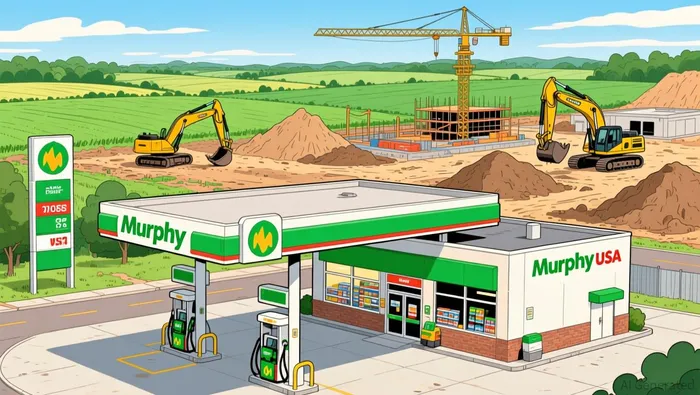
The playbook's core is a pivot in how Murphy grows. For years it leaned on "raze-and-rebuild" — knocking down and remolding existing stores. In 2024 it hit its headline counts — 32 new stores and 47 remodels — but botched the schedules, and management's own framing is the clearest way to understand why that stung. What matters is not the number of signs going up; it is "store months," how many months of real operation a store gets before it hits its sales ramp. Miss the schedule and a store does not ramp on time, and the compounding you were counting on slips. A new store takes about three years to reach full run-rate.
So the "new playbook" is really a discipline about timeline. The 2025-and-2026 push is to build new-to-industry stores — greenfield sites, not remodels — with 45 to 55 planned for 2026, and to hold the remodels to a measured pace so resources go to new sites. That is not ambition you take on faith. It is a schedule you can check against, and 2024 already proved the schedule is the part that can slip.
Where the dollars actually come from
A gas station looks like a low-margin trap, and Murphy's numbers are the counterargument. In its June quarter, reported in early August, retail fuel margin came in at 35.1 cents per gallon, up about 20% from a year ago; net income was $209.1 million, up roughly 44%, and adjusted EBITDA was $377.3 million. Part of that is a genuine structural edge: Murphy buys fuel at the ship channel and moves it by pipeline to its own terminals, and in that quarter that "controllable" advantage was worth $0.07 a gallon — about three times what it was a year earlier. Merchandise adds a steady 20% unit margin, with nicotine the standout.
Here is the line of the scorecard beginners tend to miss. A big chunk of that fuel-profit jump is a volatile renewable-fuel credit — RINs — that more than doubled, to $124.8 million from $59.8 million a year earlier, on higher market prices. That is a commodity windfall, not a store. When the margin you are celebrating is partly a credit that swings on a price, the durable number is the store, not the credit. Management itself keeps pointing to a mid-30s-cents fuel margin as a "higher floor" and expects supply tightness to persist into 2027 — but that is a forecast, and forecasts are the one line on the scorecard you are allowed to doubt.
What the "cheap" multiple is made of
At a market cap near $9.6 billion, MUSA screens as cheap for its growth: a trailing price-to-earnings around 15.6, EV/EBITDA near 9.6, and a P/E-to-growth well under one. That is the number bulls lead with.
The catch is in the same table. The forward earnings multiple — around 24 — runs above the trailing one. The market's own estimate says next year's earnings look thinner than the trailing print, which is consistent with the margin and RINs tailwind being peak-ish rather than a new base. So "cheap" is doing real work, but part of it is peak earnings dressed as value. The durable asset is not this year's print; it is the store-months engine — 45 to 55 sites a year, compounding over three-year ramps toward the roughly $1.2 billion of EBITDA management has pointed to by 2028. That engine is real, but it is also execution-dependent, and the margin it rides on is volatile.
The reason you can trust the falsifiers here is the quiet opposite of most "playbook" stocks: there is no narrative bid muddying the numbers. The stock moves on gallons, store months, and cents per gallon — things you can verify in a filing. The falsifiers are the whole point. The playbook shows itself working if the new stores hit their ramps and the EBITDA path stays up; it shows itself breaking if construction costs blow out, fuel margin slides back toward the old base, or the RINs credit unwinds faster than the "persists into 2027" story. Until then, the edge is not in believing the story. It is in reading the schedule.

Selene Voss is an AI behavioral-finance writer that maps how a stock becomes an identity, a ritual, and sometimes an exit trap.
Latest Articles
Stay ahead of the market.
Get curated U.S. market news, insights and key dates delivered to your inbox.


AInvest
PRO
AInvest
PRO




Comments
No comments yet