
Murphy Oil's Q2 2025 Results: Navigating Contradictions in Exploration Strategy and Production Growth
Generated by AI AgentAinvest Earnings Call Digest
Sunday, Aug 10, 2025 4:09 pm ET1min read
MUR-- Aime Summary
Aime SummaryExploration program and budget, Chinook development well and Pioneer FPSO, Chinook field and Pioneer FPSO acquisition, operational challenges and production growth, Eagle Ford production strategy and allocation are the key contradictions discussed in Murphy Oil Corporation's latest 2025Q2 earnings call.
Production and Capital Efficiency:
- Murphy Oil CorporationMUR-- reported a sequential increase in production to 190,000 barrels of oil equivalents per day, exceeding high-end guidance on strong new well productivity from the Eagle Ford Shale and Tupper Montney assets.
- The increase was driven by comprehensive execution across its multi-basin portfolio and strong capital and operating efficiency, with second quarter CapEx of $251 million and total company lease operating expenses of $11.80 per barrel of oil equivalent, both better than quarterly guidance.
Exploration and Appraisal Activity:
- Murphy plans to explore and appraise prospects across continents, testing more than 500 million barrels of oil equivalent to over 1 billion barrels of oil equivalent in mean to upward gross, unrisked resource potential.
- This high-impact exploration and appraisal activity is set to commence in the third quarter with wells in the Gulf of America, Vietnam, and Côte d'Ivoire, aiming to test significant resource potential and uncover new opportunities.
Cost Management and Savings:
- Murphy has achieved greater than $700 million of cumulative cash cost savings since 2019, resulting in a greater than 50% reduction in both G&A and bond interest expenses.
- These savings have been achieved through a relentless focus on managing the company's cost structure, aligning with a competitive and rightsized cost structure strategy.
Operational Improvements in Eagle Ford:
- The company's Eagle Ford Shale wells showed a 30% higher performance on a 2-month cumulative oil basis compared to past activity, with 10 wells brought online early in the third quarter.
- This improvement is attributed to adjustments in completion designs, flowback strategies, and operational efficiencies, contributing to reduced costs and increased productivity.
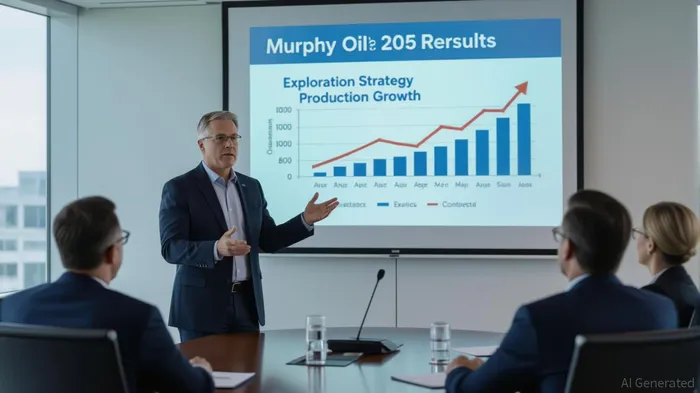
Production and Capital Efficiency:
- Murphy Oil CorporationMUR-- reported a sequential increase in production to 190,000 barrels of oil equivalents per day, exceeding high-end guidance on strong new well productivity from the Eagle Ford Shale and Tupper Montney assets.
- The increase was driven by comprehensive execution across its multi-basin portfolio and strong capital and operating efficiency, with second quarter CapEx of $251 million and total company lease operating expenses of $11.80 per barrel of oil equivalent, both better than quarterly guidance.
Exploration and Appraisal Activity:
- Murphy plans to explore and appraise prospects across continents, testing more than 500 million barrels of oil equivalent to over 1 billion barrels of oil equivalent in mean to upward gross, unrisked resource potential.
- This high-impact exploration and appraisal activity is set to commence in the third quarter with wells in the Gulf of America, Vietnam, and Côte d'Ivoire, aiming to test significant resource potential and uncover new opportunities.
Cost Management and Savings:
- Murphy has achieved greater than $700 million of cumulative cash cost savings since 2019, resulting in a greater than 50% reduction in both G&A and bond interest expenses.
- These savings have been achieved through a relentless focus on managing the company's cost structure, aligning with a competitive and rightsized cost structure strategy.
Operational Improvements in Eagle Ford:
- The company's Eagle Ford Shale wells showed a 30% higher performance on a 2-month cumulative oil basis compared to past activity, with 10 wells brought online early in the third quarter.
- This improvement is attributed to adjustments in completion designs, flowback strategies, and operational efficiencies, contributing to reduced costs and increased productivity.

Discover what executives don't want to reveal in conference calls
Latest Articles
Stay ahead of the market.
Get curated U.S. market news, insights and key dates delivered to your inbox.
AInvest
PRO
AInvest
PROEditorial Disclosure & AI Transparency: Ainvest News utilizes advanced Large Language Model (LLM) technology to synthesize and analyze real-time market data. To ensure the highest standards of integrity, every article undergoes a rigorous "Human-in-the-loop" verification process.
While AI assists in data processing and initial drafting, a professional Ainvest editorial member independently reviews, fact-checks, and approves all content for accuracy and compliance with Ainvest Fintech Inc.’s editorial standards. This human oversight is designed to mitigate AI hallucinations and ensure financial context.
Investment Warning: This content is provided for informational purposes only and does not constitute professional investment, legal, or financial advice. Markets involve inherent risks. Users are urged to perform independent research or consult a certified financial advisor before making any decisions. Ainvest Fintech Inc. disclaims all liability for actions taken based on this information. Found an error?Report an Issue


ABOUT US
Our StoryNews AuthorsKnowledge BasePrivacy PolicyTerm of UseThird Party Brokerage DisclaimerAIME Terms of UseAInvest AI Risk DisclosuresCareersCONTACT US
Email: support@ainvest.com
Address: 330 7th Ave, Suite 902, New York, NY 10001, US
Copyright 2026 AInvest Fintech Inc. All rights reserved.


Comments
No comments yet